


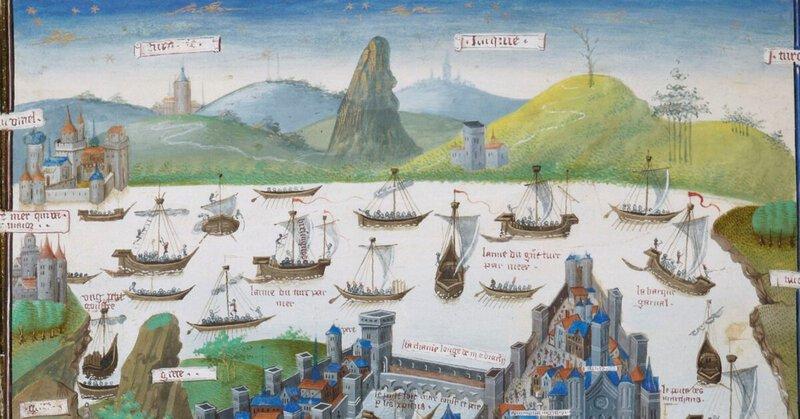
Before the sun rose over the Bosporus on Tuesday, 29 May 1453, the bells of Constantinople’s churches began to ring — not in celebration, but in alarm. Somewhere along the ancient Theodosian Walls, through a gap torn open by a weapon the medieval world had never encountered before, soldiers of the Ottoman Empire were already pouring into a city that had stood, unconquered by land assault, for more than a thousand years. What happened in those predawn hours did not merely end an empire. It ended an age.
What Constantinople Was — and What It Had Become

To understand why the fall of Constantinople shook the entire known world, you first have to understand what Constantinople was. Perched at the narrow neck of the Bosporus — the strait dividing Europe from Asia — the city was geography’s gift to an empire. Water protected three of its sides. The fourth was guarded by the Theodosian Walls: a triple-layered system of stone and brick, in places eighteen feet thick, studded with towers and fronted by a moat. Built in the fifth century under Emperor Theodosius II and continuously reinforced thereafter, they had absorbed the fury of Huns, Avars, Arabs, Bulgars, and Rus alike. No army had ever broken them from the land side. They were not merely a fortification; they were a statement about the permanence of Roman civilization.
By 1453, however, the civilization behind those walls had been hollowing out for generations. The city that had once held several hundred thousand inhabitants now sheltered perhaps 50,000. The Byzantine Empire — the eastern continuation of Rome, maintaining unbroken institutional memory since the age of Constantine the Great — had been reduced by plague, catastrophic losses in the Fourth Crusade of 1204, dynastic civil war, and the long grinding pressure of Ottoman expansion to little more than the capital and a scattering of coastal territories. The empire was a skull wearing a crown.
The man wearing that crown was Emperor Constantine XI Palaiologos, a capable soldier-emperor with no illusions about his position. He had sent envoys westward, appealing to Rome, Venice, and the courts of Europe for military aid. The response was what he likely feared: promises, delays, and nothing sufficient. The Christian West was consumed by its own quarrels — England and France exhausted by the Hundred Years’ War, the papacy locked in theological disputes with the Orthodox Church, Italian city-states calculating commercial interests over Christian solidarity. Constantine chose to fight anyway, with perhaps 7,000 defenders — Byzantine regulars, Genoese mercenaries, and armed civilians — against what was coming.
Mehmed II — the Sultan Who Refused to Inherit a Problem

What was coming had a name: Mehmed II, Sultan of the Ottoman Empire, who was twenty-one years old when he ordered his forces to march on Constantinople in the spring of 1453. Young in age, but not in obsession. Mehmed had reportedly studied the city since boyhood, examining maps, reading accounts of previous failed sieges, and analyzing each one for lessons. He was fluent in several languages, genuinely curious about classical history, and possessed of a strategic intelligence that his opponents fatally underestimated.
His reasoning was coldly logical. Constantinople sat in the geographical heart of his empire, physically separating his European domains in the Balkans from his Anatolian heartland. Every major trade route through the Bosporus passed under its influence. Leaving it in Byzantine hands was not a tolerable inheritance; it was a structural vulnerability in Ottoman power. Taking it was strategic necessity as much as ambition.
For two years before the siege, Mehmed prepared with methodical intensity. He assembled an army that historians estimate at between 60,000 and 80,000 troops. He built a fleet to seal off resupply by sea. He constructed Rumelihisarı — a fortress on the European bank of the Bosporus, north of the city — to control the strait and cut off Byzantine communications with the Black Sea. And he commissioned the weapon that would make all the careful planning of his predecessors look timid by comparison.
The Cannon That Broke History

The story of the cannon begins with a Hungarian engineer named Orban, and with a moment of Byzantine poverty that changed the world. Orban had developed a design for an enormous bronze bombard — a cannon of a size no one had cast before — and he brought the idea first to Constantinople. Constantine XI, his treasury nearly empty, could not pay what Orban asked. The engineer traveled to Adrianople, to Mehmed’s court, where resources were effectively without limit.
What Orban built for the Ottomans was extraordinary by any standard of the era. The largest of his cannon — sometimes called the Great Bombard — was reportedly around twenty-seven feet long and could fire a stone ball of several hundred pounds. Moving it into position outside Constantinople required scores of oxen and hundreds of men. It took so long to reload after each shot that the crew could fire it only a handful of times per day. And yet, even at that slow rate, it was devastatingly effective.
The reason comes down to physics. The Theodosian Walls had been engineered to absorb the impact of battering rams and catapult stones — weapons that pushed or bludgeoned masonry. A heavy stone ball fired from a large cannon at high velocity delivers a shockwave that travels through masonry faster than the stone can distribute the force. Walls that had withstood catapults for a thousand years began to crack and collapse under a categorically different kind of assault. The Theodosian Walls, formidable as they were, had no answer for it.
The cannon itself was so experimental that it cracked during the siege and had to be recast on-site — a vivid reminder that Mehmed was not wielding a perfected technology but gambling on a bleeding-edge one. The gamble paid off.
Fifty-Three Days: The Siege

The siege began on 6 April 1453. The rhythm of those weeks settled into a brutal daily pattern: Ottoman artillery — Orban’s great guns and dozens of smaller bombards — hammering sections of wall through the daylight hours, opening gaps and bringing towers down into rubble. Then darkness, and the Byzantine defenders working through the night by torchlight, filling the breaches with earth, timber, and barrels packed with soil — anything to hold the line until morning.
The defenders held longer than Mehmed had anticipated. The Genoese commander Giovanni Giustiniani Longo organized the resistance with skill, and the patched-together garrison repeatedly threw back Ottoman assault parties. The sea walls, protected by a heavy chain stretched across the mouth of the Golden Horn, kept the Ottoman fleet at bay and secured one flank.
Then came a move that stunned everyone. Unable to force that chain, Mehmed ordered his ships dragged overland. In one of the most audacious logistical feats of the entire campaign, roughly seventy Ottoman vessels were hauled on greased wooden rails over the hills north of the city and relaunched into the Golden Horn — behind the chain, opening a second front along the sea walls that the exhausted defenders now had to cover as well.
Inside Constantinople, food supplies dwindled and a hoped-for Venetian relief fleet never arrived in meaningful force. A lunar eclipse, interpreted by a population steeped in religious symbolism as a dire omen, darkened morale further. The defenders were holding — but everyone could feel the arithmetic of exhaustion working against them.
The final assault came in the predawn hours of 29 May. Mehmed had been probing and wearing down the defense for days; now he unleashed his elite Janissary infantry — his most disciplined and formidable soldiers — through a breach near the Blachernae section of the wall in the northwest of the city. Giustiniani was wounded early in the fighting and carried from the walls; his departure broke something in the resistance. Constantine XI, the last emperor of Byzantium, reportedly tore off his imperial regalia and rode into the fighting as an ordinary soldier. He was never seen again. No body bearing confirmed imperial insignia was ever positively identified. History’s last Byzantine emperor dissolved into the chaos of the city’s final hour.
The Day Constantinople Became Istanbul

The city fell on that Tuesday morning. Ottoman forces spread through the streets, and the looting was immediate and ferocious. Thousands of civilians had taken shelter inside the Hagia Sophia — the great domed church that had stood as the spiritual heart of Orthodox Christendom for nearly a thousand years — believing in a widely held prophecy that God would not permit the city to fall while people prayed within its walls. The doors were broken open. The prophecy offered no protection that morning.
Mehmed II rode into the conquered city later that day. By some contemporary accounts, he dismounted at the Hagia Sophia and pressed his forehead to the floor in prayer. By other accounts, when he surveyed the ruins of what had been one of the great capitals of the civilized world, he wept — quoting, reportedly, a verse lamenting the transience of earthly power. Whether or not any specific verse is precisely attributable to him, the sentiment is historically plausible: Mehmed was genuinely fascinated by classical civilization, and what surrounded him was its wreckage. He ordered the looting halted after the first day and converted the Hagia Sophia into a mosque rather than destroying it — a decision that preserved the building for the centuries that followed.
The consequences of the fall rippled outward for decades, touching every corner of the known world.
Why It Still Matters — What Fell With the Walls

The cannon explains the military history. But to fully understand why Constantinople fell, the larger picture is essential: a Byzantine state reduced to a skeleton, a Christian West too fragmented by its own conflicts to mount a coordinated defense, and an Ottoman Empire at the peak of its organizational capacity — disciplined, well-funded, and led by a sovereign of genuine military and administrative ability. The cannon was the decisive instrument; it was not the only cause.
What the cannon’s success did, however, was deliver a message that every court in Europe received with clarity: the walled city, the castle, the medieval fortification — none of it was secure anymore. Within decades, European powers were racing to develop their own artillery and, subsequently, to invent new forms of fortification — the low, angled bastion designs intended to deflect rather than absorb cannon shot — in a military revolution that remade the continent’s warfare entirely. The age of the high stone wall as the ultimate guarantor of security was finished.
The cultural consequences were equally profound. Byzantine scholars, fleeing the city in the months and years surrounding the siege, carried with them manuscripts of ancient Greek texts — works of Plato, Aristotle, Ptolemy, and others — that had been preserved in Constantinople’s libraries while direct access to them had largely lapsed in western Europe. Many of those scholars settled in Italy, particularly Florence, where their knowledge and the texts they brought fed directly into the intellectual ferment already stirring there. The fall of one civilization helped accelerate the birth of the next.
The Ottoman Empire that Mehmed II consolidated became the political architecture of the modern Middle East, shaping borders and power structures whose consequences endure today. The Renaissance that displaced Byzantine scholars helped ignite produced the science, philosophy, and art that formed the modern West. And the artillery revolution that began outside the Theodosian Walls runs in a direct line to every subsequent conflict fought with guns and explosives.
- The Theodosian Walls, unconquered by land assault for over a thousand years, fell to a weapon that had not existed a generation earlier.
- The Byzantine Empire — the institutional heir of Rome — ended not with a gradual fade but with a 53-day siege and a breach before dawn.
- The cannon’s success launched an arms race that permanently ended the dominance of medieval fortification in European warfare.
- Byzantine scholars fleeing westward carried Greek manuscripts that fed directly into the intellectual ferment of the Renaissance.
- The Ottoman consolidation of power following 1453 shaped the political geography of the Middle East for centuries.
The siege of Constantinople is not ancient, abstract history sealed behind glass. A city fell in fifty-three days, and the medieval world fell with it — giving way, in the wreckage, to the outlines of the world we still inhabit.

 Arabic
 French
 Spanish
 Portuguese
 Deutsch
 Turkish
 Dutch
Dutch
 Italiano
 Russian
 Romaian
 Portuguese (Brazil)
 Greek
Greek