


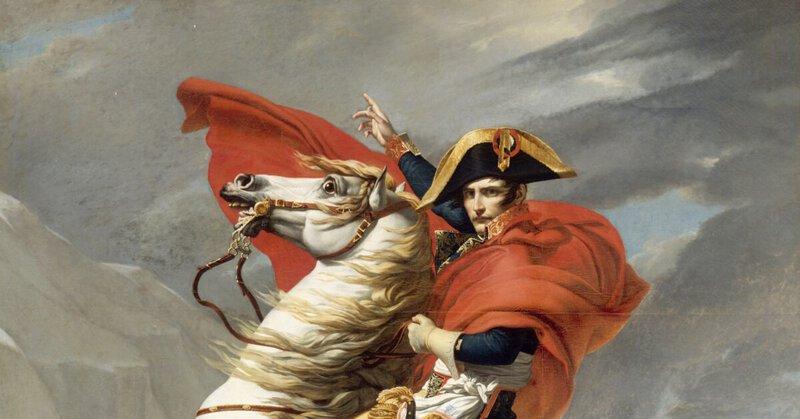
One morning in Paris, Jacques-Louis David stood in his studio with brushes ready, a primed canvas waiting, and no subject in the chair. The most painted man in Europe had simply declined to show up — again.
The General Who Refused to Sit Still

Napoleon Bonaparte understood power in almost every dimension — military, legal, symbolic — but his relationship with his own portrait was perhaps his strangest exercise of control. He loathed sitting for artists. He found the process tedious, beneath him, a waste of hours he preferred to spend dictating letters or rearranging the map of Europe. When Jacques-Louis David pressed him for proper sittings, Napoleon reportedly dismissed the request with a remark that has echoed through art history ever since: greatness was what mattered, he said — did David really think that the great men of antiquity whose portraits we admire were all painted from life?
The paradox is almost dizzying. Here was a man who flooded an entire continent with his image — on coins, on tapestries, in grand paintings hung in the palaces of client kingdoms from Madrid to Warsaw — and yet he treated his own face as almost irrelevant to the project. He was not interested in being seen. He was interested in being mythologized.
These were not vanity portraits. They were political weapons, and Napoleon was the one loading the gun.
Portrait as Propaganda: How Napoleon Weaponized Paint

Long before the word “propaganda” entered common political usage in its modern sense, Napoleon grasped something that most rulers only stumbled toward intuitively: controlling your image meant controlling your story. He told aides explicitly that he wanted paintings to “speak to the eyes” — to reach the illiterate farmer in Normandy and the skeptical aristocrat in Vienna with equal force. A canvas could travel where a speech could not.
To achieve this, he built what amounted to a state apparatus around visual art. The Salon — France’s prestigious annual exhibition — became a curated showcase for approved narratives. Government commissions flowed to painters who understood the assignment. A network of official artists learned quickly what version of Napoleon the public was meant to encounter: young but commanding, serene amid chaos, touched by something almost divine, inevitable as sunrise.
The actual man barely participated. Artists worked from brief glimpses across crowded rooms, from life masks, from each other’s earlier canvases, and from detailed written instructions about pose, setting, and symbolic props. The result was something that would not have a name for another century: a brand. Consistent, repeatable, engineered — a unified visual identity built across dozens of major canvases and hundreds of reproductions, all pointing toward the same carefully constructed idea of a man.
‘Calm on a Fiery Horse’: Inside the Most Famous Napoleon Bonaparte Painting

In the spring of 1800, Napoleon had secured a crucial victory at the Battle of Marengo, pushing French forces back into northern Italy and consolidating his grip on power as First Consul. He needed a gift for his Spanish allies — and King Charles IV of Spain, looking to commemorate the dramatic Alpine crossing that had made the campaign possible, commissioned Jacques-Louis David to produce a painting worthy of the moment. What David delivered would become the defining Napoleon Bonaparte painting of all time.
Or rather, the defining five Napoleon Bonaparte paintings. Napoleon Crossing the Alps is not a single canvas — it is a series of five oil-on-canvas equestrian portraits, painted by David between 1801 and 1805, each version slightly tailored for a different royal or institutional audience. The same composition, the same rearing stallion, the same windswept cloak and outstretched arm pointing toward glory — reproduced and refined across half a decade.
The historical reality of the crossing was considerably less cinematic. Napoleon had made the journey over the Great Saint Bernard Pass on a mule, hunched against bitter cold, guided by a local who knew the terrain. It was a logistical achievement, certainly, but not a visual one. When David asked what pose he wanted, Napoleon’s instructions were characteristically blunt: show him “calm on a fiery horse.” The mule was never going to make the cut.
David embedded the names BONAPARTE, HANNIBAL, and KAROLUS MAGNUS into the rocks at the horse’s hooves — consciously placing Napoleon in a lineage of conquerors who had also crossed the Alps to reshape civilization. It is Napoleon propaganda art at its most naked and most magnificent. The painting does not pretend to document an event. It announces a destiny. The deliberate symbolism embedded in every inch of the canvas repays close attention, from the furious weather overhead to the calm certainty on Napoleon’s face.
Jacques-Louis David: Court Painter to a Myth
David was already the most celebrated painter in France when he entered Napoleon’s orbit — a revolutionary artist who had put his extraordinary talent in service of the Republic before transferring his devotion, with clear-eyed pragmatism, to the First Consul and then to the Emperor. The relationship between the two men was one of mutual, calculating admiration. Napoleon needed David’s genius to legitimize his image; David needed Napoleon’s patronage to remain at the center of French cultural life. The collaboration between David and Napoleon reshaped how political power would be visualized for generations.
For the Crossing, David worked not from the living man but from the myth. He made only a handful of brief observations of Napoleon’s face across a period of years — stolen glimpses, essentially — and filled the rest in from imagination, from Roman triumphal sculpture he had studied obsessively, and from a wooden horse installed in his studio that he posed and lit to work out the composition’s dynamics. The horse in the painting is more Roman monument than animal. The man astride it is more symbol than portrait.
The collaboration produced one more masterpiece worth examining in depth: Emperor Napoleon in His Study at the Tuileries, now held at the National Gallery of Art in Washington, D.C. It shows Napoleon at four in the morning, rumpled and sleepless, candles burned to stubs on his desk, surrounded by scattered papers — projecting tireless devotion to the law and to his people. It reads, at first glance, like a candid moment.
Every detail was a calculation. The clock on the wall showing the predawn hour. The quill recently set down. The sword hanging at his hip even in his private study. David was still painting a legend, not a man — constructing, with exquisite craft, the image of a ruler who never rested because his people never stopped needing him. The painting was commissioned not by Napoleon himself but by a Scottish admirer, Alexander Douglas, which lent it an air of independent testimony while remaining entirely consistent with the myth David and Napoleon had spent years building together.
What Napoleon Actually Looked Like — and Why It Barely Mattered

Contemporary accounts describe a compact man standing around five feet six or seven inches tall — unremarkable by the standards of his era, and nowhere near the diminutive caricature that British propaganda would gleefully exaggerate. (The persistent myth of his extreme shortness stems partly from confusion between French and English inch measurements, and partly from deliberate enemy mockery.) Witnesses consistently remarked on his grey eyes, which they found unsettling in their directness and intensity, and on a pale complexion that could flush dramatically under stress or anger. He was not the towering physical specimen his official portraits suggested. He was, by most accounts, someone you might not notice until he spoke or moved — and then could not stop watching.
Life masks and eyewitness sketches give historians a more documentary record of his actual features. The gap between those images and David’s heroic canvases is enormous. In David’s hands, Napoleon becomes a Roman emperor reborn — broad-shouldered, serene, sculpted by destiny. The real face, as recorded in less officially managed contexts, is more complicated, more mortal, and in many ways more interesting.
Napoleon actively suppressed that complexity. He monitored and censored unflattering likenesses within France’s borders and had the savage British caricatures — James Gillray’s vicious cartoons above all — banned from French territories. He could weaponize imagery with cold genius, but he could not tolerate imagery turned against him. The irony is almost painful: the man who told David that likeness didn’t matter was simultaneously obsessed with destroying every unflattering likeness he could reach. His face mattered enormously. It just could only matter when he controlled it.
The Five Versions: Where They Are and What Sets Them Apart
Because Napoleon Crossing the Alps exists as five distinct paintings rather than one, the question of which version to seek out is worth answering directly. The first and most celebrated version, completed in 1801, hangs at the Château de Malmaison outside Paris — originally intended as a gift for the Spanish court but retained in France. A second version, also from 1801, was sent to King Charles IV and eventually made its way to the Palacio Real in Madrid. A third hangs at the Palace of Charlottenburg in Berlin, a fourth at the Palace of Versailles, and a fifth — the last, painted around 1805 — at Belvedere Palace in Vienna.
Subtle differences distinguish the versions: variations in the color of Napoleon’s cloak, the treatment of the horse’s musculature, and the atmospheric handling of the mountain sky. Scholars debate which version David considered most resolved. For most visitors, the Malmaison and Versailles versions are the most accessible. For anyone studying the series as a whole, the differences are less about artistic hierarchy than about what each patron required — and what adjustments David made to satisfy five different ideas of what Napoleon should look like conquering the Alps.
The Portraits That Outlasted the Empire
When Napoleon fell in 1815, the painted myth he had spent fifteen years constructing did not fall with him. It kept spreading. It kept being copied. It kept shaping how the world understood not just Napoleon himself but the very idea of heroic leadership — what it should look like, what it should claim, how it should use imagery to bypass rational skepticism and appeal directly to emotion.
Napoleon Crossing the Alps became, as art historians have described it, the first emblematic image of the Napoleonic myth — a template for the visual language of military and political greatness that echoed forward through the nineteenth and twentieth centuries. Its composition has been quoted, parodied, and consciously referenced by artists and image-makers working in entirely different media and contexts. The five versions of the painting now scattered across collections from Malmaison to Vienna are monuments to a crossing that looked nothing like they depict, of a man who barely resembled their subject.
The real crossing: a mule, a cold mountain pass, a practical soldier solving a logistical problem. The painted crossing: a rearing stallion, a windswept cloak, a demigod pointing toward an already-certain future. Both happened, in their way. Only one of them shaped the next two centuries of how we picture power.
The Lesson Napoleon Left for the Age of Images
Stand in front of Napoleon Crossing the Alps today — in any of its five versions, across its four countries — and you are standing in front of one of the earliest and most deliberate acts of sustained visual media management in Western history. Napoleon understood, with a clarity that his contemporaries and many of his successors lacked, that in the long run what people see shapes what they believe happened, and what they believe happened shapes the world. Reputation is not what you do. Reputation is the story that survives.
The gap between the real crossing and the painted crossing — the mule versus the rearing stallion, the cold pragmatist versus the divinely appointed conqueror — is a near-perfect case study in the distance between event and narrative, between history and the story that power wants told. Napoleon did not simply commission flattering portraits. He engineered a complete visual reality and distributed it across an empire, understanding that a manufactured image, repeated consistently and widely enough, becomes its own kind of truth.
Every political leader who has ever stage-managed a photograph, hired an image consultant, or chosen a carefully lit backdrop for an important address is working from a playbook Napoleon wrote in oil paint. He did it without the benefit of cameras, printing presses capable of mass photographic reproduction, or any of the tools that make image control comparatively easy today. And he did it, famously, without once having the patience to sit still long enough to be properly painted.

 English
 Arabic
 French
 Spanish
 Deutsch
 Turkish
 Dutch
Dutch
 Italiano
 Russian
 Romaian
 Portuguese (Brazil)
 Greek
Greek