


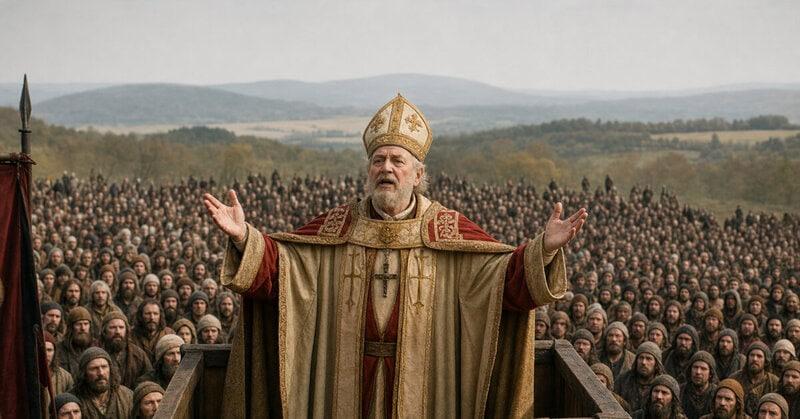
On a cold November morning in 1095, a crowd so vast it spilled beyond every church in Clermont, France, gathered in an open field to hear a pope speak — and what they shouted back would echo across a thousand years of history, through sieges and slaughters, Renaissance paintings and Victorian novels, and eventually into the ugliest corners of the early internet.
The Crowd Roared Before the Pope Finished Speaking

Pope Urban II had climbed a wooden platform in a frost-hardened field because no building in the city could hold the thousands who had come: knights in mail, barefoot pilgrims, bishops wrapped in wool, minor lords who had ridden for days. He painted a picture of Jerusalem — the city of Christ’s death and resurrection — as a place defiled, its pilgrims beaten on the roads, the Church of the Holy Sepulchre under Muslim rule. Then he asked, with the full theater of a man who understood power: who would take it back?
The answer did not wait for him to finish. From thousands of throats came two words in Latin — Deus vult. God wills it. The roar was so sudden and unanimous that chroniclers who recorded the scene later disagreed over whether Urban had planned the response or whether the crowd, moved by something beyond stagecraft, had invented it on the spot. Either way, the phrase caught fire. Participants sewed crosses onto their cloaks before they rode home. A war — one of the most consequential and catastrophic in medieval history — had its slogan.
That single moment planted a two-word phrase into Western consciousness for the next thousand years. What happened to it afterward is a story about the strange second lives that language leads when history stops paying close attention.
What the Words Actually Mean — and the Theology Behind Them

The Latin is simple enough to translate in a sentence. Deus is God. Vult is the third-person singular present of velle — to will, to want, to intend. Put together, the phrase means, plainly, “God wills it.” But those three syllables carried theological weight that took centuries of Christian thought to build.
Invoking God’s will over a human action does something remarkable to the person invoking it: it removes moral doubt. If God wills it, the killing is not murder — it is ministry. The soldier becomes an instrument of providence rather than an agent of violence. This logic drew on a long tradition stretching back through Augustine’s just-war theory and forward through medieval beliefs that military victory itself served as evidence of divine favor. Win the battle, and God has spoken.
Urban’s genius — or his danger, depending entirely on your vantage point — was collapsing centuries of complex theology into a battle cry that required no seminary to understand or repeat. The phrase circulated in variant spellings and pronunciations, including the Old French Deus lo volt, as it spread across languages and borders. The meaning, however, never wavered: God is on our side, and that settles it.
The First Crusade and the Cry That Carried Armies to Jerusalem

The First Crusade (1096-1099) did not begin in an organized or glorious fashion. The first wave — a ragged, largely unarmed mass of peasants and minor knights known as the People’s Crusade — set out months before the professional armies, driven more by fervor than strategy. They never reached the Holy Land in any meaningful sense. Many were massacred in Anatolia before they could engage the enemies they had imagined.
The baronial armies that followed were another matter. Disciplined, heavily armed, and led by lords with genuine military experience, they pushed through Anatolia, survived brutal sieges, and arrived at Jerusalem in the summer of 1099. When the city fell in July of that year, the surviving participants interpreted events exactly as the battle cry had promised: God had willed it. Victory was its own theology.
That reading cemented deus vult as sacred language for every crusading campaign that followed. Over the next two centuries, through eight major expeditions and dozens of smaller ones, the phrase — or its local variations — appeared on banners, in letters, at the lip of sieges, and in the prayers of soldiers who were cold and sick and far from home. It was war cry, benediction, and propaganda all at once, inseparable from what it meant to call yourself a crusader.
Centuries of Use — Sacred, Literary, and Political

Even after the crusading era faded, the phrase refused to die. Medieval seals carried it as a motto. Papal bulls invoked it as shorthand for righteous authority. Chivalric romances kept the imagery alive in literature long after the actual military campaigns had collapsed into failure and recrimination.
Renaissance and Baroque writers returned to the Crusades as dramatic material, and deus vult appeared in chronicles and paintings as historical color — a window into a world that seemed, from a comfortable distance, heroic and morally uncomplicated. The 19th century gave the phrase yet another life. European powers competing for colonial territory looked back at the Crusades as a golden age of Christian martial virtue, a story of civilization pushing outward. It was a selective reading, willfully blind to the massacres and political failures, but it served an ideological purpose and proved durable.
By the early 20th century, deus vult had settled into the respectable category of historical artifact — potent in the right context, largely confined to academic texts and the occasional revival sermon. Then the internet arrived and changed the terms entirely.
How Online Communities Resurrected — and Weaponized — an Ancient Phrase

Around the mid-2010s, deus vult began appearing on forums like 4chan and Reddit, attached to memes featuring cartoon Crusaders in full armor. The tone was initially ironic — the kind of trollish, winking humor those platforms cultivated — but the ideological undercurrent was present from the start. The Crusader imagery was not chosen at random.
Far-right and white supremacist communities adopted the phrase with increasing openness, pairing it with crusader crosses and medieval iconography to advance an argument that the Crusades represented a racially pure, proudly Christian Europe worth reclaiming. The phrase migrated from screens into the physical world, appearing on clothing and in extremist materials circulated at rallies and protests. Researchers tracking far-right movements flagged it as a recognizable in-group signal.
The strategy followed a pattern those researchers had documented before: launder extremist ideas inside the aesthetics of history and culture. If challenged publicly, claim you are simply a history enthusiast interested in medieval warfare. If speaking to ideological allies, the meaning is already understood. The ambiguity is not accidental — it is the mechanism.
What Scholars Say: The History These Groups Got Badly Wrong
Historians who study the medieval period are direct about this: the version of the Crusades promoted online bears almost no resemblance to what actually happened. Scholars say white supremacists chanting deus vult got the history badly wrong on nearly every significant point.
The crusading armies were not a racially unified European force. They were ethnically and linguistically diverse — Normans, Franks, Germans, Italians, Byzantines, and others who frequently could not understand one another and sometimes turned their violence on fellow Christians. More fundamentally, the concept of “whiteness” as a racial category did not exist in the 11th century. It is an invention of a much later era, projected backward onto people who would have found it incomprehensible.
The Crusader states established in the Levant were not ethnic enclaves. They were messy, multicultural contact zones where Latin Christians, Eastern Christians, Jews, and Muslims traded, intermarried, and negotiated the terms of daily life — far from the fantasy that white supremacist appropriators project onto them. The violence of the Crusades was indiscriminate in ways that undercut any romantic reading: crusading armies massacred Jewish communities in European cities before they ever reached the Holy Land, and later campaigns turned on Eastern Christian populations labeled as heretics.
By any military or political measure, the Crusades were also largely failures. Jerusalem, captured in 1099 at enormous human cost, was lost within a century. Subsequent expeditions accomplished progressively less at greater cost until the project exhausted itself entirely. This is not a history of triumphant civilization — it is a history of staggering ambition meeting staggering loss.
The modern appropriation, scholars argue, reveals far more about present-day anxieties over immigration and demographic change than it does about any honest engagement with the medieval past. The Crusades are being used as a mirror, not a window.
A Living Phrase in an Unresolved Present
Deus vult today exists in an uncomfortable split state that resists easy resolution. For many Catholics and other Christians, the phrase remains part of a genuine devotional heritage — an expression of trust in divine providence that long predates its internet reinvention and carries no extremist connotation in their use of it. It is still taught in history classrooms as the authentic battle cry of the First Crusade. And it is simultaneously flagged by extremism researchers as a recognized identifier of far-right movements.
Video games like Crusader Kings have introduced the phrase to millions of players who have no ideological agenda, absorbing it into the language of a hobby and further complicating any simple judgment of intent. A teenager quoting the phrase while playing a strategy game is not the same as someone deploying it as a movement slogan — but the phrase itself cannot make that distinction for you, and neither can the words alone.
This ambiguity is precisely why accurate history matters. The most effective counter to the phrase’s hijacking is not to abandon the history but to insist on its full complexity: the chaos and failure of the People’s Crusade, the multicultural reality of the Crusader states, the repeated military catastrophes, the violence turned on European Jews before the armies left the continent, and the enormous gap between the original cry and the cause being claimed in its name today.
The real history of deus vult — from a frozen French field in 1095, through siege walls and papal bulls and Victorian paintings, to a meme template in the 2010s — is messier, stranger, and more morally complicated than any slogan can contain. That is exactly why it deserves to be told accurately, in full, and without the comfort of a simple ending.

 English
 Arabic
 French
 Spanish
 Portuguese
 Deutsch
 Turkish
 Dutch
Dutch
 Italiano
 Romaian
 Portuguese (Brazil)
 Greek
Greek