


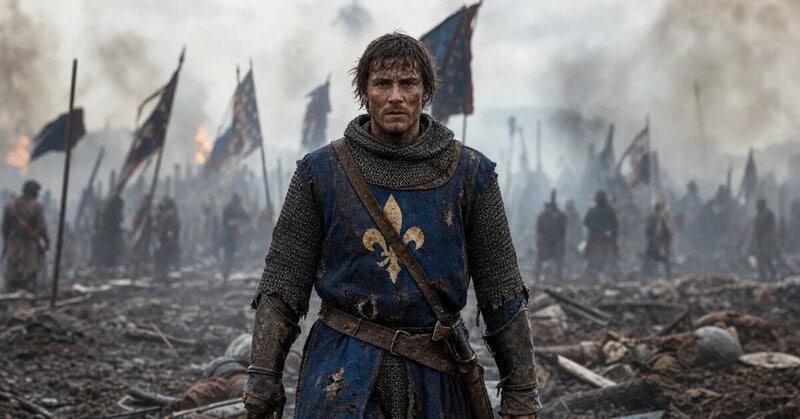
Imagine a French soldier standing on a battlefield in 1453, sword in hand, lungs burning with smoke and effort. He was born around 1430. His father was born around 1405. His grandfather around 1380. Not one of them had been alive when the war he was now fighting had supposedly begun — and yet here it was, still going, older than anyone could personally remember, a conflict so sprawling and strange that calling it a single war was already a kind of historical lie.
A War That Outlived Everyone Who Started It

The Hundred Years’ War is one of history’s most misleading labels. It ran from 1337 to 1453 — a span of 116 years, not one hundred. But the number is almost the least of the mislabeling. What most people picture as a single grinding clash between England and France was, in reality, something far stranger: a fire that kept going out and then refusing to stay out. Truces were signed. Soldiers went home. Crops were planted over scorched fields. Whole decades passed in uneasy, exhausted peace. And then, always, it started again.
Britannica describes it as an “intermittent struggle” — not a continuous campaign but a series of distinct conflicts stitched together by a shared grievance that neither kingdom could resolve and neither could fully walk away from. What follows is the story of how that impasse lasted longer than most dynasties, turned on the courage of a teenage peasant girl, and ended up remaking two nations in the process.
The Spark: One King’s Audacious Claim to Two Thrones

The trouble began, as so many medieval catastrophes did, with an inheritance argument. In 1337, Edward III of England made a declaration that was either brilliantly audacious or spectacularly reckless depending on which side of the Channel you stood: he claimed to be the rightful king of France. His reasoning was not entirely absurd. His mother was Isabella of France, daughter of French King Philip IV, and when the French royal line faltered after Philip IV’s three sons died without surviving male heirs, Edward argued that his claim through her was legitimate. The French countered by invoking what they called Salic law — the principle that inheritance could not pass through the female line — and elevated Philip VI, a cousin of the last king through the male line, instead. That Edward’s claim was dismissed in favor of a more distant male relative was, to the English, an insult dressed in legal clothing.
But the inheritance dispute was only part of the kindling. English kings had long controlled Gascony, a wealthy wine-producing duchy in southwestern France, and they held it in a feudal arrangement that required them to pay homage to the French crown — a humiliation Edward had no intention of tolerating indefinitely. France had also been interfering in Scotland, England’s perennial northern problem, and had been squeezing English merchants out of the lucrative Flemish wool trade. Land, pride, legal theory, dynastic ambition, and economic rivalry had been soaking in each other for generations, and Edward III’s formal claim to the French throne in 1337 was the spark that finally set it all alight.
Philip VI of France saw none of this as legitimate. To him, Edward’s legal arguments were naked aggression wearing a law student’s robes. Both men had reasons to fight and reasons to believe they would win quickly. Both were catastrophically wrong on the second count in ways that would echo through the next century and more.
Not One War But Several

Here is the fact that most retellings of the Hundred Years’ War underplay: the fighting was not constant. It could not have been. No medieval economy, no medieval army, could sustain unbroken warfare for a century. What historians have mapped out instead are three broad phases of intense conflict separated by periods of genuine, sometimes lengthy, peace.
The first phase, the Edwardian War, ran roughly from 1337 to 1360. It ended with the Treaty of Brétigny, in which England gained enormous territorial concessions — control over roughly a third of France — and Edward formally dropped his claim to the French throne, at least for a while. The second phase, the Caroline War, burned from 1369 to 1389, as a resurgent France under Charles V and his brilliant constable Bertrand du Guesclin clawed back much of what it had lost, avoiding pitched battles and instead starving English garrisons and raiding English supply lines. The third and final phase, the Lancastrian War, exploded into life in 1415 with Henry V’s invasion and did not extinguish itself until 1453.
Between those bursts of fighting lay years — sometimes entire decades — when the two kingdoms were technically at peace. Towns rebuilt. Merchants traded. Diplomats argued in candlelit halls about the exact wording of treaties that everyone knew were provisional. Ordinary people on both sides tried, with varying success, to forget. The war was always there in the background, a debt that kept coming due.
To complicate matters further, France was not simply fighting England during all of this. Running parallel to the Anglo-French conflict was a vicious civil war between two French noble factions: the Armagnacs, who supported the royal house, and the Burgundians, whose Duke controlled vast territories and had his own ambitions. The Burgundians were not above allying openly with England when it suited them, and for significant stretches, the Hundred Years’ War was as much a French civil war as a foreign invasion. This internal fracture helps explain how England, a smaller and considerably less wealthy kingdom, was able to punch so far above its weight for so long.
The Greatest Battles: Crécy, Poitiers, and Agincourt

The war produced a sequence of battles so lopsided — so visually dramatic and strategically significant — that they have become shorthand for the entire era. What links them is a single, devastating English weapon: the longbow.
At Crécy in 1346, English longbowmen stood their ground on a gentle slope in northern France and methodically destroyed wave after wave of French cavalry. The mounted knights of French chivalry, armored and proud and certain of their superiority, rode into a storm of arrows they could not answer. The longbow — cheap to produce, fast to deploy, capable of loosing ten to twelve arrows per minute at ranges exceeding 200 yards — made a mockery of the feudal battlefield’s old rules. French crossbowmen, who fired perhaps two bolts per minute, were swept aside before they could close the distance. Crécy was proof that England had found a tactical formula that French tradition could not immediately solve.
Ten years later, at Poitiers in 1356, Edward III’s son Edward the Black Prince repeated the lesson. The French King John II was captured on the field — a humiliation so complete that the French crown had to negotiate an enormous ransom while governing a kingdom that was simultaneously erupting in peasant revolts triggered by the war’s economic devastation. The Treaty of Brétigny that followed effectively gave England more French territory than any English king had controlled since the Norman period.
Nearly sixty years after Poitiers, at Agincourt in 1415, Henry V of England delivered the war’s most famous single day. Outnumbered by a French army that may have been three or four times the size of his own — exhausted after a long march through northern France, weakened by dysentery — Henry’s forces, again anchored by longbowmen positioned on a narrow, muddy field that negated French numerical advantage, shattered the French nobility in roughly an hour of brutal fighting. Thousands of French knights and men-at-arms were killed or captured. English casualties were comparatively light. It was the battle that inspired Shakespeare’s soaring speeches about bands of brothers and English valor, and it opened the Lancastrian phase of the war with a statement of English power so loud it reverberated across Europe.
And yet England won Crécy, won Poitiers, won Agincourt, won battle after battle across a century — and still lost the war. The explanation is almost mathematical: you can win fields without winning countries. Holding French territory required garrisons, supply lines, loyal local administrators, and an endless expenditure of money that England simply could not sustain forever against a kingdom three times its size. Every English victory planted the seeds of a future French recovery.
The war’s highest-water mark for England came with the Treaty of Troyes in 1420, when the mentally unstable French King Charles VI — in a moment of dynastic desperation, his position hollowed out by civil war and English military pressure — agreed to recognize Henry V as his heir, disinheriting his own son. The whole conflict seemed on the verge of ending in total English victory. Then Henry V died in August 1422, just two years later, at the age of 35, probably of dysentery contracted during a siege. The French throne he had been promised passed to his infant son, who was nine months old. And into the vacuum left by Henry’s death walked a teenager from a village in Lorraine.
Joan of Arc: The Turning Point in a Teenager’s Hands

She was about 17 years old when she appeared at the court of the French Dauphin — the uncrowned heir to France, whose legitimacy was disputed and whose cause was flagging — and told him that the voices of saints had commanded her to drive the English from French soil. Her name was Joan of Arc. She was a peasant girl with no military training and no political connections. The Dauphin, Charles, was desperate enough, or curious enough, or perhaps genuinely moved enough, to give her a chance. Before doing so, he subjected her to weeks of theological examination by church officials, who found no heresy in her claims.
What happened next is the most dramatic single story the Hundred Years’ War produced. In the spring of 1429, Joan led French forces to Orléans, a strategically vital city on the Loire River that had been under English siege for more than six months. Its fall would likely have broken French resistance in the region and opened the road south to the Dauphin’s remaining territories. In nine days of fighting, the siege was lifted. Commanders with decades of experience had failed to do what this teenager accomplished in just over a week, and the psychological effect on both armies was seismic. The French, who had been losing for so long that losing felt like fate, suddenly believed they could win. The English, who had won for so long that winning felt like birthright, suddenly felt something they had not felt in years: doubt.
Joan’s role in the conflict cannot be reduced to symbolism. She was a military catalyst who made specific tactical decisions, boosted the morale and cohesion of armies that had been dispirited and fractious, and provided the French crown with a narrative of divine sanction at the precise moment it most needed one. Her presence at Orléans was followed by a rapid campaign along the Loire that cleared English positions from the region. She then pressed Charles to march to Reims — deep in territory still contested by the English and Burgundians — for a coronation. He did. In July 1429, Charles VII of France was crowned in Reims Cathedral, the traditional coronation site of French kings. The political and spiritual effect was transformative. France had a legitimate, crowned, anointed king. It had momentum. It had a story to tell about itself.
Joan herself did not live to see what she had started bear its full fruit. Captured by Burgundian forces during a sortie near Compiègne in May 1430 and sold to the English, she was tried for heresy in a court at Rouen controlled by her enemies — a proceeding historians have long regarded as a judicial travesty driven by political necessity rather than genuine theological concern. She was convicted and burned at the stake on May 30, 1431. She was approximately 19 years old.
Her death did not undo what she had done. The psychological stalemate she had broken stayed broken. Charles VII kept his crown and kept fighting. The momentum she had ignited — military, moral, and spiritual — did not reverse.
The Long Unraveling: How England Lost

Through the 1430s and 1440s, English power in France crumbled with a kind of slow, grinding inevitability. English domestic politics grew poisonous, with factions at court fighting over the regency government ruling in the name of the infant Henry VI, a king who would prove, as an adult, to be gentle, pious, and entirely unsuited to the demands of war. Funding for French campaigns dried up as Parliament grew reluctant to vote taxes for a conflict that seemed to produce diminishing returns. But the single most decisive blow came in 1435, when the Burgundians — the crucial French faction that had allied with England, handed Joan of Arc to English custody, and propped up English ambitions for decades — switched sides. The Treaty of Arras reconciled Burgundy with the French crown, and the rug was pulled from beneath England’s entire strategic position in France.
Charles VII did not simply wait for England to collapse. He modernized his army with methodical efficiency, creating a standing professional force — the compagnies d’ordonnance — that replaced the old feudal levy system. More decisively still, he invested in gunpowder artillery at a scale that changed the war’s physical reality. The Bureau brothers, Jean and Gaspard, built a French artillery train that was the most formidable in Europe. Stone walls that had sheltered English garrisons safely for decades crumbled before the new cannons in weeks. Normandy, which England had controlled for thirty years, fell in a campaign of less than two years between 1449 and 1450. Gascony, the English wine duchy that had been the original casus belli of the whole conflict, fell in 1451.
The final act came at the Battle of Castillon on July 17, 1453. A French artillery barrage annihilated an English relieving force that had charged the French field fortifications — the precise circumstances that triggered the assault remain debated by historians, but the outcome was not in doubt. The English commander, John Talbot, Earl of Shrewsbury, once so feared across France that his name was reportedly used to frighten children, was killed. He was approximately 65 years old and had been fighting in France for most of his adult life. With his death, the Lancastrian War effectively ended. No peace treaty was formally signed — England never officially conceded defeat — but English military operations in France ceased. The only territory England retained was Calais, a single fortified port on the northern coast, which it would hold until 1558.
From 1337 to 1453: 116 years. That span is longer than the distance in time between the American Civil War and today. It encompasses the lifetimes of great-great-grandparents and great-great-grandchildren. When you hold that number against the name — “Hundred Years’ War” — you begin to understand how thoroughly history can mislabel itself.
What Changed: The War’s Deeper Legacy
The war’s legacy ran deeper than any single battle or treaty. In England, expulsion from the continent forced a painful reckoning with national identity. No longer a kingdom with territorial ambitions in France, England turned inward through the chaos of the Wars of the Roses that followed almost immediately after 1453, and then eventually seaward, toward the Atlantic — toward the maritime empire that would define its next four centuries. The loss of France helped close one chapter of English history and, eventually, open another.
In France, the long struggle forged something that had barely existed before: a genuine sense of shared nationhood. A population that had fought and suffered under a single crown long enough — that had shared the story of Orléans, of Joan, of the coronation at Reims — began to feel, collectively, French in a way that was qualitatively different from mere feudal loyalty to a distant king. The war was as much a nation-building exercise as a military conflict.
The war also accelerated a revolution in how armies were organized and how battles were won. The longbow had already fatally undermined mounted chivalry at Crécy and Agincourt. Gunpowder artillery, as demonstrated so conclusively by the French Bureau brothers at Castillon and throughout the final campaigns in Normandy and Gascony, finished the transformation. The armored knight, the defining military figure of the medieval world, was rendered obsolete within the war’s own 116-year span — a transformation that reshuffled European military and political power for centuries to come. Professional standing armies, paid in wages rather than bound by feudal obligation, began to replace the old levy systems. Castillon is sometimes cited as the battle that ended the Middle Ages as a military era.
And Joan of Arc outlasted the war by becoming something larger than it. Formally acquitted by a posthumous retrial ordered by Charles VII in 1456 — just three years after Castillon — she was beatified in 1909 and canonized as a saint in 1920, named patron of France. Her image has been claimed by movements across the political spectrum for six centuries, a testament to how powerfully her story transcends the specific conflict that produced her.
The Hundred Years’ War is proof that history rarely fits its own names. It was longer than a century, messier than a single war, and decided as much by a teenage peasant’s courage, a Burgundian diplomatic betrayal, and a revolution in artillery technology as by anything that happened in the pitched battles that fill the history books. It did not end with a dramatic final blow so much as it simply ran out of road — one side exhausted, the other transformed, and both irrevocably different from what they had been when an ambitious English king first looked across the Channel and decided that France was rightfully his.

 English
 Arabic
 Spanish
 Portuguese
 Deutsch
 Turkish
 Dutch
Dutch
 Italiano
 Russian
 Romaian
 Portuguese (Brazil)
 Greek
Greek