


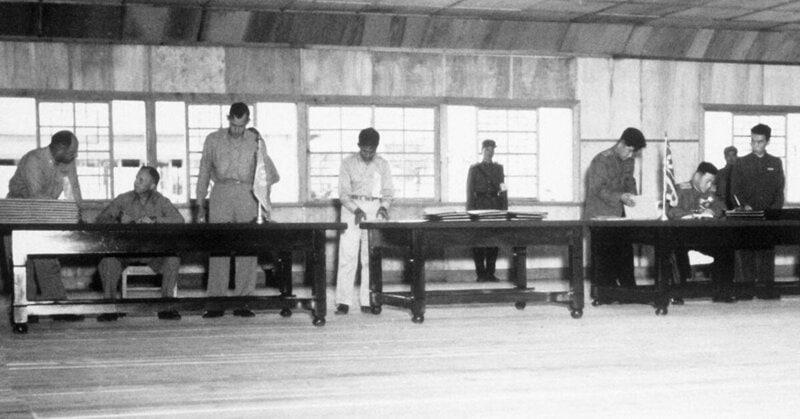
On July 27, 1953, in a prefabricated building in the village of Panmunjom, generals from opposing sides of a brutal three-year conflict sat down, signed a document, and then — without handshakes or champagne — stood up and walked away. They left behind a war that was neither won nor lost, suspended in a legal limbo that has never, in more than seventy years, been resolved.
The Ceasefire That Froze a War in Time

The Korean War armistice of 1953 is not a peace treaty. It is a military ceasefire agreement between commanders, not governments — a document that stopped the shooting without formally ending the conflict. The war did not end. It paused. And in that pause, seventy years have accumulated.
The result is a geopolitical condition unlike almost anything else in the modern world: two Koreas still technically at war, separated by a 160-mile Demilitarized Zone that is simultaneously one of the most heavily fortified strips of land on Earth and, by dark irony, one of its most biodiverse nature preserves. Undisturbed by human activity for decades, wildlife has quietly reclaimed the minefields — Amur leopard cats, Asiatic black bears, and rare migratory birds moving through terrain shaped entirely by war and then, involuntarily, surrendered back to nature.
The Korean War occupies a peculiar blind spot in Western memory, sandwiched historically between the triumphant narrative of World War II and the cultural upheaval of Vietnam. Historians have long called it “the Forgotten War,” and that label — however unfair to those who fought it — captures something real about how mainstream culture processed, or failed to process, its inconclusive ending. What is quietly remarkable is where serious memory of this conflict has persisted: in wargames. From Cold War-era simulations to meticulously researched board game titles and modern strategy releases, the Korean War has found a strange second life in game design — a form of remembrance that says something revealing about what we choose to preserve, and how.
How the War Started — and Why the Details Still Matter

On June 25, 1950, North Korean forces crossed the 38th parallel in a pre-dawn assault that caught South Korea and an understrength American garrison almost completely unprepared. Within three days, Seoul had fallen. The collapse was stunning in its speed, and the history of those first weeks reads like a case study in catastrophic unreadiness.
The context that shaped everything traces back to 1945, when Korea — having endured decades of Japanese colonial occupation — found itself partitioned almost arbitrarily between American and Soviet occupation zones. The 38th parallel that would define the peninsula’s fate was reportedly drawn in approximately 45 minutes by American military planners working from a National Geographic map, chosen for reasons of administrative convenience. A line drawn that casually would eventually cost millions of lives.
By September 1950, United Nations and South Korean forces had been pushed into a desperate defensive perimeter around the southern port city of Pusan — roughly 140 miles of improvised front line holding against sustained North Korean pressure. The Pusan Perimeter held, barely, and it became the pivot on which the entire war turned. General Douglas MacArthur then executed one of the most audacious operational gambles in modern military history: an amphibious landing at Incheon, far behind enemy lines, that reversed the strategic situation almost overnight. UN forces surged north, Seoul was retaken, and for a brief moment it appeared the conflict might end in outright victory.
Then China entered. In late November 1950, as UN forces pushed toward the Yalu River and the Chinese border, a massive People’s Volunteer Army counteroffensive struck with devastating force. At the Chosin Reservoir, United States Marines and Army soldiers fought through temperatures approaching -40°F in an engagement that has since entered the mythology of American military history — a fighting withdrawal against overwhelming numbers that became, depending on who tells it, either a story of extraordinary valor or a symbol of dangerous strategic overreach. Either way, it shattered any prospect of a quick resolution and locked the war into two more years of grinding, attritional combat along lines that barely moved.
The Armistice That Wasn’t Peace — and the Legal Limbo That Followed

When the shooting finally stopped in July 1953, the armistice established a Military Demarcation Line running close to the original 38th parallel, created the DMZ, and set up a Neutral Nations Supervisory Commission to monitor compliance. It also, crucially, called for a political conference to be convened within 90 days — a conference that would negotiate an actual peace treaty and formally end the conflict.
That conference met in Geneva in 1954. It collapsed without agreement. The 90-day provision, enshrined in Article IV of the armistice, was never fulfilled. And so the question of why the Korean War ended is, in a strict legal sense, a question without a clean answer — because it has not ended. The armistice created a framework for peace and then left that framework standing empty for over seven decades.
The cost of this unresolved limbo has not been abstract. The 1968 seizure of the USS Pueblo by North Korean forces, the 1976 axe murder incident in the Joint Security Area, North Korea’s successive nuclear weapons tests, the 2010 sinking of the South Korean naval vessel ROKS Cheonan — each crisis has unfolded in the shadow of a conflict that never formally concluded, giving the peninsula a permanently destabilizing ambiguity that a peace treaty might, at least in part, have reduced.
Why “Forgotten” — and Whether That Label Was Ever Fair

The “Forgotten War” label emerged almost immediately after 1953. American culture pivoted quickly: postwar economic prosperity, the deepening anxieties of the nuclear arms race, and a collective emotional exhaustion left little appetite for processing a conflict that had ended without victory, without defeat, and without a parade. The war produced no unambiguous moral narrative and no triumphant homecoming story to sustain public memory.
The numbers, however, demand to be remembered. Approximately 36,000 Americans were killed in action and more than 100,000 wounded. Estimates of Korean civilian deaths reach approximately three million. Chinese losses ranged, by various estimates, from roughly 180,000 to 400,000 killed — figures that make it one of the costliest conflicts of the twentieth century, compressed into just over three years of fighting.
Korea did find one major cultural footprint: the television series M*A*S*H, set during the Korean War, ran for eleven seasons and produced one of the most-watched series finales in American broadcast history. But M*A*S*H was always understood, even at the time, as an allegory for Vietnam — which means that even Korea’s most prominent cultural monument was effectively borrowed for a different war’s argument. The Forgotten War’s most famous memorial was, in practice, someone else’s.
Historians increasingly push back on the “forgotten” framing. For Koreans on both sides of the DMZ, and for Chinese veterans and their families, the war is deeply present — in national memory, in official commemoration, in lived consequence. The amnesia is a specifically Western phenomenon, rooted in the discomfort of inconclusiveness. A war that ends without resolution is harder to narrate, harder to commemorate, and harder to turn into the kind of story that fills museum galleries and generates feature films.
Simulating the Unresolved: Korean War Games From the Cold War to Steam

Which is perhaps why games stepped in where broader culture stepped back.
The earliest Korean War video games emerged in the early 1980s, with titles like MacArthur’s War: Battles for Korea placing players in operational command decisions that mainstream film was ignoring entirely. The air war dimension attracted its own dedicated simulations: titles reconstructing the first jet-versus-jet air war in history, in which American F-86 Sabres dueled Soviet-built MiG-15s over a stretch of North Korean airspace near the Yalu River that pilots nicknamed “MiG Alley.” This was a genuinely revolutionary chapter in aviation history, and flight simulators preserved it with archival seriousness while the broader culture looked elsewhere.
The modern evolution of this digital memory is represented by titles like SGS Korean War on Steam, a detailed operational wargame covering the conflict with unusual chronological completeness. Its scenarios move through the defensive stand at Pusan, the Incheon amphibious landing, the Chosin Reservoir withdrawal, the Chinese Spring Offensive, and the full arc of the war’s operational history — with options for individual scenarios or a grand campaign spanning the conflict’s actual duration. No major documentary series has attempted that level of structured, chronological engagement with the Korean War as a whole. A strategy game on Steam has.
What the scenario design reveals is striking: the moments that game designers have independently identified as the conflict’s defining episodes — Pusan, Incheon, Chosin, the Chinese counteroffensive — are precisely the episodes that serious historians identify as pivotal. The games are, inadvertently, doing historical periodization.
The Board Game Historians: Cardboard, Counters, and the Conflict Nobody Made a Blockbuster About

If video games preserved the Korean War in pixels, a parallel community of board game designers preserved it in considerably more granular detail. The BoardGameGeek Top 10 Korean War Games list includes titles such as Korea: The Forgotten War, The Korean War: June 1950-May 1951, and Yalu: The Chinese Counteroffensive in Korea: November 1950-May 1951 — precise, periodized, and designed for players who want to understand the strategic logic of a conflict that mainstream culture largely dismissed.
Hex-and-counter wargames demand research. The designers of these Korean War titles have produced treatments of the conflict that are, in terms of operational and logistical detail, competitive with anything available outside specialist academic literature. It is serious history dressed as play — or perhaps serious play that happens to produce history as a byproduct.
Yalu, focused specifically on the Chinese November 1950 counteroffensive, does something that official commemorative history rarely attempts: it invites players to interrogate the counterfactuals directly. What if MacArthur had exercised restraint near the Chinese border? Could different decisions have prevented Chinese intervention? Might a different outcome in late 1950 have produced a functioning peace conference in 1954 rather than a collapsed one? These are questions that make politicians uncomfortable and historians cautious — and a board game asks them straightforwardly, across a hex grid, on a quiet evening.
The irony is worth acknowledging plainly. The most granular, operationally complete reconstructions of the Korean War exist not in prestige television dramas or major motion pictures but in wargames sold to a few thousand dedicated enthusiasts. That fact says something specific about whose conflicts get glamorized, whose get analyzed, and whose get gamed because nobody else bothered to engage with them seriously.
The War That Waits — and Why Remembering It Still Matters
The armistice is more than seventy years old. North Korea possesses nuclear weapons. The DMZ remains manned by an estimated two million combined troops on both sides. The political conference mandated by Article IV of the 1953 agreement has never produced a peace treaty. The statement that the Korean War never officially ended is not a historical curiosity or a technical footnote — it is an accurate description of the current geopolitical reality of Northeast Asia, a region where great-power tensions intersect with an unresolved mid-century conflict in ways that shape diplomatic calculations in Washington, Beijing, Seoul, and Pyongyang to this day.
What the persistence of Korean war games — video and board alike — suggests is something quietly important about institutional memory and its failures. When official commemoration falls short, enthusiasts remember. The players reconstructing the Pusan Perimeter in a digital campaign or pushing cardboard counters across a hex grid representing the Yalu River are doing something that billion-dollar entertainment industries and national memorial institutions have largely not done: engaging with the Korean War on its own terms, as its own conflict, with its own logic and its own unresolved stakes.
Calling a war “forgotten” can itself be a form of forgetting — a way of acknowledging an absence without examining why that absence exists. The Korean War was inconclusive. It ended with a ceasefire that was not peace, drew a border that had not previously existed in that form, and left two countries that had been one locked in a military standoff from which they have not emerged. That discomfort, that persistent lack of resolution, is precisely what makes the war hard to commemorate and easy to set aside. Conclusive wars write their own memorials. Inconclusive ones wait.
Somewhere in the DMZ, in the forests that have grown undisturbed between the minefields, animals move through a landscape shaped entirely by human violence and then, for seventy years, left alone by it. The Korean War in 2025 looks something like that: present in the landscape, unresolved in the architecture, and still waiting — technically, legally, geopolitically — for the peace conference that the armistice promised and the world never delivered.

 English
 Arabic
 Spanish
 Portuguese
 Deutsch
 Turkish
 Dutch
Dutch
 Italiano
 Russian
 Romaian
 Portuguese (Brazil)
 Greek
Greek