


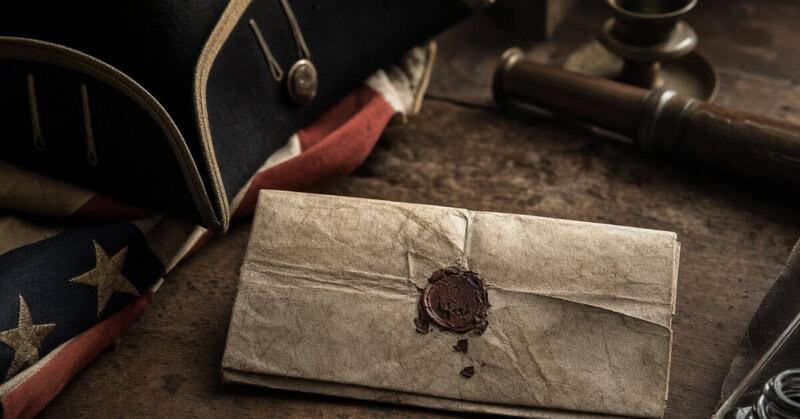
The letter was folded in thirds, sealed with wax that had long since crumbled, and addressed in a hand so hurried the ink had smeared before it dried. Somehow, through two and a half centuries of floods, fires, moving boxes, and indifference, it survived — a small paper miracle from a revolution that nearly lost its own voice.
The Letter Nobody Was Supposed to Find

Imagine a Continental soldier in the winter of 1777, scrawling a few lines home by firelight, folding the page into a coat pocket, and marching into a campaign from which he might not return. He was not thinking about posterity. He was thinking about cold feet and empty rations and whether the letter would reach his family before the roads became impassable. The document’s survival was never the point — which is precisely what makes every recovered Revolutionary War letter feel like an act of rescue rather than routine record-keeping.
This tension haunts every historian who works the American Revolution: the men and women who lived through the founding of a nation were not, in most cases, trying to leave a paper trail. And the trail they left is astonishingly thin. Unlike the Civil War, which generated an almost obsessive culture of memoir-writing, regimental histories, and personal diaries — produced by a more literate population with a sharper collective sense that they were living through history — the Revolutionary era left comparatively few personal records from ordinary participants. The generals wrote. The statesmen wrote, brilliantly and at length. The common soldier, more often than not, did not, or could not, or did and then watched the pages rot.
So who is chasing those pages now? And what happens when they find one?
Why the Revolution’s Records Are So Hard to Find

The scarcity has several explanations, and none of them are simple. Literacy in eighteenth-century America was uneven — higher in New England than in the rural South, higher among merchants and clergy than among laborers and farmhands. Many of the men who shouldered muskets at Lexington or crossed the Delaware with Washington had never written a letter in their lives and saw no reason to start under fire.
Then there was deliberate destruction. Patriots burned letters when they feared British patrols. Loyalists destroyed correspondence when neighbors turned hostile. Officers traveling between encampments carried dispatches sewn into coat linings or written in cipher, and documents that fell into enemy hands were sometimes destroyed rather than surrendered. The chaos of mobile armies moving across thirteen colonies — colonies that had no unified government, no centralized archive, no systematic plan for preserving anything — meant that records scattered into private homes, church vestries, county courthouses, and eventually into ocean-crossing trunks bound for London or the Caribbean.
No federal archive existed during the war to catch what fell through the cracks. The Library of Congress and the National Archives came later, and by the time they arrived, an unknowable quantity of primary material had already been lost to fire, flood, neglect, and the ordinary entropy of time.
The irony is almost cruel. The men who produced some of the most celebrated political prose in the English language — Jefferson drafting the Declaration, Madison taking notes at the Constitutional Convention, Hamilton writing at a pace that seems physically impossible — were surrounded by ordinary soldiers whose inner lives are nearly invisible to us now. The Founders wrote for the ages. Their neighbors wrote for survival, if they wrote at all.
What Survives — and What It Tells Us

The categories of American Revolution primary sources that did survive are worth knowing, because they are stranger and richer than most people expect. Official orderly books — the daily administrative records kept by regimental officers — survive in reasonable numbers and tell us an enormous amount about the rhythm of army life: the orders given, the punishments assigned, the prayers required before battle. Printed broadsides, pamphlets, and newspaper accounts from the period exist in archives from Boston to London, offering the propaganda wars of the era in vivid, often furious detail.
But perhaps the most unexpected archive is the pension application. Decades after the war ended, aging veterans applied to the federal government for financial support, and in doing so they dictated or wrote narratives of their service — specific, personal, sometimes astonishing accounts of what they had seen and done as young men. Filed by the thousands in the early nineteenth century, these documents became an accidental repository of common-soldier experience, full of details no general’s memoir would bother to record: the name of a tavern where a company sheltered from sleet, the precise sequence of a skirmish on a farm lane, the faces of men who died without making it into any official history. Researchers have been mining this vein for decades, and it has not run dry.
Reading these sources requires something more than transcription. Documents written under duress, composed by semi-literate scribes, or deliberately coded for secrecy demand what might fairly be called forensic reading — the ability to hear what a text is not saying, to understand the conventions and fears that shaped every word choice. Even a fragmentary record — a single inventory of a quartermaster’s supplies, a ship’s log from a privateer, a court-martial proceeding — can reframe an entire campaign when read alongside other sources by someone who knows what to look for. For those beginning their own exploration of this documentary landscape, the guide to Revolutionary War diaries and memoirs offers an invaluable map of what survives and where to find it.
The Modern Rescue Operation: Enter the Journal of the American Revolution
Into this landscape of scattered, fragile, hard-to-read evidence came a publishing project that has quietly become indispensable. The Journal of the American Revolution operates as a daily online magazine, publishing articles that range from deep archival dives — the kind a specialist might take years to produce — to sharp, accessible pieces that give curious general readers a fresh angle on the founding era without requiring a graduate seminar to follow along.
The model is unusual in the best possible way. Traditional academic journals move slowly: submission, peer review, revision, publication — a cycle that can stretch to years. The Journal of the American Revolution moves daily, which means that when a researcher makes a discovery, readers can encounter it while it is still fresh. The range of contributors is equally broad: university historians with decades of archival experience publish alongside independent researchers who have spent years with a single collection, and the result is a genuine conversation rather than a disciplinary monologue.
Each year, the best of that conversation gets preserved in a more durable form. Through Westholme Publishing, the Journal compiles its finest research and writing into annual print volumes — a kind of yearly state-of-the-field report that does for the Revolution’s historiography what the founders themselves tried to do for their era’s events: gather it, organize it, and make sure it lasts. The 2025 Annual Volume and the forthcoming 2026 Annual Volume edited by Don Hagist represent the field’s current best thinking, bound and preserved against the same entropy that claimed so many original documents.
The connection between the Journal’s mission and the scarcity problem is not accidental. When primary sources are rare, the quality of secondary interpretation becomes critical. A poorly researched article does not just mislead its readers — it fills a gap that might otherwise prompt someone to go looking in the archive. A well-researched one is, effectively, a lantern held up to a dark room. The Journal holds a great many lanterns.
Voices on the Air: The Podcast Bringing Scholarship to Life

For those who prefer their history spoken rather than read, the Journal extends its reach through Dispatches: The Podcast of the Journal of the American Revolution. Released weekly, the podcast features interviews with leading scholars on the latest findings, controversies, and reinterpretations in the Revolutionary era — and it accomplishes something a written article sometimes cannot: it lets you hear a historian think.
Consider what that means in practice. A researcher who has spent years decoding a single loyalist letter — learning the handwriting, tracing the biographical network around the writer, placing the document in the political context of a specific month in a specific colony — can explain the significance of that work in twenty minutes of conversation in ways that a footnoted article, however careful, may struggle to convey. The enthusiasm is audible. The reasoning is transparent. The listener follows the detective, not just the conclusion.
There is also something historically fitting about the format. The founders were creatures of oral culture as much as written culture. The coffeehouse debates, the pamphlets read aloud in taverns, the committee arguments that preceded every major vote — ideas about liberty were tested in conversation before they were committed to paper. A podcast that brings scholarly argument to a general audience is not so different in spirit from a broadside pinned to a tavern door in 1775: it is an invitation to think, distributed as widely as the technology of the moment allows. For the general reader approaching American Revolution research for the first time, Dispatches is often the most accessible entry point into serious scholarship — lowering the barrier to engagement without lowering the intellectual standard of what gets discussed.
What Groundbreaking Research Actually Looks Like

It is worth being honest about what “groundbreaking” means in this field, because it rarely resembles the dramatic single discovery of popular imagination. The Journal of the American Revolution surfaces reattributed pamphlets, newly identified battlefield maps, and pension records that restore names and faces to regiments previously known only by number. Each of these findings matters, but none alone rewrites the textbook. What rewrites the textbook is the slow, meticulous accumulation of corrected details: a date adjusted here, a misidentified officer there, a skirmish relocated to a different farm lane — until eventually the received narrative strains under the weight of what it can no longer accommodate and has to give way.
The ecosystem that produces these corrections is notably collaborative. Independent historians, university researchers, archivists at state historical societies, and dedicated amateurs who have spent decades with a single county’s records all work in parallel, cross-checking each other’s findings through venues like the Journal, building a collective understanding that no single scholar could assemble alone. The American Revolution Museum’s recognition of the Journal as a key resource for serious readers reflects how central this collaborative model has become to the field.
The urgency is real and not rhetorical. Private family collections containing Revolutionary-era letters are still being discovered in attics, still appearing at estate auctions, and occasionally still being lost when no one recognizes their significance in time. The rescue operation is genuinely ongoing. Every year produces new finds; every year also produces new losses.
Who Should Follow This Work — and Why It Matters
Return, for a moment, to that water-stained letter, that coat-pocket diary. The founders’ words did not survive by accident. They survived because successive generations made a choice — sometimes conscious, sometimes instinctive — to treat them as worth saving. A widow kept her husband’s letters in a box. A county clerk filed a pension application carefully rather than carelessly. A librarian catalogued a broadside that might have gone into a rubbish bin. These were not grand gestures. They were small, repeated acts of cultural attention, accumulated over two and a half centuries into the imperfect, irreplaceable archive we now have.
The platforms devoted to rigorous, readable American Revolution research are the modern equivalent of that choice. They represent a decision, made again each day, to keep the conversation alive rather than let it calcify into myth — to insist that the Revolution was not a set of marble portraits and memorized declarations but a lived experience, documented imperfectly and partially, that still has things to tell us if we are willing to look carefully enough.
The curious general reader does not need to be a professional historian to follow this work. The Journal’s daily articles, the annual volumes, and the Dispatches podcast are designed for engagement by anyone who finds the founding era genuinely interesting — anyone who wants to understand how a group of colonies became a country and what the people who made that happen actually thought and felt and feared. Engaging with serious history is not a specialist activity. It is, in the most literal sense, an act of citizenship: choosing to understand where you came from and refusing to settle for the simplified version.
The Revolution is not a closed archive. It is an argument still in progress. The next document that changes our understanding may already be sitting in someone’s attic, waiting for the right person to open the box.

 English
 French
 Spanish
 Portuguese
 Deutsch
 Turkish
 Dutch
Dutch
 Italiano
 Russian
 Romaian
 Portuguese (Brazil)
 Greek
Greek