


The screen flickered, the instruments hummed against the wind, and then — slowly, unmistakably — a shape began to resolve from the noise: a curve, then an arc, then the ghost of a circle that no human eye had seen for perhaps four thousand years. Beneath the heather and peat of Machrie Moor on the Isle of Arran, something had been waiting.
A Ghost Beneath the Heather

It was not waiting in a museum case or behind a rope barrier. It was waiting underfoot — beneath every walker who had ever crossed the moor, beneath every researcher who had studied the site’s famous standing stones, beneath the sheep that graze the boggy plateau on Arran’s western edge. A previously unknown buried circle, entirely invisible above ground, had been lying in silence at one of Scotland’s most celebrated prehistoric sites, and nobody knew it was there.
The discovery was made by archaeologists from Historic Environment Scotland (HES), who deployed advanced geophysical survey techniques across the moor and identified a buried feature showing traces consistent with a stone or timber circle. Believed to date from the same broad prehistoric period as Machrie Moor’s other ceremonial monuments, the newly identified circle is a genuine addition to the map of a landscape that archaeologists considered reasonably well understood. It joins six previously recorded stone circles at the site, making it the seventh known circular monument — and the only one that remains entirely below ground.
The central question it leaves behind is deceptively simple: stone or timber? The answer, when it comes, will reshape what we know about who built this place, in what sequence, and why.
The Moor That Already Held Wonders

To understand why this discovery matters, it helps to know what Machrie Moor already was before the survey team arrived. Drive west across Arran, past the village of Blackwaterfoot, follow a farm track through rough grassland, and the moor opens before you — a wide, flat, boggy plateau, hemmed in by hills, scoured by Atlantic wind, and scattered with monuments that have stood since the Bronze Age.
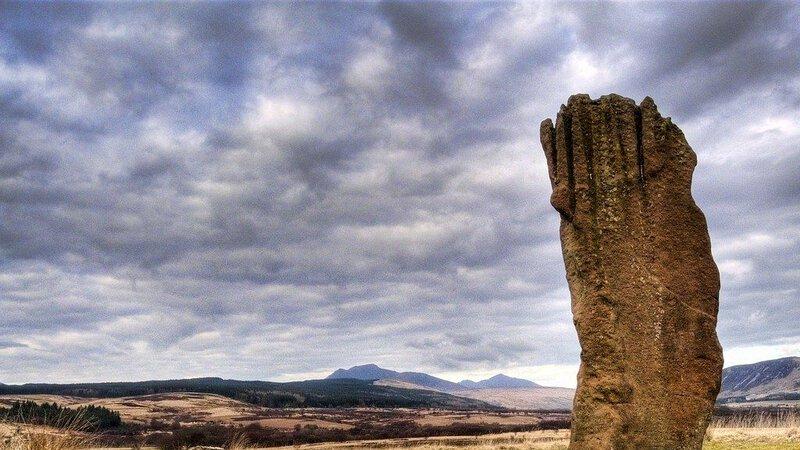
Six stone circles have long been recorded at the site, designated as circles 1, 2, 3, 4, 5, and 11. They vary dramatically in character. Circle 2 is the one that tends to stop visitors in their tracks: three slender red sandstone pillars, the tallest reaching more than five metres, rising from the peat like fingers pointed at the sky. Others are lower and squatter, built from granite boulders that hunker close to the ground, worn and lichen-crusted. Some are nearly complete; others survive only as stumps or partial arcs.
Together, they give the moor a quality that is difficult to name — not quite eerie, not quite serene, but somewhere between the two, as though the place remembers being important. And it clearly was important — repeatedly, deliberately, across generations. Six circles in a single location is not the result of accident or convenience. This was a ceremonial landscape that Bronze Age communities returned to, built upon, and reshaped over long periods. The discovery of a seventh buried feature does not disrupt that story. It deepens it considerably.
Reading the Invisible: How Geophysical Survey Works

For most of human history, finding buried structures meant digging — which also meant disturbing or destroying what you were trying to understand. The geophysical techniques that revealed the hidden Machrie Moor circle represent a fundamentally different approach: reading the landscape’s memory without opening a single spade of earth.
Depending on the method used, geophysical survey instruments measure subtle variations in the soil — differences in magnetic properties left by ancient hearths or decayed organic material, changes in electrical resistance that betray the presence of buried stone or disturbed ground, or reflected pulses from ground-penetrating radar that map what lies beneath the surface in close to real time. The data returns as a map of anomalies: a picture of the invisible world beneath the turf.
Moorland environments like Machrie Moor present both challenges and opportunities for this kind of work. The peat covering much of the plateau has, in some cases, preserved organic material far better than drier soils would — ancient timbers, for instance, can survive in waterlogged conditions for millennia. But the same peat accumulation that preserves can also obscure, building up gradually over centuries until a structure that once stood proud above the ground is swallowed entirely. This is almost certainly what happened to the newly discovered circle: not a dramatic burial or deliberate concealment, but the slow, patient work of time and ecology.
What makes the HES survey significant is both the sophistication of the techniques applied and the interpretive skill required to make sense of what they return. Archaeologists working with geophysical data are not simply reading a photograph of the past. They are interpreting faint signals that could indicate a buried wall, a filled-in ditch, a decayed timber post, or a simple variation in underlying geology. Identifying the arc of a previously unknown circle within that noise requires deep technical expertise combined with a thorough familiarity with how Bronze Age monument-builders worked and how their constructions tend to survive.
The Discovery: A Circle Hiding in Plain Sight

When the survey data from Machrie Moor was processed and the results examined, one anomaly stood out: a circular feature, previously unrecorded, its form unmistakable once the signal was clear. HES archaeologists determined that the buried traces were consistent with a stone or timber circle, constructed during the same broad prehistoric period as the moor’s other known monuments.
There is something quietly extraordinary about this moment. Machrie Moor is not an obscure or neglected site. It is one of the most visited and most studied prehistoric landscapes in Scotland. Generations of archaeologists, surveyors, and researchers have walked its surface and recorded its monuments. Thousands of visitors have made the trek across the bog to stand among its standing stones. And through all of that sustained attention, through every previous survey and every season of fieldwork, the buried circle remained unknown — hiding in the most obvious place imaginable, directly within a site where everyone was already looking.
The explanation for its invisibility lies in the moor itself. Over millennia since the circle was constructed, peat has accumulated across the plateau, potentially burying the structure so thoroughly that no surface trace survives. Whether the stones or timbers were eventually removed, collapsed inward, or simply sank beneath the rising peat, the outcome was the same: a monument that was once presumably as visible and significant as its neighbours became, across the long span of time, completely hidden.
Finding it now, at a site this thoroughly documented, has been described as a reminder that Scotland’s ancient past is not fully mapped, even at its most celebrated locations. It is a useful corrective to any assumption that the archaeological record of a well-studied site is essentially complete.
Stone or Timber? Why the Answer Matters

The question of whether the buried feature is a stone circle or a timber circle is not merely technical — it goes to the heart of what this monument was and where it fits in the sequence of activity at Machrie Moor.
Timber circles are generally considered among the earlier forms of circular monument in British prehistory. Built from wooden posts set into the ground and in some cases elaborately arranged, they were organic and perishable — which is precisely why so few survive in any visible form. In many cases, archaeologists understand timber circles to represent an older phase of ritual activity that was later accompanied or replaced by stone structures: the imperishable expression of the same underlying impulse. If the Machrie Moor buried feature proves to be timber in origin, it could indicate an earlier chapter of monument-building at the site, extending the story of human activity on the moor further back in time and adding a new layer to what is already a complex ceremonial sequence.
If it proves to be stone, a different set of questions arises. Why did this particular circle become buried while its neighbours remained standing? Was it deliberately dismantled — its stones perhaps removed and reused elsewhere — or did it simply succumb more completely to the transforming landscape? Either possibility carries meaningful implications for our understanding of how Bronze Age communities managed and modified their ceremonial spaces over long periods of time.
What both possibilities share is a connection to the broader question of why Machrie Moor accumulated so many monuments in the first place. Leading interpretations of multi-circle sites like this one point to places of sustained, multigenerational significance — locations associated with ancestor veneration, seasonal gathering, or the performance of rituals that bound communities together and marked the passage of time. Each new monument added to such a site was built not in isolation but in conscious relationship to what had come before, layering meaning upon meaning across centuries.
Arran as Scotland’s Prehistoric Crossroads

Zooming out from the moor itself, the discovery also invites reflection on why Arran became such a focus of prehistoric activity. The island sits in the Firth of Clyde, at a natural convergence of the western sea routes that connected communities along the Atlantic coast of Britain and Ireland throughout the Bronze Age and earlier. For people moving by boat — and coastal and island sea travel was far more practical in prehistory than overland movement through dense forest and rough terrain — Arran was a waypoint, a landmark, and perhaps a destination in its own right.
The island’s prehistoric richness extends well beyond Machrie Moor. Chambered cairns, standing stones, and other ancient features are distributed across Arran in a density that speaks to long periods of sustained occupation and ritual activity, suggesting a place of genuine cultural and spiritual weight — somewhere that accumulated importance not by chance but because people, generation after generation, chose to mark it as significant.
The builders of the Machrie Moor circles were farmers and herders living in a world where the relationship between the living and the dead, the visible and the invisible, was managed through collective acts of monument-building. They quarried stone, felled timber, organised communal labour, and returned season after season to a place their community had decided mattered. The buried circle is one more piece of evidence that it mattered more, and for longer, than we previously had reason to know.
What Comes Next — and Why It Matters Beyond Arran
The geophysical survey is, as HES archaeologists have been careful to note, a beginning rather than an end. The data will be subjected to detailed analysis, and decisions about next steps — whether to undertake targeted excavation, conduct further remote sensing, or pursue other investigative approaches — will be guided by the dual need to understand and to protect the buried feature. Any excavation, should it take place, will require the care and precision that a monument of this age and significance demands.
The discovery also raises questions that reach well beyond Machrie Moor. If a major prehistoric monument can lie entirely undetected at one of Scotland’s most scrutinised ancient sites, it compels a broader reckoning with how much remains hidden across the hundreds of other significant locations around the country — sites that are walked over, farmed, managed, and occasionally developed without any knowledge of what lies beneath. Modern geophysical survey technology is not simply an academic tool. It is a heritage management instrument of real and practical consequence, with the capacity to protect things we do not yet know exist.
The newly discovered circle at Machrie Moor has lain in the dark for thousands of years, patient beneath the peat while the world above it changed beyond recognition — from Bronze Age ceremony to medieval farming, from Victorian curiosity to modern archaeological science. The people who built it could not have imagined that one day it would be found not with a shovel but with an invisible pulse of energy sent into the earth, returning a faint echo of something they made with their hands.
The moor still looks the same to the eye. The wind still moves through the heather, and the red sandstone pillars of circle 2 still reach toward an Arran sky. But somewhere underfoot, a Bronze Age circle is finally, quietly, known again — and the work of understanding what it means has only just begun.

 English
 Arabic
 French
 Spanish
 Portuguese
 Deutsch
 Turkish
 Dutch
Dutch
 Italiano
 Romaian
 Portuguese (Brazil)
 Greek
Greek