


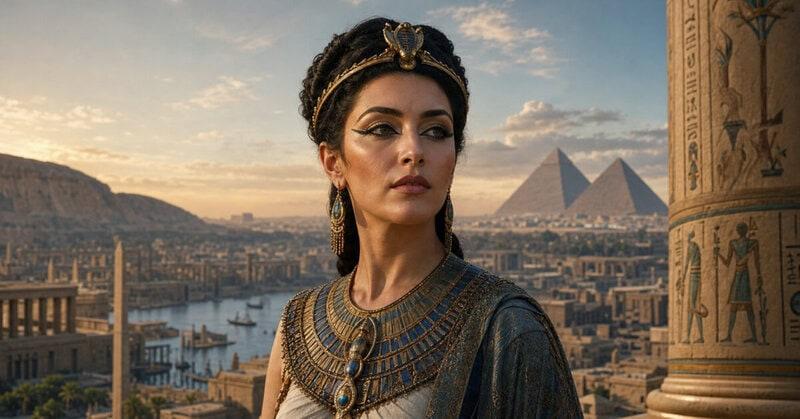
When Cleopatra VII died in 30 B.C., she was closer in time to the Moon landing than she was to the workers who hauled the capstone onto the Great Pyramid of Giza. Pause on that. The civilization she represented — the one she was burying with her own death — had already been ancient when Homer was composing his epics, already venerable when Rome was a cluster of mud huts on a river bend in central Italy.
A Civilization So Long It Defies Imagination

Most of us absorb history in manageable chunks: the Roman Empire, the medieval period, the Renaissance, the modern age. Ancient Egypt refuses that kind of tidy compression. From the unification of the Nile kingdoms around 3100 B.C. to the Roman absorption in 30 B.C. is roughly 3,000 years of recognizable, continuous civilization — longer than Christianity has existed, longer than the gap between Julius Caesar and a modern smartphone. The question of how long ancient Egypt lasted is not purely a historical question. It is almost a philosophical one. How does anything built by human hands endure for three millennia?
The short answer is that Egypt did not simply endure. It collapsed repeatedly, sometimes catastrophically, and rebuilt itself each time with enough institutional memory intact that historians can trace a single coherent cultural thread from the first pharaoh to the last. The rise and fall of ancient Egypt, properly understood, is not one arc but a dozen — a civilization that learned, almost structurally, how to survive its own destruction. To understand why that matters, you have to start at the very beginning, in the mud and flood of the Nile.
The First Spark: Unification and the Birth of a Civilization (c. 3100 B.C.)

Picture the Egyptian landscape before the pharaohs: a single green ribbon of cultivable land cutting through absolute, merciless desert — a few miles of fertility on either bank, and then nothing for hundreds of miles in every direction. That ribbon was the Nile, and it made everything possible. Every summer, reliably, the river flooded its banks, deposited a fresh layer of nutrient-rich black silt, and retreated, leaving behind some of the most productive soil on earth. Surplus grain followed. Surplus grain meant population growth, specialization of labor, and the slow machinery of organized society.
Around 3100 B.C. — and dates at this depth of time carry an uncertainty of a century or more — a ruler known as Narmer unified the competing kingdoms of Upper and Lower Egypt into a single state. The Narmer Palette, a carved ceremonial schist tablet now held in Cairo’s Egyptian Museum, is among the earliest pieces of historical documentation we possess: a king wearing two different crowns, striding across two different kingdoms, claiming both. Within a few generations of that unification, the structural markers of civilization were in place — hieroglyphic writing, centralized government, monumental architecture, and a priestly class managing cosmology and the relationship between the living and the dead. Egypt had not merely formed a state. It had invented an entire worldview.
The timeline of ancient Egypt that follows that founding moment stretches so far it can feel abstract. It helps to think of it this way: the Old Kingdom that emerges in the centuries after Narmer is only the ground floor of a 3,000-year staircase. And what a ground floor it was.
The Pyramid Age and the First Great Collapse (c. 2686-2055 B.C.)

The Old Kingdom is Egypt at its most mythically confident. Pharaohs were not merely kings — they were gods in human form, intermediaries between the cosmic and the earthly, their claimed divine permanence literally inscribed in stone on a scale no human society had attempted before. The Giza plateau, with its three great pyramids oriented to cardinal points with a precision that still impresses modern engineers, was not simply a royal cemetery. It was a theological statement: order over chaos, permanence over decay, the state as something larger than any individual life.
Then it cracked. The First Intermediate Period, beginning around 2181 B.C., saw the central state fragment as regional governors — nomarchs — accumulated enough autonomous power to govern as petty kings. Drought and famine likely accelerated the collapse; ancient administrative texts record food shortages severe enough to strain the social contract between the god-king and his subjects. The god-king’s aura, it turned out, depended in part on the Nile behaving itself.
What happened next is the key to understanding the entire sweep of ancient Egyptian history: the civilization did not die. It reconstituted itself. The Middle Kingdom that emerged around 2055 B.C. was in many ways a more sophisticated Egypt — more self-aware of its own fragility, more attentive to provincial administration, more nuanced in its literature and art. The first collapse was not an ending. It was a rehearsal. Egypt had learned something that most civilizations never get the chance to learn: how to fall apart and still remember who you are.
Empire, Invasion, and the Resilience of the New Kingdom (c. 1550-664 B.C.)

The New Kingdom, beginning around 1550 B.C., represents Egypt at its imperial apex — a period so rich in surviving monuments, texts, and mummies that it tends to dominate popular imagination when people think of ancient Egypt at all. Thutmose III campaigned deep into the Levant across more than a dozen military campaigns and is sometimes called the Napoleon of ancient Egypt, with considerable justification. Ramesses II fought the Hittite Empire to a standstill at the Battle of Kadesh around 1274 B.C. and then commissioned so many self-aggrandizing inscriptions about the encounter that his propaganda machine arguably outlasted his actual military achievement.
Around 1200 B.C., a wave of disruption known as the Bronze Age Collapse swept across the eastern Mediterranean with a ferocity that historians are still debating. The Hittite Empire, Egypt’s great rival, vanished almost entirely. The Mycenaean civilization of Greece collapsed so completely that literacy disappeared from the Aegean for approximately four centuries. Kingdoms across the Levant were destroyed by raiders whom the Egyptians called the Sea Peoples. Egypt bent — there were battles, incursions, and real internal stress — but it did not break. It stands, in the archaeological record, as the only major Bronze Age palatial civilization to survive that catastrophe in recognizable form, reduced in power and territory but coherently itself.
The centuries that follow, through the Third Intermediate Period and the Late Period, see Egypt ruled in succession by Libyan dynasties, Nubian pharaohs — who in some cases revived pyramid-building with extraordinary enthusiasm — and eventually Assyrian overlords. And yet Egyptian culture, religion, and language persisted beneath every occupying power with extraordinary stubbornness. By 664 B.C., when the Assyrian sack of Thebes marks a precisely dated point in the record, the historical documentation sharpens dramatically. From here, we are in anchored history — names, dates, and events we can pin to specific years. For a narrative account of these upheavals, Toby Wilkinson’s sweeping history of ancient Egypt, reviewed in The Guardian, covers this entire arc with both scholarly rigor and genuine storytelling verve.
The Borrowed Centuries: Persia, Alexander, and the Ptolemies (525-30 B.C.)

In 525 B.C., the Persian king Cambyses II conquered Egypt and assumed the pharaonic title — the first of several foreign rulers who would find it politically essential to adopt Egyptian costume while speaking a different language entirely. Alexander the Great arrived in 332 B.C. and was received by many Egyptians as a liberator from Persian rule. He traveled to the oracle of Amun at Siwa, where he was reportedly declared the god’s son — a claim that suited both his ambitions and the Egyptian priestly establishment’s need for a legitimizing narrative. He founded Alexandria on the Mediterranean coast, a city that would become one of the intellectual centers of the ancient world, then departed eastward and never returned.
The dynasty that followed his death — the Ptolemies, Greek Macedonians by origin — proved to be among history’s most successful cultural chameleons. They built temples in the traditional Egyptian style, honored the old gods alongside their own, engaged with hieroglyphic script, and called themselves pharaohs. It was calculation as much as conviction: Egyptian priests controlled enormous resources and popular loyalty, and a foreign ruler who ignored them did so at his peril. The Ptolemies represent, as historians now recognize, a documented phase of Egyptian decline coinciding with Rome’s rise to dominance — each generation of Ptolemaic rulers more dependent on Roman goodwill, more indebted to Roman creditors, more cornered by the relentless gravitational pull of the republic, and then the empire, expanding from the west.
Cleopatra VII — the Cleopatra history remembers — was the last of them, and the last ruler to hold the title of pharaoh with any real sovereign meaning. Ancient sources credit her with speaking multiple languages including Egyptian, making her a notably engaged ruler by Ptolemaic standards. She aligned herself first with Julius Caesar and then with Mark Antony in calculated attempts to use Roman power to preserve Egyptian independence. When Antony’s forces were defeated by Octavian at the Battle of Actium in 31 B.C. and Octavian marched on Alexandria, she had no remaining moves. She died in 30 B.C., and with her the 3,000-year thread snapped. Egypt became a Roman province — a breadbasket, not a sovereign civilization. The pharaohs were finished.
The Long Twilight: Roman Province to Arab Conquest (30 B.C.-A.D. 642)

Even as a Roman province, something of Egypt refused to simply disappear. Alexandria remained one of the greatest cities on earth — its scholarly institutions, its philosophical schools, its position as the hinge of Mediterranean trade all persisting long after the last pharaoh was dead. The city became a crucible of early Christianity; Egypt produced some of the faith’s most influential theologians and became the cradle of Christian monasticism, with the Desert Fathers withdrawing into the same vast desert that once framed the pharaohs’ eternal monuments. The ancient Egyptian landscape was being reinscribed with new meaning, but it was still inhabited, still layered, still accumulating history.
In A.D. 642, the Arab conquest of Egypt brought an end to the region’s millennium-long Greco-Roman period, opening a new chapter that persists to the present day. If you count from Narmer’s unification to the Arab conquest, you are looking at roughly 3,700 years of continuous inhabitation under recognizable cultural succession. There is no modern analogy for that number. It simply sits there, too large to fully absorb.
Why It Lasted: The Secret Architecture of Three Thousand Years
The Nile’s annual flood was not just an agricultural event — it was ideology made physical. A civilization built on guaranteed, cyclical renewal develops a psychological and cosmological template that other cultures lack: the understanding that collapse is not the end of the story, that the waters recede and the black earth returns, that what was lost can be reconstituted. Egypt collapsed and rebuilt itself so many times in part because its entire cosmological framework was organized around exactly that cycle of destruction and restoration.
Geography reinforced this resilience enormously. Desert to the east and west, sea to the north, Nile cataracts to the south — Egypt’s natural boundaries meant that while invasion was always possible, total cultural erasure was extraordinarily difficult. Conquerors arrived and repeatedly found themselves absorbed. They needed the priests, the scribes, the administrative apparatus that only Egypt’s indigenous institutional class could provide. So they adopted Egyptian dress, Egyptian gods, and Egyptian legitimacy. The invaders became Egyptians, generation by generation.
That priestly and scribal class forms the final piece of the puzzle. They maintained what modern historians would call institutional memory across regime change after regime change — preserving the language, the ritual forms, the administrative techniques that allowed the state to function regardless of who sat on the throne. When a new dynasty arrived, the priests were already there, the temples were already standing, the records were already kept. The machinery of civilization did not depend on any single ruler’s survival.
This is the real lesson of the rise and fall of ancient Egypt, and why it repays serious study rather than mere cataloguing. It is not a story about a civilization that succeeded and then failed. It is a story about a civilization that failed repeatedly and chose, each time, to remember itself clearly enough to begin again. Toby Wilkinson’s comprehensive study of ancient Egypt’s full span captures this rhythm better than almost any other modern account — the collapses, the renewals, the long accumulation of a culture that somehow outlasted everything around it. For any reader who wants the full sweep of Egyptian civilization laid out with both scholarly rigor and human warmth, it remains an essential starting point.
Three thousand years. No rival civilization came close to that duration. Babylon rose and was swallowed by the desert. Greece blazed brilliantly and fragmented. Rome built the ancient world’s greatest empire and watched it slowly dissolve. Egypt was already old when all of them began, and the sand still conceals more of its story than any of us will live long enough to uncover.

 English
 Arabic
 French
 Spanish
 Portuguese
 Turkish
 Dutch
Dutch
 Italiano
 Russian
 Romaian
 Portuguese (Brazil)
 Greek
Greek