


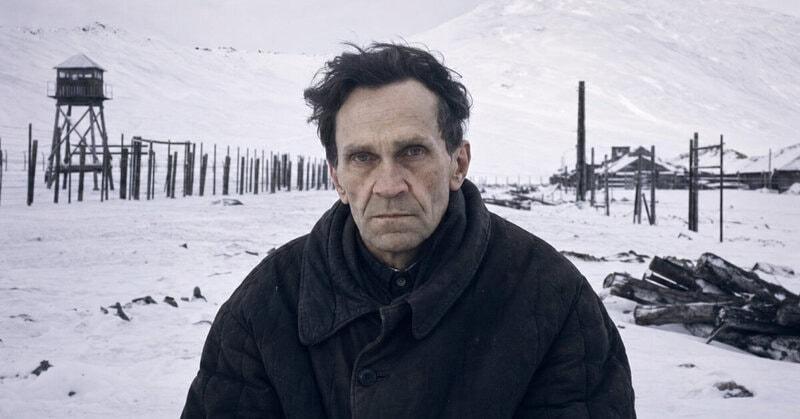
He came back from the ice looking like something the cold had already finished with — frostbitten, hollowed out, his body carrying seventeen years of Arctic punishment that no official record was supposed to acknowledge. Varlam Shalamov had survived the Kolyma camps, one of the most lethal corners of the Soviet forced-labor system, and the world he returned to had almost no idea any of it had happened. As he later observed, a human being survives by his ability to forget — a bitter principle the Soviet state had built an entire empire of silence upon.
An Empire Hidden in Plain Sight

While Shalamov was being worked to near-death in temperatures that dropped to minus sixty degrees Celsius, Western newspapers were running photographs of Soviet tractor factories and grinning workers. Industrialization was the story. Progress was the story. A continent-sized archipelago of suffering, scattered across eleven time zones from the Ukrainian steppe to the Siberian permafrost to the Arctic Circle, was not the story — because almost no one on the outside had the language, the framework, or the verified testimony to tell it.
That invisibility was not an accident. It was, in many ways, the system’s most sophisticated feature. Understanding how it worked — and how it was finally exposed — requires starting with a single bureaucratic word that concealed more human misery than almost any other term in the twentieth century.
What the Word “Gulag” Actually Means

Gulag is an acronym, and acronyms are useful things when you are trying to make atrocity sound like paperwork. The word derives from Glavnoe Upravlenie Lagerei — translated as “Main Camp Administration,” or more fully as “Chief Administration of Corrective Labor Camps.” Read that phrase again slowly. Corrective. Labor. Camps. The Soviet state’s gift to the language of horror was making it sound like a filing department.
Crucially, the word originally referred not to the camps themselves but to the secret-police division that administered them. It was an organizational label, a bureaucratic unit — which reveals everything about how the system was engineered to feel: routine, administrative, invisible. Prisoners were not imprisoned; they were “corrected.” Their sentences were not punishment but “education.” The camps were officially “labor colonies,” a phrase that conjured images of industry and rehabilitation rather than starvation and mass graves.
This vocabulary was not incidental. It was load-bearing architecture. If you cannot name a thing, you cannot easily think about it, protest it, or mourn it. The word “gulag” entered global consciousness only when the Russian writer Aleksandr Solzhenitsyn weaponized it as the title of his monumental work — before that publication reached the world, most people outside the Soviet Union had no single word, and therefore almost no mental image, for what was happening behind that language of correction and labor.
How the System Was Born: Lenin’s Blueprint, Stalin’s Factory

One of the most important and least comfortable facts about the Gulag system is that Stalin did not invent it. The creation of concentration and corrective labor camps began in 1919, under Lenin, establishing a foundational logic that would outlast its creator by decades: the Soviet state could warehouse entire categories of people deemed untrustworthy, counterrevolutionary, or simply inconvenient.
Those early camps held political opponents, priests, former tsarist officers, and so-called “speculators.” From the very beginning, the system conflated punishment with economic extraction — prisoners were not merely caged, they were put to work. The camp was simultaneously a disposal mechanism and a production unit. That dual function would define everything that followed.
What Stalin did, from 1929 onward as he consolidated absolute power, was industrialize the apparatus. He transformed a brutal but relatively modest system into one of the largest forced-labor operations in human history. The geographic scale defies easy comprehension: camps in the Arctic mining gold and uranium, camps in Siberia logging timber in temperatures that killed exposed skin within minutes, camps on the steppe building canals and railways, camps in Central Asia extracting coal. A hidden country inside a country, its borders made of barbed wire and silence.
The Years the Camps Swallowed the Country: 1929-1953

From 1929 through Stalin’s death in 1953, the Gulag became a structural pillar of the Soviet economy. Estimates based on Soviet archives opened after 1991 suggest that approximately 18 million people passed through the camps during this era, with millions more subjected to forced exile, deportation, or transit detention. These are numbers that resist visualization — each one was a person with a name, a family, a life interrupted by an arrest that often came without warning and was supported by evidence that was often nonexistent.
The Great Terror of 1937 and 1938 sent arrest quotas down to regional NKVD offices the way production targets descended to factory floors. Officers competed to fill them. Entire professions were consumed — military officers, engineers, academics, writers. Entire ethnicities were deported en masse: Chechens, Crimean Tatars, Volga Germans, Koreans. The system did not discriminate in any meaningful sense; it devoured indiscriminately, which was in part the point. A population that understood arrests to be arbitrary was a population in a permanent state of disciplined terror. The millions outside the wire were controlled by the system just as surely as those inside it.
Conditions inside were calibrated to extract maximum labor before a body gave out. Rations were tied to work quotas — the less you could physically produce, the less you were fed, which ensured you would produce even less the next day. In Kolyma, temperatures fell to minus sixty degrees Celsius. Shifts in gold mines and logging operations ran twelve to sixteen hours. Death rates spiked catastrophically in the early 1940s when food supplies collapsed under the pressure of the German invasion; some camps lost a third of their population to starvation in a single winter.
Life and Death Inside the Wire

Shalamov spent seventeen years inside this system, most of them at Kolyma, and what he documented in his Kolyma Tales — written over years after his release — was not the kind of testimony that offers redemption or uplift. He described how extreme hunger stripped prisoners of solidarity, turning survival into a solitary, animal project. He wrote about how camp doctors held the power of life and death by assigning lighter work duties to those they chose to save. He documented the brutal internal hierarchy that separated criminal prisoners from political ones, with the former often empowered by guards to terrorize the latter.
Survival, for those who managed it, frequently depended on what prisoners called blat — a web of connections, small thefts, and informal trades — because the official ration system was, by design, insufficient to sustain life for anyone who relied on it alone. The camp economy ran in parallel with the official one, invisible to the administration but essential to anyone trying to last another week.
The Gulag was not one thing. It was an ecosystem of different degrees of hell. Women entered it. Children of arrested “enemies of the people” entered it. Entire deported nationalities entered it. Some survived relatively intact; many did not survive at all. The oral histories and records preserved by researchers make clear that no single narrative captures its range — which is itself a reflection of how vast and varied the system truly was.
Three Voices That Refused Silence

Shalamov was not alone in bearing witness, though the witnesses shared almost nothing except the fact of what they had seen. Eugenia Ginzburg, arrested in 1937 during the Great Terror and sentenced on fabricated charges of Trotskyist terrorism, spent eighteen years in camps and exile and wrote her account, Journey into the Whirlwind, in secret. Where Shalamov’s prose is stripped to bone, Ginzburg’s burns with outrage and a determination to indict the system by precise, named detail. Alexander Weissberg, an Austrian physicist arrested in Kharkov in 1937, survived interrogation and the camps and brought his testimony westward in Conspiracy of Silence, one of the earliest detailed accounts to reach non-Soviet readers. Together, these three voices — a poet, a journalist, a physicist — illustrate something important: the Gulag consumed without regard for profession, nationality, or ideological loyalty, and it was resisted, in the only way available, by those who chose to remember.
The Book That Broke the Silence
Aleksandr Solzhenitsyn’s The Gulag Archipelago, smuggled to the West and published in Paris in 1973, was a detonation. An 1,800-page monument of testimony, history, and moral fury, it made ignorance almost impossible for any serious reader in the democratic world. The title’s central metaphor was precise and devastating: the camps formed an archipelago — a hidden chain of islands inside the Soviet mainland, each island a world of its own, invisible from the mainland shore. It named the nameless thing.
The Soviet authorities expelled Solzhenitsyn within weeks of publication. That reaction was itself informative. The KGB had already seized the manuscript once; a typist who had helped preserve it was arrested. The fury of the state’s response confirmed what the book claimed: this was real, it was vast, and it was something those in power desperately needed the world to keep not knowing.
The global shockwave reshaped Western political debate. For portions of the left that had maintained faith in the Soviet project — or at least suspended disbelief — the book forced a reckoning that could no longer be deferred. It influenced Cold War policy discussions, accelerated the intellectual delegitimization of Soviet-style communism, and, perhaps most importantly, gave historians and journalists a framework and a name for a system that had been deliberately engineered to remain nameless. The full history of how the Gulag evolved across the decades is extensive, but without Solzhenitsyn’s intervention, much of that history might have remained inaccessible to public understanding for far longer.
The Reckoning That Never Fully Came
The Gulag officially wound down after Stalin’s death in 1953. Mass releases followed in waves; the camp system shrank, though it persisted in smaller form into the 1980s. But the wounds never fully healed in Russian society, largely because the reckoning was never fully permitted to happen. Survivors returned to a country that preferred silence. Rehabilitations were partial, slow, and incomplete. Perpetrators were almost never prosecuted. A structural amnesia settled over the decades, shaping Russian political culture in ways that remain visible today.
For a time, genuine reckoning seemed possible. The organization Memorial, founded in 1989 during the glasnost era, spent more than three decades painstakingly documenting Gulag victims — collecting names, photographs, testimonies, and case files that would otherwise vanish with the last survivors. It built databases, published research, and maintained a physical archive that represented one of the most serious efforts any society has made to confront mass state criminality. Researchers at institutions dedicated to understanding the Gulag’s scope and legacy drew on Memorial’s work as a primary resource.
Russian courts forcibly liquidated Memorial in 2021 and 2022, ruling that it had violated administrative regulations — a charge widely understood as a pretext. The message encoded in that liquidation was not subtle: accurate memory of the Soviet Gulag remains politically dangerous in ways that reveal how unresolved that history truly is. When a state moves to destroy the organization keeping the names of the dead, it is not engaging in archival housekeeping. It is making an argument about the past — and about who is permitted to remember it.
What the Unpaid Debt Looks Like
Shalamov spent the rest of his life writing his Kolyma Tales, insisting with quiet ferocity on a truth that comfortable narratives of suffering-redeemed tend to resist: the camps had not ennobled anyone. They had only damaged people. He refused to offer his readers the consolation of meaning extracted from atrocity, because he had seen too clearly what the atrocity actually was.
That refusal is itself a form of testimony — and a challenge. Most histories of large-scale atrocity eventually arrive at a moment of institutional acknowledgment: trials, memorials, formal apologies, truth commissions. Germany’s reckoning with the Holocaust, however imperfect and contested, produced Nuremberg, the Holocaust Memorial, mandatory school curricula, and legal prohibitions on denial. The Soviet Gulag, which imprisoned and killed on a comparable scale over a longer period, has produced none of these things in the country where it happened. The archives opened briefly; some names were rehabilitated; Memorial did what states would not. Then the window closed.
That gap — between the scale of what occurred and the inadequacy of what followed — is not merely a historical footnote. It shapes how memory, accountability, and political culture interact in Russia today, and it poses a question that extends well beyond Russia’s borders: what does a society owe to a past it has chosen not to fully see? Some historical debts are still being counted. Some are still unpaid.

 Arabic
 French
 Spanish
 Portuguese
 Deutsch
 Turkish
 Dutch
Dutch
 Italiano
 Russian
 Romaian
 Portuguese (Brazil)
 Greek
Greek