


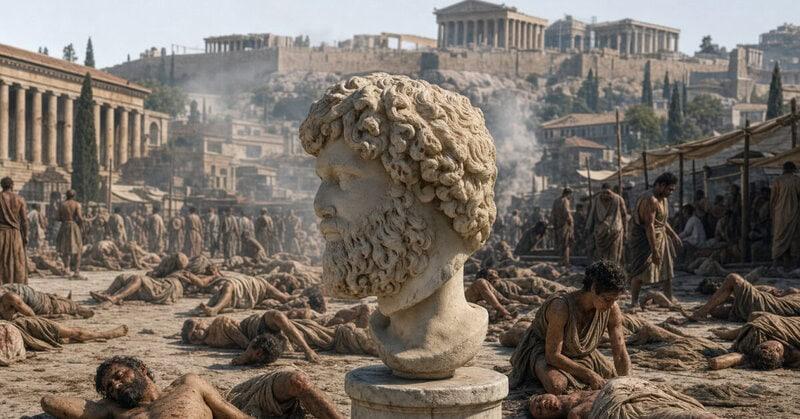
In the summer of 430 BC, the wells of Athens began to fill with bodies. The city had swallowed its own countryside whole — farmers, shepherds, and their families packed behind the Long Walls by order of the statesman Pericles — and now, in that airless crush of humanity, something invisible and merciless had arrived to collect its rent.
A City That Burned From the Inside Out

Athens in 430 BC should have been untouchable. It had turned back the Persian empire at Marathon and Salamis. Its treasury gleamed with silver from the mines at Laurion. The Parthenon, barely a decade old, still smelled of fresh marble. Sophocles was writing tragedies. Socrates was arguing philosophy in the agora. By almost any measure, this was the most intellectually alive city the ancient world had ever produced — a democracy, however imperfect, that believed in its own astonishing destiny.
And then the plague came through the port of Piraeus, and the golden age began to die in earnest.
The central irony of the Peloponnesian War is this: Sparta’s famous soldiers, the most feared infantry in the Greek world, never managed to break Athens by force of arms alone. The walls held. The navy kept the grain routes open. What destroyed the most brilliant city of antiquity was a combination of microscopic catastrophe and strategic self-destruction — a 27-year drama in which Athens diseased itself, exhausted itself, and ultimately talked itself into ruin while Sparta stood at the gates and waited.
Two Leagues, One Greek World, Zero Room for Both

To understand the conflict between Athens and Sparta, you have to understand that by 431 BC these were not simply two rival cities. They were two entirely different ideas about how human beings ought to organize themselves. Athens was democratic, maritime, and cosmopolitan — a city that made money from trade and empire, welcomed thinkers from across the Mediterranean, and derived its military power from the thousands of poor citizens who rowed its warships. Sparta was oligarchic, land-locked, and rigidly militaristic — a society built around a warrior caste sustained by an enslaved population called helots, deeply suspicious of innovation and change.
Nearly every Greek city-state was forced to pick a side. Athens led the Delian League, a defensive alliance formed after the Persian Wars that had quietly transformed into an Athenian tribute empire. Sparta led the Peloponnesian League. Both alliances presented themselves as protectors of Greek freedom. Both were, in their own ways, empires in all but name.
Scholars distinguish an earlier phase of conflict running roughly from 460 to 446 BC from the catastrophic second and definitive war stretching from 431 to 404 BC. The earlier conflict ended in an uneasy truce called the Thirty Years’ Peace, which lasted approximately fifteen years before the pressures became unbearable. Corinth, alarmed by Athenian interference in its disputes with Corcyra and Potidaea, pushed Sparta toward confrontation. Sparta, watching Athens’ empire grow richer and bolder by the year, concluded that the threat could no longer be endured.
In 431 BC, Spartan armies crossed into Attica and began burning farms. The strategy was deliberate provocation: come out, fight us on land where we are strongest, and die. Pericles, Athens’ dominant statesman, refused. He had a different plan — one that was strategically elegant and, as events would prove, quietly catastrophic in ways he could not have foreseen.
Pericles’ Gamble and the Strategy That Invited Catastrophe

Pericles’ defensive concept was brutally simple. Pull every Attic farmer and villager inside the Long Walls connecting Athens to its port at Piraeus. Let Sparta burn the fields and olive groves — irritating, economically painful, but survivable for a city with a navy that could import grain from the Black Sea. Use that same navy to raid Spartan coastlines and the territories of Sparta’s allies. Win not by fighting Sparta’s strongest hand but by refusing to play Sparta’s game at all. Victory through endurance rather than pitched battle.
The flaw hiding inside this logic was demographic. Athens’ population, already substantial, roughly doubled inside the walls almost overnight. Sanitation collapsed under the weight of so many bodies in so little space. People slept on temple steps and in towers along the walls. Shared wells became contaminated and desperately overused. The city had effectively become a sealed environment for contagion, and the seal was Pericles’ own strategic reasoning — the very walls that Themistocles had built after the Persian Wars to guarantee Athenian security had become the mechanism of its biological destruction.
Pericles had guided Athens through three extraordinary decades. He was not merely a politician but an institutional force — the man who directed the construction of the Parthenon, cultivated the city’s intellectual culture, and held together fractious democratic factions through authority and persuasion. When the plague arrived, it did not just kill citizens indiscriminately. It began stalking the one man Athens could least afford to lose.
The Plague of Athens: When the Real Enemy Arrived
Thucydides, the Athenian general and historian who would write the definitive account of the war, survived the plague himself. His clinical description of its symptoms remains one of the most harrowing passages in ancient literature. Victims suffered burning eyes and a bloody, ulcerated throat. The disease moved into the chest, causing violent coughing. Then came vomiting, convulsions, and a fever so intense that sufferers tore off their clothing and threw themselves into cisterns and fountains, desperate for any relief. Those who managed to survive often lost their fingers, toes, or eyesight. The disease respected no social hierarchy and honored no piety — the devout and the irreverent died with equal indifference.
The plague struck Athens in multiple waves between 430 and 426 BC. Estimates of its death toll suggest it killed somewhere between a quarter and a third of the city’s entire population — a figure that staggers even in the abstract. In practical terms, this meant thousands of trained soldiers, experienced naval rowers, skilled craftsmen, and the accumulated civic memory of a generation, all gone within a few devastating years. Sparta had spent years trying to inflict damage of this magnitude on the field and had failed utterly. A pathogen accomplished it in a single outbreak.
Modern scholars have debated the plague’s identity extensively. Proposed candidates have included typhus, typhoid fever, smallpox, measles, and Ebola-like hemorrhagic fever, among others. A analysis of dental pulp recovered from a mass burial pit near the Kerameikos cemetery in Athens found DNA evidence consistent with typhoid fever, though this finding has not achieved universal acceptance in the academic literature. The honest answer is that the disease remains unidentified with certainty — a reminder that Thucydides’ clinical precision, remarkable as it is, cannot substitute for the laboratory evidence we do not have.
The death of Pericles in 429 BC — almost certainly from the plague’s lingering effects — was the symbolic turning point that made all subsequent catastrophes more likely. Athens was left without its indispensable man. The democratic factions Pericles had managed with such careful authority now splintered. Demagogues rose to fill the vacuum, men who told the assembly what it wanted to hear rather than what it needed to know. The city that had been steered by a visionary now lurched between competing voices, each louder and less reliable than the last. Pericles’ death did not just end one politician’s career; it amputated Athens’ institutional judgment at the worst possible moment in its history.
The Long Bleed: Twenty-Seven Years of Strategic Self-Destruction

Athens stumbled forward. The war’s timeline reveals a brief respite — the Peace of Nicias in 421 BC offered both sides a genuine chance to stop the bleeding. The treaty was meant to last fifty years. It collapsed within six. Athens had allowed a man named Alcibiades into its councils, and Alcibiades was constitutionally incapable of restraint. Brilliant, charismatic, and personally corrupt, he convinced the Athenian assembly that the path to final victory lay not in Greece at all but in Sicily — in conquering Syracuse, the great western Greek city-state, and using its resources to overwhelm Sparta once and for all.
The Sicilian Expedition of 415 BC was the largest military force Athens had ever assembled, and it sailed into catastrophe with its flags flying. Alcibiades, one of the expedition’s three commanding generals, was recalled almost immediately on charges of religious sacrilege — specifically the mutilation of the herms, stone boundary markers bearing the head of the god Hermes, on the eve of the fleet’s departure. Rather than return to face trial and almost certain execution, he defected to Sparta and began advising Athens’ enemies. The expedition continued without him under generals who proved unequal to the task. By 413 BC, virtually the entire force — ships, soldiers, sailors, and remaining commanders — had been destroyed or captured in the harbor of Syracuse and in the disastrous retreat that followed. Some Athenian prisoners reportedly improved their treatment by reciting passages from Euripides for their Sicilian captors. The treasury was devastated. The fleet that had made Athens a Mediterranean power was shattered. No city could absorb a wound of that scale and simply recover.
Sparta, crucially, adapted. Persian gold — provided by the satraps Tissaphernes and Pharnabazus, who had their own reasons for wanting Athens weakened — funded the construction of a Spartan fleet capable of challenging Athenian naval supremacy in the Aegean. The war shifted from the hoplite land battles Sparta had always preferred into a complex, multi-domain contest Athens had not anticipated and could not sustain. The conflict normalized mercenary soldiers, extended sieges, and the deeply uncomfortable alliance between Greek city-states and the Persian empire they had once united to resist. The Peloponnesian War permanently changed how Greeks thought about warfare — and the changes were not ennobling ones.
Athens was not conquered in a final, heroic engagement. What ended the war was the destruction of Athens’ last significant fleet at the Battle of Aegospotami in 405 BC, where the Spartan admiral Lysander caught the Athenian ships beached and largely unguarded on the Hellespont shore. The loss was almost total. What followed was a siege that closed off the grain routes and starved the city into submission. In 404 BC, Athens surrendered unconditionally.
The Fall and What It Actually Destroyed

The image of the ending is almost unbearably vivid: Spartan soldiers tearing down the Long Walls to the music of flutes, the Thirty Tyrants installed under Spartan supervision to govern a humiliated city, the democratic institutions temporarily abolished. The Parthenon still stood on the Acropolis. The plays of Sophocles and Euripides were still performed. But the confidence that had built the Parthenon — the sense of Athenian destiny and surplus and creative ambition — had drained away with the treasury and the generations of dead.
The narrative of Spartan victory deserves immediate complication. Sparta’s dominance lasted barely three decades. The city proved far better at winning wars than at administering the peace that followed. Its heavy-handed treatment of former allies bred resentment across the Greek world, and its chronic demographic weakness — the helot system that freed Spartan warriors from labor had always kept the citizen-soldier class precariously small — left it vulnerable to a single decisive defeat. Thebes, under the military genius of Epaminondas, broke Spartan supremacy at the Battle of Leuctra in 371 BC, killing a disproportionate share of Sparta’s irreplaceable citizen-soldiers in a single afternoon. Sparta never fully recovered.
The Peloponnesian War produced no lasting winner. It produced a Greek world so exhausted, so depleted of its best minds and soldiers and civic trust, that it could offer only disorganized resistance when Philip II of Macedon came south two generations later. Athens, Sparta, Thebes — all the proud city-states — eventually became dependencies of a Macedonian empire, and then provinces of Rome. The war that was supposed to determine which vision of Greek civilization would prevail instead ensured that neither would.
The conflict’s military legacy was a permanent shift toward the kind of warfare that neither side had originally planned to fight: professional armies for hire, naval power as a strategic instrument equal to land forces, and the casual normalization of allying with foreign powers against fellow Greeks. Civic warfare — the bounded, seasonal, heavily ritualized hoplite battles of the earlier classical period — did not survive the Peloponnesian conflict intact. What replaced it was something colder, more professional, and far more destructive in scale.
Why It Still Matters: The Trap Nations Set for Themselves
Thucydides wrote his history explicitly as what he called a possession for all time. He believed — and his text argues on every page — that human nature’s constants of fear, honor, and self-interest would reproduce catastrophes of this kind again and again across generations and civilizations. He was not wrong. The pattern he described — a dominant power, a rising challenger, mutual miscalculation, overextension, internal fracture, and eventual ruin — has recurred with sobering regularity ever since. The political scientist Graham Allison famously termed this dynamic the Thucydides Trap in reference to the historian’s own observation that the growth of Athenian power and the fear it inspired in Sparta made the war effectively inevitable. Whether that label oversimplifies a complex situation is itself a worthwhile debate — but the underlying observation about the structural dangers of power transitions remains as pointed now as it was in the fifth century BC.
The plague functions, in retrospect, as the war’s most revealing episode. Not because disease is merely a metaphor for anything, but because it exposes something that purely military history tends to miss: the most dangerous threats to a powerful society are frequently internal, and the structures built to protect it can become the instruments of its undoing. The walls meant to defend Athens became the mechanism of its biological destruction. The empire that funded the Parthenon attracted precisely the resentments that started the war. The democratic confidence that produced Socrates also produced Alcibiades, and the assembly that was capable of listening to the best argument in the room sent thousands of men to die in Sicily on the strength of the most exciting one.
Athens at its peak was extraordinary — perhaps the most intense concentration of civic energy and intellectual ambition the ancient world ever produced. It did not fall to Spartan spears. It fell to plague, to the political vacuum that plague created, to the reckless ambition that rushed to fill that vacuum, and finally to the slow grinding exhaustion of a war it had helped to provoke and then refused to end on reasonable terms when the opportunity existed. The golden age was not stolen from Athens. It was spent — deliberately, incrementally, and with the full, fractious participation of Athenian democracy itself.
Thucydides recorded that during the plague, Athenians died trying to help each other — that the most devout and the most irreverent perished alike, tended by neighbors who caught the disease in the act of caring. History, at its cruelest, is indifferent to virtue. The pious and the brilliant and the brave all went into the same mass graves outside the walls, while inside the city, the future Athens had been building so magnificently continued, quietly and then catastrophically, to come apart.

 Arabic
 French
 Spanish
 Portuguese
 Deutsch
 Turkish
 Dutch
Dutch
 Italiano
 Russian
 Romaian
 Portuguese (Brazil)
 Greek
Greek