


The winter of 1950 settled over the Korean Peninsula like a sentence with no end — a killing cold that turned rivers to iron and made the ground impossible to bury the dead. It was somewhere in this blasted landscape, during a field mission through the wreckage of a village, that a Turkish sergeant named Süleyman Dilbirliği heard something that stopped him cold: the sound of a small child, crying alone in the rubble, with no one left in the world to answer her.
Turkey Goes to War: Why Turkish Soldiers Were in Korea at All
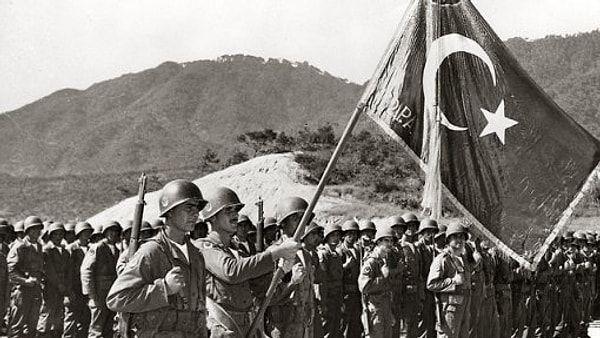
To understand how a young man from Anatolia came to be picking through the ruins of a Korean village, you have to understand the anxious geopolitics of 1950. When North Korean forces crossed the 38th parallel that June and the United Nations called for a coalition response, Turkey — then in the middle of a careful courtship with the Western alliance and eager to cement its place in NATO — was among the first nations to volunteer troops. It was a decision shaped as much by Cold War calculation as by any direct stake in the peninsula’s fate.
The Turkish Brigade that deployed to Korea rotated some 15,000 soldiers through the conflict between 1950 and 1953. They arrived with a fierce reputation that the war would quickly justify. At the Battle of Kunuri in late November 1950, Turkish forces fought a grinding rearguard action — taking devastating casualties — to slow the Chinese advance and allow retreating UN forces to escape encirclement. It was the kind of sacrifice that earns lasting respect among those who served alongside them, even as it fades from the memory of everyone else.
For ordinary conscripts like Süleyman, Korea was a world built entirely from the unfamiliar. The frozen, mountainous peninsula shared nothing with the landscapes of Anatolia — not the terrain, not the language, not the logic of survival in temperatures that could kill a man who stopped moving. And yet the soldiers brought something with them across that vast distance: a culture saturated in hospitality, in the fierce protection of family, in the belief that you do not leave the vulnerable to fend for themselves. That cultural inheritance would soon matter enormously.
The Girl in the Rubble: How Süleyman Named a Daughter
The details of the discovery, as they have come down through survivor accounts and the reporting that eventually inspired the film, are simple and shattering. During a field mission in 1950, Süleyman encountered a five-year-old girl who appeared to be the only survivor in the area — her family consumed by the war that had swept through around her. She was alone in the way that only a child in a destroyed place can be alone: entirely, with no frame of reference for what had happened or what might come next.
Süleyman made a choice. He took her with him.
He gave her a name — Ayla, the Turkish word for the soft halo of light that rings the moon on a clear night. It was a name that transformed a refugee into something more: not a problem to be handed off, not a casualty of paperwork, but a child with an identity and, by implication, someone responsible for her. In that single gesture of naming, a soldier became something closer to a father.
Life in the military camp was not designed for children, and Süleyman improvised everything. Food scraped from mess rations. Warmth built from army blankets layered in ways their designers never intended. Other soldiers, far from their own families, gradually folding themselves into a kind of improvised extended family around the girl. The camps of the Turkish Brigade, for a time, held something that war zones almost never do: a child being genuinely cared for, growing up amid the incongruous tenderness of armed men who had decided, collectively, that she was theirs to protect.
The real woman at the center of this story was named Kim Eunja. Her wartime bond with the Turkish sergeant — those years in the camp, the routines they built together in impossible circumstances — became the emotional core of both the true story and, decades later, the film that would eventually carry her Turkish name to audiences around the world.
The Armistice and the Loss No Enemy Could Have Inflicted
The Korean War’s armistice was signed in July 1953, and with it came the brutal arithmetic of demobilization. Turkish troops had to go home. Military authorities would not permit Süleyman to bring Ayla with him back to Turkey. The rules of the world — the paperwork, the protocols, the logistics of moving thousands of soldiers back across the globe — did not accommodate one sergeant’s love for a Korean child he had raised for years.
The farewell was the story’s most devastating chapter. A man who had survived some of the Korean War’s fiercest fighting now faced a loss that no enemy had managed to inflict on him. He had to hand her over — to an institution, to an uncertain future, to a Korea that was rebuilding itself from near-total destruction — and then board a ship home with nothing but the memory of a child whose name he had chosen.
Süleyman returned to Turkey carrying Ayla with him in the only way that remained available: in memory. By the accounts that have shaped the story’s telling, he spoke of her throughout his life, searching for any thread that might lead back across the decades and the distance. Korea was far. The war was over. The mechanisms for finding one child in a shattered country simply did not exist in any form that could help him.
Kim Eunja, meanwhile, grew up in Korea. She lived her life. She carried her own fragmented wartime memories of a Turkish soldier who had given her warmth and a name and then, through no fault of his own, disappeared. Two people on opposite sides of the world, connected by a few years in a military camp that neither would ever fully leave behind. The full weight of their unlikely bond — and the nearly 60-year silence that followed — is documented in accounts that would eventually reach a global audience.
‘Ayla: The Daughter of War’ — How a True Story Found Its Film

The 2017 Turkish film brought Süleyman’s story to audiences who had never heard of the Turkish Brigade, who knew nothing of Kunuri, and who had perhaps only the haziest sense of the Korean War as a conflict sandwiched between the more cinematically celebrated catastrophes of the twentieth century. Ayla: The Daughter of War dramatized the sergeant’s wartime years with period detail and emotional precision that drew on the real history without embellishing it — because the real history was already, in its essentials, almost too much to believe.
The film’s central performance leaned into the restraint the story demands. There is nothing heroic in the conventional sense about what Süleyman does — he does not win a battle or save a regiment. He saves one child, one day at a time, through the accumulation of small domestic acts: feeding her, holding her, teaching her words in a language she did not know. The film understood that this was the story’s true subject, and it built everything around that understanding.
Ayla was Turkey’s official submission to the Golden Globes, a signal of how seriously the country regarded this particular chapter of shared history with South Korea. The film’s release also reignited public interest in the broader, largely untold story of Turkey’s participation in the Korean War — a conflict that Koreans themselves sometimes call “the Forgotten War,” a name that carries its own particular sorrow for the nations whose soldiers died there.
Audience and critical reception reflected the story’s emotional power, with viewers responding less to the film as a war picture and more to it as a portrait of an improvised family formed in the wreckage of one — a distinction that says something important about what the filmmakers chose to prioritize.
The Reunion, and the Quiet Coda of Kim Eunja’s Life

After nearly 60 years of separation, Süleyman and Kim Eunja were reunited. The footage of that meeting — two elderly people, one Turkish and one Korean, recognizing each other across the enormous distance of time — produced some of the most emotionally charged images to emerge from any effort to reckon with the Korean War’s human legacy. Whatever the decades had done to both of them, whatever lives they had built in the interim, the original bond held. It had simply been waiting, as certain things do, for the world to catch up with it.
Kim Eunja lived to see herself become the subject of international attention — the real woman behind a story that a film had carried to audiences she would never meet, in countries she had never visited, speaking languages as foreign to her as Turkish had once been to a five-year-old girl in a ruined village. Kim Eunja passed away at the age of 80, her death a quiet coda to a story that had already outlasted the war that created it.
She died still carrying the Turkish name a young sergeant had given her in the winter of 1950 — Ayla, the halo of light around the moon.
Why This Story Still Matters: Memory, Legacy, and the Two Nations It Connects

South Korea and Turkey maintain deep and genuinely warm diplomatic ties today, ties rooted in part in the specific history of the Korean War — in the Turkish soldiers who fought and died on Korean soil, and in the Koreans who have never forgotten that sacrifice. The story of Süleyman and Ayla sits at the heart of that connection, making tangible and personal what might otherwise remain abstract in the ledgers of alliance and mutual interest.
For the curious general reader, the film and the true story it carries offer something no textbook on the Korean War can quite provide. Not the statistics of the conflict — the casualty figures, the territorial gains and losses, the diplomatic maneuvering that finally produced an armistice — but the texture of what it meant to be a human being inside that war. One child. One soldier. A few years of improvised family in the middle of organized destruction.
The story endures because it is, at its core, about something that wars cannot manufacture and cannot destroy: the instinct to protect, to name, to claim someone as your own when the world has taken everything else from them. In a conflict remembered primarily for its geopolitical stakes and its staggering human cost, a Turkish sergeant and a Korean orphan remind us where history actually lives — in the smallest and most human moments, in the choices made in the rubble, in the names we give to the people we refuse to leave behind.
The name Ayla — that soft lunar halo, that small persistence of light at the edge of darkness — turns out to be the perfect metaphor for what this story actually is: a luminous thing that survived nearly 60 years of silence and distance, and then, when a film finally gave it a voice, turned out to have been burning quietly the entire time.

 English
 Arabic
 French
 Spanish
 Portuguese
 Deutsch
 Turkish
 Italiano
 Russian
 Romaian
 Portuguese (Brazil)
 Greek
Greek