


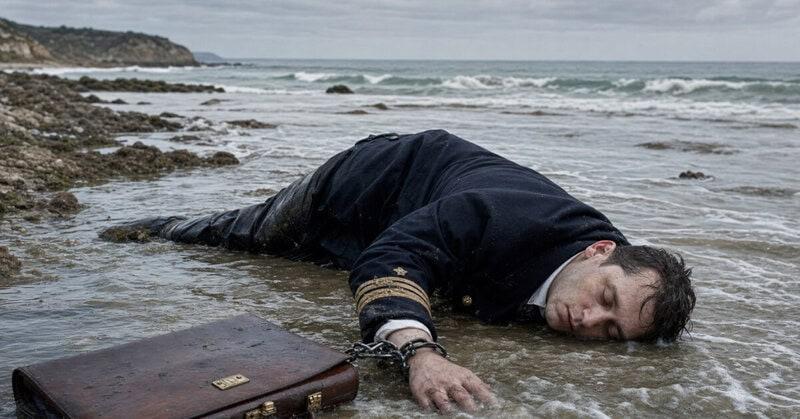
On the morning of April 30, 1943, a Spanish fisherman working the shallow waters near Huelva spotted something strange drifting in the surf: a British officer in uniform, face-down, a briefcase chained to his wrist. Within weeks, Adolf Hitler had reshuffled his entire Mediterranean defense — moving troops away from the one island the Allies actually intended to invade — because of what was inside that briefcase. The officer was a fiction. The corpse was real. And the operation that put them both in the water remains one of the most audacious intelligence gambits in the history of modern warfare.
The Problem: How Do You Invade Sicily Without Looking Like You’re Invading Sicily?

By early 1943, the strategic arithmetic was brutal. Allied commanders had settled on Sicily as the next major target — to be executed under Operation Husky — but the island was the most obvious stepping stone in the Mediterranean, and everyone on both sides of the war knew it. Heavily fortified, positioned at the crossroads of Axis supply lines, and within range of the Luftwaffe, Sicily without the element of surprise would be a killing ground. A frontal assault against a fully prepared German and Italian defense could shatter the Allied momentum so painfully won in North Africa.
The job of solving this problem fell to two British intelligence officers working within the deception apparatus overseen by the London Controlling Section: Lieutenant Commander Ewen Montagu of naval intelligence and Flight Lieutenant Charles Cholmondeley of MI5. Their brief was almost absurdly ambitious — invent a deception so convincing that Hitler himself would pull his forces away from Sicily and station them elsewhere. After considerable deliberation, they settled on a plan so strange it nearly defied serious consideration: dress a corpse as a British officer, fill a briefcase with forged letters suggesting the real Allied targets were Greece and Sardinia, and let neutral Spain’s notoriously porous intelligence channels do the rest.
The idea drew on a core insight about how enemy intelligence works. The Germans expected the British to be clever; they were primed to look for deception. So Montagu and Cholmondeley decided to hide their lie not in elaborate tradecraft but in texture — in the messiness and mundanity of a real human life. If the dead man felt completely real, the documents he carried would feel completely real.
Building the Man Who Never Was

The team needed a body — and not just any body. It had to be one that could plausibly survive a Spanish military examination without revealing signs of having been stored rather than drowned. Their search eventually led them to Glyndwr Michael, a Welsh vagrant who had died in London in January 1943 after ingesting rat poison. He was young enough, his condition obscure enough, and crucially, no one was looking for him. He was, in the most heartbreaking sense, available.
Around Glyndwr Michael, Montagu and Cholmondeley constructed an entire human being from scratch. They named him Captain William Martin of the Royal Marines. They gave him a wallet with cash, a book of stamps, a pencil stub. They invented a fiancée — a woman named Pam — and produced love letters and a photograph to prove she existed. They added a sternly worded note from his landlord demanding overdue rent, a letter from his father, receipts, and theater ticket stubs. Each item was chosen not for drama but for the specific, almost boring authenticity of a life actually being lived.
The crown jewels of the deception were letters between senior British commanders, written in a deliberately casual register — the kind of breezy, between-friends language that senior officers might use precisely because they assume the correspondence will never be read by anyone outside their circle. One letter alluded to operations in Greece; another implied Sardinia was the real target. Sicily was mentioned only as a possible decoy — the sort of detail that, if planted clumsily, would scream fabrication, but nestled inside an apparently private correspondence, screamed truth.
Every element was stress-tested. Were the tides off Huelva reliable enough to carry a body ashore naturally? Was the local Abwehr contact — a known Nazi sympathizer — likely to act as Montagu had predicted? Would a Spanish pathologist, examining a body that had been refrigerated for months, miss the signs of preservation? The answers, after exhaustive preparation, were yes, yes, and almost certainly yes. Almost was going to have to be good enough.
The Drop: A Submarine, a Canister, and a Pre-Dawn Coast

On April 19, 1943, HMS Seraph, a British submarine, slipped out of Holy Loch in Scotland carrying a sealed metal canister packed with dry ice and the body of Glyndwr Michael. Most of the crew had no idea what they were transporting. Only the commanding officer, Lieutenant Norman Jewell, and a small circle of trusted officers were cleared for what came next.
In the pre-dawn darkness of April 30, Seraph surfaced off the Spanish coast near Huelva. Jewell and his officers unsealed the canister, placed the body — now fully dressed as Captain William Martin, briefcase chained to his wrist — into the water, and let the current carry him toward shore. They had calculated the tides with obsessive care. The body needed to arrive as if it had drifted from a plane crash or a sinking vessel, not as if it had been deposited by a submarine sitting suspiciously close to neutral territory.
Hours later, a fisherman named José Antonio Rey María found him in the shallows. Spanish authorities recovered the body and the briefcase. Within a day, German intelligence was involved — and within days, Nazi agents in Madrid were carefully photographing every document, resealing the envelopes with practiced care, and transmitting their contents to Berlin.
Hitler Takes the Bait
The letters were assessed as authentic at the highest levels of German intelligence. Hitler personally ordered reinforcements to Greece and strengthened defenses in Sardinia. Field Marshal Rommel was dispatched to inspect Greek coastal positions. Entire armored formations that might otherwise have been waiting on the beaches of Sicily were repositioned based on the contents of a dead man’s briefcase.
British intelligence, monitoring German signals through the Ultra intercept program, watched the deception take hold in something close to disbelief. Confirmation came in a message that has since become one of the most celebrated signals of the entire war: Mincemeat swallowed rod, line and sinker.
When Allied forces landed in Sicily on July 10, 1943, they faced a defense that had been significantly diluted by Hitler’s misdirected confidence. The campaign was still brutal — war is always brutal — but the resistance was a fraction of what a fully prepared Axis force would have mounted. Military historians have credited Operation Mincemeat with saving thousands of Allied lives and with accelerating the wider Italian campaign, which eventually knocked Italy out of the war entirely.
Why Mincemeat Stands Apart Among the Great WWII Deceptions

British intelligence during the Second World War produced a remarkable constellation of deception operations. The Double Cross System turned captured German agents into Allied assets feeding false intelligence back to Berlin. Operation Fortitude persuaded Hitler that the main D-Day landings would fall at Pas-de-Calais rather than Normandy. But Operation Mincemeat occupies a singular place among these achievements, because its central asset was not a double agent or a radio transmitter — it was a human being who had to be invented from nothing, detail by painstaking detail, with no opportunity for improvisation once the canister was sealed.
What Montagu and Cholmondeley understood, almost instinctively, was what intelligence professionals have since called the whole man problem. A cover identity collapses the moment a single detail fails to cohere. The theater ticket stubs, the landlord’s irritable letter, the photograph of Pam — none of these were strictly necessary to pass the documents. They were necessary to make Captain William Martin feel like a person who existed in the world, whose death was a small tragedy, and whose briefcase contained correspondence rather than props. The Germans, primed to detect British cleverness, were ultimately disarmed by British humanity.
Ewen Montagu published his account of the operation in 1953 under the title The Man Who Never Was, and it became an immediate bestseller — the secret had held for nearly a decade. A film adaptation followed in 1956. Ben Macintyre’s rigorously researched 2010 book Operation Mincemeat brought renewed scholarly and popular attention to the story, recovering details about Glyndwr Michael’s identity that had been deliberately obscured in earlier accounts. A 2022 Netflix film introduced the operation to a new generation of viewers — you can read what critics made of it on Rotten Tomatoes. The story has since reached the stage: Operation Mincemeat: A New Musical has toured to considerable acclaim, testament to the narrative’s seemingly inexhaustible dramatic power.
The Strange Immortality of Glyndwr Michael

Glyndwr Michael was buried in Huelva, Spain, under the name he had been given in death. His grave marker carries one of the most unusual epitaphs in the history of military commemoration: Glyndwr Michael; served as Major William Martin, RM. A nameless vagrant, a man who died alone and was claimed by no one, became — posthumously, fictionally, and permanently — a soldier who helped change the course of the Second World War.
The moral dimension of that fact is not something the operation’s planners took lightly, and it is precisely why Mincemeat endures as a story rather than merely a historical footnote. Montagu and his colleagues treated the dead man with enough imaginative investment to make him completely believable. In doing so, they gave Glyndwr Michael something he never had in life: a full identity, a woman who loved him, a father who wrote to him, a life sufficiently rich in texture to deceive the Third Reich.
The lesson that intelligence services have drawn from Mincemeat in the decades since is not simply that deception works, or that the bodies of the dead can be pressed into service. It is something more fundamental: that the most effective lie is one built from the inside out, furnished with all the irrelevant, undramatic, deeply human clutter of an actual existence. The Germans were not fooled by forged documents. They were fooled by a man — or rather, by the meticulous, respectful, and genuinely brilliant illusion of one.
In the spring of 1943, with the outcome of the war still genuinely uncertain, a handful of British intelligence officers gambled everything on a fisherman finding a body in the right place at the right time. The fisherman found the body. The tide came in exactly as calculated. And the man who never was became, perhaps, the most consequential ghost in the history of modern conflict.

 English
 French
 Spanish
 Portuguese
 Deutsch
 Turkish
 Dutch
Dutch
 Italiano
 Russian
 Romaian
 Portuguese (Brazil)
 Greek
Greek