


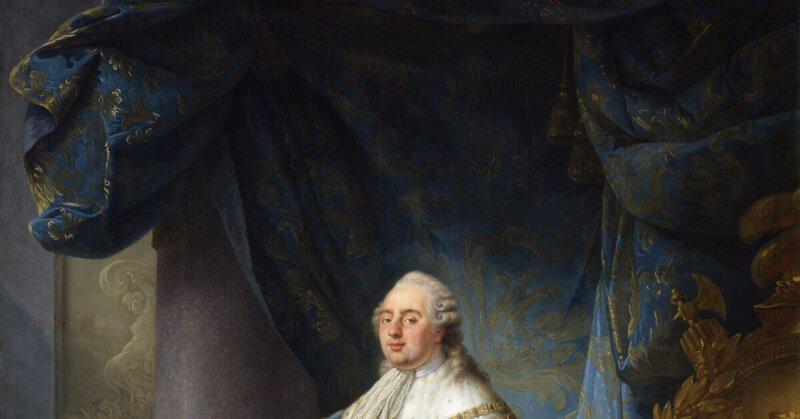
Somewhere inside the Palace of Versailles, while ministers argued about bankruptcy and hungry crowds sharpened their grievances outside the gilded gates, a king was bent over a workbench, filing down a lock mechanism by candlelight — content, absorbed, briefly free. That king was Louis XVI, and the distance between the man at that workbench and the man history required him to be is one of the most poignant gaps in the entire story of European monarchy.
The Wrong Man on the Right Throne at the Worst Possible Moment

Born on August 23, 1754, and dead by guillotine on January 21, 1793, Louis XVI lived just 38 years — years that happened to span the most seismic political eruption in modern European history. The biography that matters most, however, is not the one written in revolutionary decrees and royal proclamations. It is the one written in the quiet hours: in a private forge and workshop he built inside Versailles, where he studied metallurgy, designed functioning lock mechanisms, and worked alongside a master craftsman named Gamin. His hobby was not the eccentric affectation of a bored aristocrat. It was a window into who he actually was — a man who wanted, above all else, to make things work.
The central paradox of his life is almost unbearably sharp. Here was a person of genuine gentleness, mechanical curiosity, and private warmth, placed by the pure accident of birth order at the center of history’s most violent political upheaval. This is not a story about a tyrant. The historical record does not support a tyrant. It is a story about a decent person whose every virtue became a liability, and about what happens when character and circumstance are catastrophically misaligned.
Born Into a Crown He Never Asked For

Louis-Auguste — the boy who would become Louis XVI — was not supposed to be king. Born third in the line of succession, the son of Louis, Dauphin of France, and Maria Josepha of Saxony, he existed in the comfortable shadow of spares, not expected to carry the weight of France on his shoulders.
Then death began rearranging the furniture. His two older brothers died young, and in 1765 — when Louis-Auguste was just eleven years old — he found himself the Dauphin, the heir to the French throne. He had not been groomed for it. He had not been prepared for the elaborate theater of Versailles, the political intrigue, or the crushing symbolic burden of absolute monarchy. Suddenly, all of it was pointed directly at him.
His education fell under the supervision of the Duke of La Vauguyon, who shaped him in theology, history, and languages. The curriculum was rigorous, and Louis applied himself seriously. But witnesses who knew the boy consistently noted where he came most genuinely alive: tinkering with physical objects — maps, clocks, locks — the tangible world of things that could be understood, adjusted, and repaired. Court ritual, by contrast, seemed to drain rather than animate him.
When Louis XV died in May 1774, Louis-Auguste inherited the throne at the age of twenty, stepping into sovereignty over a kingdom already groaning under catastrophic debt. According to accounts that passed through contemporaries close to the royal family, he turned to his new queen, Marie Antoinette, and expressed that God would need to guide them — that they were far too young to reign. It was not false modesty. It was an accurate diagnosis that neither of them, in the years that followed, would quite find the cure for.
The Locksmith King: A Portrait in Contradiction

Understanding the personality behind the reign of Louis XVI requires resisting the temptation to flatten him into either villain or victim. He was, by most credible accounts, shy in court settings — prone to awkward silences, physically uncomfortable with the elaborate performance that Versailles demanded of its monarch. Yet in private he was warm, intellectually curious, and genuinely well-read. He consumed English-language texts, studied geography with real appetite, and hunted with considerable passion.
He also kept detailed diaries, and those diaries have long fascinated historians for a striking reason. On some of the most historically momentous days of his reign — days when France was convulsing with revolution — his entries recorded little more than the morning’s hunt, the weather, or simply nothing at all. Most historians read this pattern consistently: a man retreating into routine because the pressure outside that routine had become genuinely unbearable, not a monarch indifferent to events but one overwhelmed by them.
Louis XVI built a forge and a proper workshop inside the Palace of Versailles, studied locksmithing with genuine seriousness, and designed functioning mechanisms alongside the craftsman Gamin. The hobby, taken alone, reads as charming. Taken alongside his full biography, it reads as something closer to heartbreaking. Locksmithing is the art of control — designing systems that hold, that function, that keep order. Louis XVI devoted his private hours to mastering the craft of making things hold together. He never quite managed to do the same with France.
The ‘Liberating King’ and the American Gamble

One of the most surprising and consequential facts about Louis XVI is that his people once celebrated him as the “Liberating King.” It was not an ironic title. Louis XVI supported the American Revolution both diplomatically and militarily, framing French involvement as a strategic blow against Britain and, at least rhetorically, as an ideological stand for liberty. France under his reign supplied the American colonists with arms, money, and naval power. The Marquis de Lafayette sailed with royal blessing. The Treaty of Paris in 1783, which recognized American independence, bore the clear fingerprints of French royal diplomacy.
The bitter irony is one of history’s most elegant and terrible reversals. The ideals of liberty, popular sovereignty, and the rights of man that Louis helped export to America did not stay in America. They sailed back across the Atlantic, translated into French, and lit the fuse beneath his own throne. The king who helped birth one revolution became the most prominent victim of another.
The financial reckoning compounded the ideological one. France’s debt had been severe when Louis inherited the throne. Backing the American Revolution deepened it catastrophically. The kingdom he received was already structurally cracked; the war he sponsored broke it further. The consequences arrived in bread prices, tax revolts, and eventually in the streets of Paris.
1789: When History Stopped Waiting for Him

The French Revolution did not begin as a demand to abolish the monarchy. It began as a fiscal crisis, a famine, and a collapse of institutional trust — and Louis XVI’s temperament, at that specific moment, was precisely the wrong instrument for the situation. He was conciliatory by nature, genuinely sympathetic to the idea of reform, and incapable of the swift, decisive action the crisis demanded. He opened doors to negotiation and then quietly closed them again. He accepted conflicting advice from competing counselors and satisfied none of them. He was, in the most painful sense, a moderate man in a moment that had ceased to have room for moderation.
For a brief and genuinely strange window, he adapted. He accepted a constitutional monarchy, swore oaths to the new order, and became for a moment something resembling a popular figure in the emerging new France. The Estates-General convened in May 1789; the National Assembly proclaimed itself in June; the storming of the Bastille followed in July. Louis moved with events rather than ahead of them, which is precisely the problem — revolution does not reward those who follow its pace. Then came Varennes, and everything changed.
In June 1791, Louis XVI and his family attempted to flee France, apparently hoping to reach royalist forces and foreign allies who might help restore his authority. They were caught at Varennes, recognized by a local postmaster, and returned to Paris under humiliating circumstances. The flight to Varennes was the hinge on which the French Revolution turned. A king who runs is a king who has been plotting. After Varennes, the possibility of a peaceful constitutional monarchy evaporated. The revolution’s trajectory bent sharply from reform toward radicalism, from constitutional monarchy toward republic, from negotiation toward the scaffold.
From Louis XVI to Louis Capet: The Prisoner of the Temple

After being formally dethroned in September 1792, Louis XVI was stripped of his royal title and held in the Temple prison not as a king but as “Louis Capet” — a deliberately pointed historical insult, invoking the dynastic origins of the Capetian line to reduce him from sovereign to commoner, from symbol to prisoner. The man who had reigned over France from 1774 to 1792 now lived in a tower, attended by guards, stripped of the name he had borne his entire life.
The trial before the National Convention charged him with conspiracy against French liberty and treasonous communication with foreign powers — the gravest possible accusations in a republic newly at war with most of Europe. He was convicted by the Convention in January 1793. On January 21, 1793, Louis XVI was executed by guillotine at the Place de la Révolution in Paris.
Eyewitness accounts of his final moments describe him attempting to address the crowd from the scaffold, asserting his innocence, and offering forgiveness to those responsible for his death. The drums that rolled to drown out his words could not entirely silence them. By most historical readings, it was the most composed and authentically himself that Louis XVI had been in years — the private man, pious and sincere, finally visible without the apparatus of kingship obscuring him. The mechanisms of revolution had closed around him, and the locksmith king could not find the release.
Legacy: Why Louis XVI Still Demands Our Attention
The legal answer to why Louis XVI was executed is treason — conspiracy with foreign powers against the French nation. The deeper historical answer is more complicated and more human. He was a man of real decency and real limitations, ground to pieces between an old order that could not be preserved and a new one that could not yet be controlled. He was neither the callous tyrant of revolutionary propaganda nor the spotless martyr of royalist mythology. He was a human being whose genuine virtues — caution, kindness, a deep reluctance to shed blood, an abiding desire to be liked and to be good — became catastrophic liabilities at a moment that demanded something else entirely.
His historical reputation has shifted substantially across the centuries. To the revolutionaries who executed him, he was a traitor. To nineteenth-century royalists, he was a martyr. To twentieth-century social historians focused on structural forces — debt, famine, class conflict — he was largely beside the point, a footnote to larger economic tides. More recent scholarship has returned attention to the man himself, examining how temperament, decision-making, and the specific texture of individual personality interact with historical forces that seem, in retrospect, overwhelming and impersonal.
The final days of Louis XVI illuminate what the years of his reign obscure: a man who, when stripped of every prop and pretension, faced his end with genuine dignity. That dignity does not redeem his political failures or erase his miscalculations. It simply makes him human in a way that pure political analysis cannot quite capture.
History is often understood as the product of grand forces — economics, ideology, class struggle, the tides of empire. Louis XVI’s story insists that it is also shaped by something far more intimate: the mismatch between a person’s temperament and the demands of their moment. The wrong preparation. The wrong instincts. The wrong century arriving all at once on a young man’s doorstep.
In the candlelit workshop at Versailles, bent over a lock mechanism, working a problem with his hands until the parts aligned and the mechanism finally, satisfyingly yielded — that was Louis XVI at his most himself. The tragedy is not simply that he died on a scaffold at thirty-eight. The tragedy is that he was never, in all his years, truly given the chance to be who he actually was. He remains, across more than two centuries of scrutiny, one of history’s most achingly human figures: a man swallowed by a story that was never really his to tell. You can explore the full timeline of Louis XVI’s reign and its revolutionary context to trace how each turning point reshaped the world he was struggling to hold together.

 English
 Arabic
 Spanish
 Portuguese
 Deutsch
 Turkish
 Dutch
Dutch
 Italiano
 Russian
 Romaian
 Portuguese (Brazil)
 Greek
Greek