


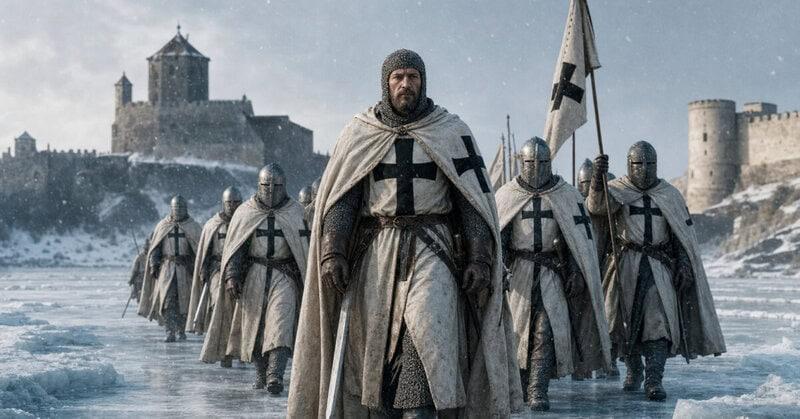
On a frozen morning sometime in the 1230s, a column of armored men picked their way across the ice of the Vistula River, white mantles snapping in the Baltic wind, black crosses stitched across their chests. They were marching into a wilderness that had swallowed every missionary and army Europe had sent before them — and they would not come back until they had built a country.
The Men in White Cloaks Who Built an Empire No One Saw Coming

The full name alone should stop you cold: the Order of the Teutonic Knights of St. Mary’s Hospital in Jerusalem. It is the name of a hospital charity, a holy war, and a sovereign state all tangled into one breathless sentence — and it perfectly captures the strange, overdetermined institution that would reshape northern Europe across three centuries. Most people who know anything about the Crusades think of Jerusalem, Saladin, Richard the Lionheart. Fewer know about the parallel crusade being waged in the pine forests and frozen lakes of the Baltic, where the Teutonic Order was doing something that should have been institutionally impossible: governing a conquered country with an army of celibate monks.
Their trajectory is one of history’s most improbable arcs. From a canvas hospital tent outside the walls of a besieged city, to the throne room of the largest brick castle ever constructed, to a quiet religious house in modern Vienna — the Teutonic Knights lived through more institutional transformations than most nations manage in a millennium. Understanding them means understanding something essential about how religious zeal, military discipline, and colonial ambition can fuse into a force that reshapes landscapes and outlasts the men who made it.
Born in a Siege Camp: Who Were the Teutonic Knights?

The founding moment was one of improvisation under pressure. During the brutal siege of Acre in the late 12th century — the grinding, disease-ridden campaign central to the Third Crusade — German merchants and nobles found themselves in a bind. The established military orders ran hospitals in French and other languages that many Germans did not speak well enough to ask for water, let alone treatment for wounds. So a group of merchants from Bremen and Lübeck stretched a ship’s sail between poles and began caring for German casualties themselves. That improvised shelter became a formal brotherhood, and within a decade it had been militarized and recognized by papal authority as a full knightly order, fusing the Hospitaller model of charitable care with the Templar model of armed combat.
What made the Teutonic Knights distinctly different from their crusading peers was a feature that would define their political future: membership was effectively restricted to men of German noble birth. In the cosmopolitan, polyglot world of the Crusades, this ethnic and social coherence gave the order a political solidity and a natural constituency back in the German-speaking lands of the Holy Roman Empire. When the Holy Land campaigns began their long, losing slide, the Teutonic Knights had somewhere specific to go — and a population of German settlers ready to follow them there.
The legal foundation for everything that followed was a privilege granted by the papacy: the Teutonic Order was given the right not merely to conquer pagan lands, but to govern them as sovereign lords. This was not a minor administrative distinction. It meant the Knights could build a state, levy taxes, administer justice, and conduct foreign policy in their own name. As Britannica’s account of the Teutonic Order makes clear, this extraordinary grant of sovereign authority was the juridical engine behind everything that followed in the Baltic.
The Crusade Nobody Taught You About: War in the Baltic Forests

While the kings of Europe were fighting — and losing — over Jerusalem, the Teutonic Knights were waging a different kind of war, one that would prove far more durable in its consequences. The Northern Crusades against the pagan peoples of the Baltic are among the least-taught chapters of medieval history in the English-speaking world, yet they were, in their way, just as consequential as anything that happened in the Levant.
The indigenous Old Prussians were not the passive, primitive people that medieval propaganda — and some later historiography — liked to depict. They were organized, militarily capable, and deeply resistant to Christianization. The Teutonic Knights’ campaign in Prussia, which began in earnest in the 1230s, was not a swift conquest but a grinding, decades-long struggle punctuated by catastrophic indigenous uprisings that repeatedly forced the Order back nearly to square one. The Great Prussian Uprising of the 1260s nearly destroyed the Order’s presence in the region entirely. The pattern of conquest, rebellion, and brutal reconquest repeated itself across roughly fifty years before Prussian resistance was finally broken.
The strategic instrument the Knights wielded most effectively was the castle — not as a refuge, but as a weapon. Each fortification placed in freshly conquered territory became a node in a network of control, a permanent garrison from which German settlers could be organized and native resistance monitored and suppressed. The castle system slowly strangled indigenous autonomy by making the land itself inhospitable to rebellion.
The historical irony embedded in this success is as dark as any in medieval history. The people the Knights were commissioned to Christianize were, in the process, largely destroyed as a distinct culture. The Old Prussian language — a Baltic tongue related to Lithuanian and Latvian — died out entirely by the early 18th century, leaving no living descendants. What survived was only the name: Prussia. The most enduring monument to the Old Prussians is the word their conquerors borrowed and made famous.
Nation-Builders in Chainmail: The Monastic State of the Teutonic Order

What the Teutonic Knights built in the Baltic was not merely a conquered territory but a functioning state — the Ordensstaat, or Monastic State — a political entity so strange in its construction that it has few real parallels in European history. At its head was not a king or a duke but a Grand Master, elected by the order’s senior knights and bound, like all of them, by vows of poverty, chastity, and obedience. The entire government apparatus — military commanders, estate managers, diplomats, judges — was staffed by celibate warrior-monks who owned nothing individually and owed everything institutionally.
This sounds like a recipe for dysfunction, but in practice the Ordensstaat was a remarkably effective early administrator. The Knights managed vast agricultural estates with something close to corporate efficiency. They developed amber and grain trade networks that made the Baltic economically significant to all of northern Europe. They built roads, bridges, granaries, and the physical infrastructure of a state that would outlast them by centuries.
The physical embodiment of all this ambition was Marienburg — modern Malbork, in what is now Poland — where the Grand Master’s fortress-palace grew across the 14th century into the largest brick castle ever constructed. Walking through Malbork today, even in its partially restored state, is to feel the full weight of the Order’s self-conception: this was not a military headquarters but a sovereign capital, built to announce that these monks had become something the world had to reckon with.
The administrative and social structures the Knights planted in Prussia did not disappear when the Order itself faded. The land tenure systems, the tradition of a militarized, duty-bound landowner class — the Junker aristocracy — and the culture of disciplined state administration that the Ordensstaat established echoed forward through the Hohenzollern rulers who eventually made Prussia the core of modern Germany. The line from a Grand Master’s chancellery in Marienburg to Frederick the Great’s Prussia is crooked and complicated, but it is traceable.
The Battle That Broke Them — and Why They Survived Anyway

On July 15, 1410, on a field near the villages of Grunwald and Tannenberg — known in German history primarily as Tannenberg — the Teutonic Knights met their reckoning. A combined Polish and Lithuanian army, one of the largest military forces assembled in medieval Europe to that point, faced the Order in open battle. By the end of the afternoon, Grand Master Ulrich von Jungingen was dead, the Order’s military supremacy in the region was shattered, and the long decline had begun.
Yet the ending was not clean, which is part of what makes the story genuinely interesting. The Order staggered on for more than a century after Grunwald, losing territory in grinding installments — through the Thirteen Years’ War, through the Peace of Toruń in 1466, through the steady encroachment of the Polish-Lithuanian Commonwealth. The Knights were weakened by military defeat, political isolation, and the simple arithmetic of an institution that could not reproduce itself biologically and was increasingly failing to inspire the donations and recruits needed to sustain a sovereign state.
The symbolic final blow came not from an enemy’s sword but from within. In 1525, the last Grand Master of the Prussian branch, Albert of Brandenburg-Ansbach, converted to Lutheranism and dissolved the Order’s authority in Prussia, transforming the Monastic State into a secular duchy under Polish suzerainty. It was an act of institutional self-destruction so complete that it would be remarkable even by modern standards. A celibate religious order had effectively voted itself out of existence in one of its core territories.
But not entirely. A rump Teutonic Order continued in the Holy Roman Empire, stripped of political power, reduced to an honorific institution for German nobles, and refusing with remarkable stubbornness to fully disappear. That ghost institution persisted through the Reformation, through the Napoleonic dissolution of the Holy Roman Empire, through two world wars — and it still exists today, headquartered in Vienna, functioning as a small Catholic religious order whose members wear the black cross as chaplains and in charitable work. The hospital has, in a sense, come back.
Legacy: From Geopolitics to Popular Culture
Few medieval institutions have been as enthusiastically misappropriated by later ages as the Teutonic Knights. Nineteenth-century German nationalism embraced them as proto-nationalist heroes, noble civilizers bringing German culture to the east — a romantic reading that erased the violence and colonial displacement at the heart of the enterprise. Nazi ideology took this a step further, deploying the Order’s eastward expansion as historical justification for Lebensraum, a misappropriation so grotesque that it permanently complicated any straightforward reckoning with the Order’s legacy in German public memory.
The Polish and Baltic perspectives offer a corrective that historians increasingly take seriously. In those traditions, the Teutonic Knights are remembered not as civilization-bringers but as colonial conquerors whose methods — forced Christianization, cultural erasure, the physical elimination of indigenous peoples as distinct communities — left wounds in regional identity that are still actively explored in historical scholarship. The destruction of Old Prussian culture is not an unfortunate side effect of the Knights’ story; for many historians, it is the story.
The Order’s popular cultural footprint has grown in ways its founders could never have imagined. The Teutonic Knights appear as a recurring playable faction in strategy games such as Crusader Kings, and discussions of their historical role and visual identity draw engaged audiences on platforms ranging from academic forums to communities like dedicated history enthusiasts online. Millions of players and readers have spent hours thinking about Baltic conquest and monastic governance without always realizing they were engaging with genuine history. That informal transmission matters: it keeps the questions alive, even when the answers remain incomplete. Channels devoted to medieval military history, such as the detailed video chronicle of the Teutonic Knights’ conquest of Prussia, have introduced the Order to audiences far beyond academic history.
Why the Teutonic Knights Still Matter
The Teutonic Order is not, finally, just a medieval curiosity for enthusiasts of armor and siege warfare. It is a case study in how a small, disciplined organization — armed with religious conviction, legal sovereignty, and military competence — can transform a landscape so thoroughly that the transformation long outlasts the transformers. The administrative culture of Prussia, the geography of modern Poland, the very name of a country that no longer exists: these are the Knights’ most enduring monuments, hiding in plain sight in the political map of Europe.
Their story raises questions that have not become less urgent with age. How do religious mission and colonial violence relate to each other when they are institutionally fused from the start? What survives when a state dissolves — and what should survive? How do small, coherent organizations punch so far above their apparent weight? The Teutonic Knights offer a remarkably concentrated test case for all of these questions, compressed into three centuries of Baltic history.
Consider the facts that still have the power to surprise: the Order still exists. The castle at Malbork still stands, the largest brick structure on earth, drawing visitors who often arrive knowing nothing of the warrior-monks who built it. The name Prussia — the name of the culture the Knights destroyed — became the name of one of modern Europe’s most consequential states. And the white cloak with the black cross remains one of the most recognizable symbols in medieval iconography, instantly identifiable to anyone who has spent time with history, historical fiction, or strategy games.
Most people who could sketch that symbol from memory could not say what it stood for, where it came from, or what it cost. That gap between the symbol and its story is precisely why the Teutonic Knights are worth knowing — and why the frozen crossing of the Vistula, on a morning eight centuries ago, is a journey that has not yet fully arrived at its destination.

 English
 Arabic
 Spanish
 Portuguese
 Deutsch
 Turkish
 Dutch
Dutch
 Italiano
 Russian
 Romaian
 Portuguese (Brazil)
 Greek
Greek