


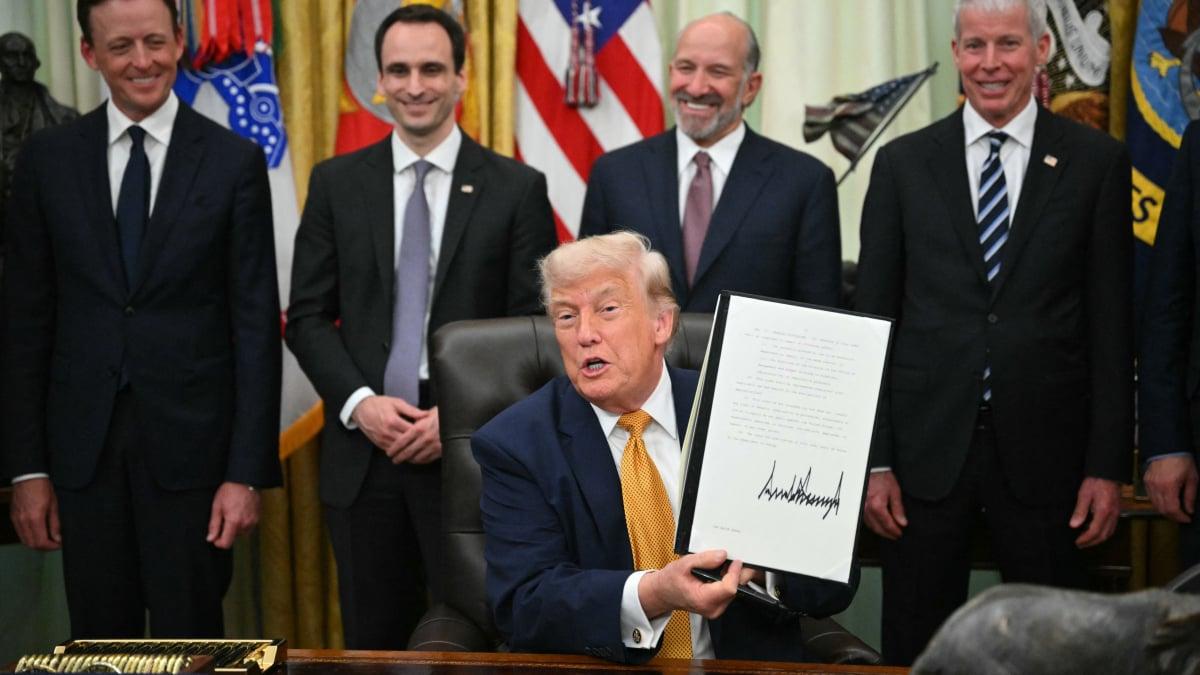
It's been a week since President Trump signed an executive order directing a whole-of-government push on quantum computing — funding it, securing its supply chains, building its workforce, and making sure adversaries like China don't get there first.
This marks a significant federal commitment to a technology that is either the next great computing revolution, or the most expensive science experiment in history, depending on the expert opinion. But one thing it can do: replace AI as the carrier of long-term hopes for the tech industry.
This would be the right moment for a switch, as the vibe shifts on AI itself: models are more expensive to train, returns are harder to demonstrate. Investors who have sent AI stock soaring may soon be looking for the next big thing to believe in.
Quantum computing — with its theoretical promise of solving problems that would take classical computers millennia — is a real and genuinely fascinating technology. It's just a lot more complicated, and further away, than the White House-led hype suggests.
Your laptop processes information in bits. Tiny switches in a computer see data in binary code: either as a 0 or a 1. Quantum computers swap those out for qubits, which can exist as 0, 1, or a combination of both at the same time — a property called superposition.
Which, if we can harness it, would fundamentally supercharge everything a computer can do.
As IBM describes it, think of solving a maze. A classical computer tries every path until it finds the exit. A quantum computer, by using the interference patterns of qubits — the way their probability waves cancel out wrong answers and amplify right ones — can zero in on solutions without brute-forcing every option.
Add entanglement, where qubits become so linked that measuring one instantly tells you about others, and you have a machine that approaches certain problems in a completely different way than anything humanity has built before.
Mashable Light Speed
For one thing, researchers say, a fully functional quantum computer would likely mean the death of Bitcoin.
What can it do?
Still, the most credible near-term applications are in science and industry, not consumer tech. Quantum computers are particularly well-suited to simulating molecular behavior — which could dramatically accelerate drug discovery and materials science — and to crunching complex optimization problems in finance and logistics.
According to IBM, the field is projected to grow into a $1.3 trillion industry by 2035, with major players like Google and Microsoft, as well as startups like IonQ, already investing heavily.
An MIT report from 2025 found that quantum computing patents have grown fivefold over the last decade, venture capital hit a new high of $1.6 billion in 2024, and demand for quantum skills has nearly tripled since 2018.
Business executives, the report noted, are increasingly "quantum curious" — in part because watching AI explode taught them not to sleep on the next big thing.
Why is there a 'but'?
The gap between what quantum computers can theoretically do, and what they can actually do right now, remains enormous.
According to IBM, current quantum processors are fragile, error-prone, and require cooling to temperatures colder than outer space to function. A researcher on r/Physics who works in quantum information put it plainly: the commercial use cases are "speculative at best," and the classical computing baseline is "shifting so fast it's impossible to get a read on the gap."
Engineering bottlenecks, such as error correction, qubit stability, and scaling, also remain major unsolved problems. IBM says it's targeting 200 logical qubits by 2029 and 2,000 by 2033. These are timelines that make quantum computing a decades-long project, not an imminent revolution.
Why is the Trump administration suddenly all in?
Last week, President Trump signed Executive Order 14413, directing a sweeping whole-of-government push to accelerate quantum computing research, secure domestic supply chains, expand the quantum workforce, and prevent adversaries — China specifically holds 60 percent of global quantum patents, per MIT's report — from gaining a strategic edge.
The order establishes a new effort to build a quantum computer at a Department of Energy facility and sets aggressive timelines across multiple agencies.
It's a legitimate national security concern, dressed up in the language of a tech boom. Like fusion power, quantum computing is real and will matter — probably a lot — but the current moment looks a lot like the early AI hype cycle. Expect lots of startups with "quantum" in their name to launch as a result.

 English
 Arabic
 Spanish
 Portuguese
 Deutsch
 Turkish
 Dutch
Dutch
 Italiano
 Russian
 Romaian
 Portuguese (Brazil)
 Greek
Greek