


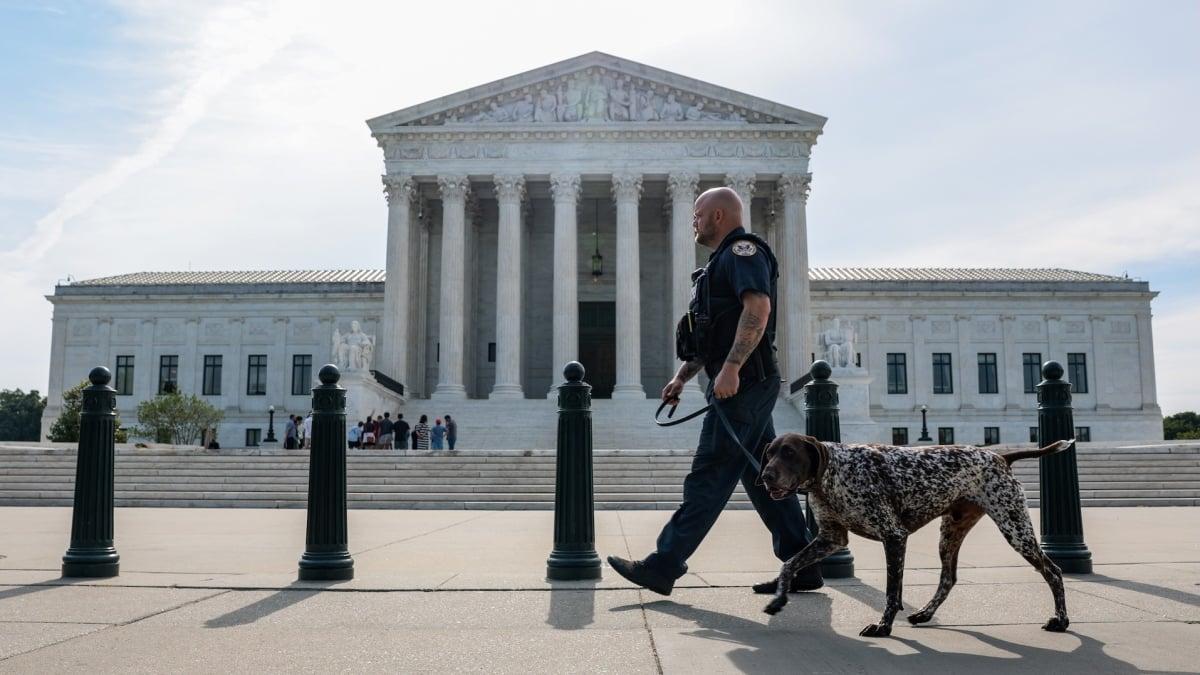
The Supreme Court ruled 6-3 that police must obtain warrants to conduct wide searches of cell phone data at crime scenes, also known as "geofence" searches.
In its ruling on Chatrie v. United States, the justices said that Americans are entitled to privacy with the location data their phones track, even if they consent to sharing it with tech companies like Google and Apple.
The case involved Okello T. Chatrie, a man convicted of robbing a Virginia bank in 2019. Prosecutors obtained a warrant for a geofence search that captured location data near the bank around the time of the robbery and, as a result, identified Chatrie as a suspect. Geofence searches draw a digital fence around a crime scene and pull data from all digital devices within that space.
Even with the warrant, Chatrie's lawyers claimed the government sought an "overly broad set of data that violated the Fourth Amendment," the New York Times reports. The Fourth Amendment protects Americans from unreasonable searches and seizures by the government.
The Justice Department claimed the government did not need a warrant to view anonymous location data, especially since users had already acquiesced to tech companies tracking that data. A majority of the justices disagreed.
Mashable Light Speed
"An individual has a reasonable expectation of privacy in records about his cell phone’s location, and police intrude on that constitutionally protected interest when they demand the information — even though for only a limited time, and from a third-party tech company," Justice Elena Kagan wrote for the majority. Kagan was joined in the decision by Justices Roberts, Sotomayor, Jackson, Kavanaugh, and Gorsuch (the latter agreed with the ruling but not its rationale, according to the Times).
Most smartphone track user location every few minutes, though users can view, edit, and delete that data. Google Maps is one of the most common ways Big Tech tracks movements, with more than 1 billion daily users. Chatrie's lawyers argued to the justices that his location data was private since it was password-protected.
Google has tried to get ahead of the legal complications surrounding data tracking. The company announced three years ago that it would store location data on individual phones rather than on Google servers, allowing it to avoid complying with location requests.
Even though Google found a workaround, the government has requested such location data from other companies, including Apple, Microsoft, Snapchat, and Uber.
While the justices ruled on the broader legality of the government seeking private data, they did not rule on the warrant used in the Chatrie case, instead sending it back to an appeals court.

 English
 Arabic
 French
 Spanish
 Deutsch
 Turkish
 Dutch
Dutch
 Italiano
 Russian
 Romaian
 Portuguese (Brazil)
 Greek
Greek