


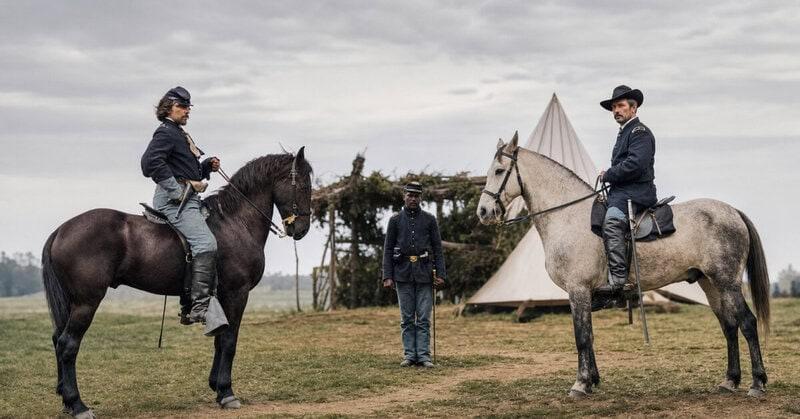
In October 1862, New Yorkers lined up outside Mathew Brady’s gallery on Broadway to stare at something that had never existed before: photographs of the unburied dead at Antietam, bodies bloated and twisted in the September heat, lying exactly where they fell. “The living that hurry by,” wrote a New York Times correspondent, “are given a terrible reality to the war.” That reality — muddy, fly-blown, catastrophically human — is the baseline against which every Civil War film should be measured. Most of them don’t come close.
Why It Matters Which Films You Trust

Tens of millions of Americans have absorbed their entire mental image of the Civil War not from Alexander Gardner’s battlefield photographs or the 128 digitized volumes of the Official Records of the War of the Rebellion, but from darkened movie theaters. Some of what they absorbed is genuine history. Much of it is mythology wearing a uniform.
The question worth asking — the one this guide is built around — is which films historians actually recommend, which ones spread comfortable lies, and how an ordinary viewer can tell the difference. The American Battlefield Trust’s Teacher’s Guide to Civil War Movies offers the most rigorously sourced starting point for that conversation, and its endorsements are not handed out casually.
Films That Actually Earn the Trust

Glory (1989)
Glory opens not with a general’s strategy session but with a charge — chaos, smoke, a young colonel named Robert Gould Shaw face-down in the dirt of Antietam. Edward Zwick’s film earns its place at the top of any historically grounded list because it centers the question that most Civil War cinema spends enormous effort avoiding: what did the war mean for the Black men who fought it?
The depiction of the 54th Massachusetts Infantry, the institutional racism the regiment faced from the Union Army itself, and the assault on Fort Wagner are all substantiated by primary sources. The American Battlefield Trust flags it as a landmark for exactly this reason. Its central argument — that Black soldiers fought not just against the Confederacy but against a white military establishment that doubted, underpaid, and underequipped them — is documented in the regiment’s own letters and in the official records of the Bureau of Colored Troops. Shaw’s death at Fort Wagner, and the Confederate decision to bury him in a mass grave alongside his men as a deliberate insult, is confirmed by multiple contemporary accounts. The film does not flinch from it.
Where Glory simplifies, it does so in ways historians have clearly documented: Private Trip, played by Denzel Washington, is a composite figure rather than a single documented soldier. That compression matters, but it does not undermine the film’s core historical argument.
Lincoln (2012)
Steven Spielberg and screenwriter Tony Kushner worked extensively with Doris Kearns Goodwin’s sourced biography of Lincoln before a frame was shot, and it shows. The procedural accuracy of the Thirteenth Amendment’s passage — the horse-trading, the patronage deals, the floor maneuvering — reflects the historical record with unusual fidelity. Daniel Day-Lewis’s Lincoln, storytelling manner and all, is grounded in contemporary accounts of the man’s rhetorical habits recorded by aides and cabinet members.
The film is not without documented criticism. A scene implying that two Connecticut representatives voted against the Amendment drew a formal protest from the state’s congressional delegation shortly after release — a reminder that even the most conscientious historical films compress and occasionally misplace facts for dramatic effect. But as a portrait of how constitutional change actually gets made — through sweat, compromise, and moral pressure applied in back rooms — Lincoln is among the most accurate Civil War films in its chosen lane. It also refuses the temptation of making abolition feel inevitable. In Kushner’s script, it almost doesn’t happen, which is closer to the truth than most audiences expect.
Gettysburg (1993)
Four hours long and based directly on Michael Shaara’s Pulitzer Prize-winning novel The Killer Angels — itself built on extensive primary research — Ronald F. Maxwell’s Gettysburg is the film historians most reliably assign. Its tactical geography holds up under scrutiny. The unit movements across Seminary Ridge and Little Round Top track against the Official Records. The character portraits of Joshua Chamberlain and James Longstreet are grounded in memoir and correspondence, even where dialogue is dramatized for the screen.
Historians and serious enthusiasts consistently place it at the top of accurate Civil War film discussions, not because it is perfect, but because its imperfections are those of dramatization rather than ideology. The film’s central weakness is one of omission: Gettysburg was fought over three days in a Pennsylvania town whose civilian population endured the battle from their cellars and attics, and that experience is almost entirely absent from Maxwell’s account. Twenty-year-old Mary Virginia Wade, the only civilian killed during the battle, does not appear. What the film shows is accurate. What it excludes shapes how viewers understand the war’s reach.
Andersonville (1994)
This TNT film is almost entirely absent from casual best Civil War movies conversations, which is itself a form of myth-making by omission. Roughly 13,000 Union soldiers died at Camp Sumter near Andersonville, Georgia — from disease, starvation, exposure, and violence among prisoners themselves — making it one of the war’s most thoroughly documented atrocities. Confederate commandant Henry Wirz was tried and executed after the war, the only Civil War figure to be executed for war crimes.
The American Battlefield Trust includes Andersonville in its Teacher’s Guide precisely because it confronts a dimension of the conflict that prestige cinema almost universally ignores: the prisoner-of-war system as a site of deliberate and catastrophic suffering. The film is slow and often brutal in ways that work against its popular rediscovery. Those are also the qualities that make it honest. Uncomfortable films are often the most accurate ones.
Accurate Costumes, Invented Souls: The Complicated Middle

A film can get every button on a Confederate frock coat exactly right and still be doing historical damage. This is the trap that catches several otherwise competent productions.
Gods & Generals (2003)
The prequel to Gettysburg is a case study in the difference between material accuracy and ideological accuracy. The uniforms are correct. The formations are credible. The film runs nearly four hours and reproduces several engagements with genuine tactical detail. And it is a near-hagiography of Stonewall Jackson that soft-pedals what Confederate soldiers said, in their own letters and diaries, about why they were fighting.
Historians have documented extensively that the defense of slavery was explicit in Confederate soldiers’ personal correspondence, in the Confederate Constitution itself, and in the secession declarations of individual states. Mississippi’s declaration of secession, adopted in January 1861, opens by stating plainly that the state’s position is “thoroughly identified with the institution of slavery.” Gods & Generals treats the Lost Cause not as a post-war revisionist mythology — which is what it demonstrably is — but as the war’s lived emotional reality. That is precisely what the Lost Cause always wanted, and handing it a four-hour prestige film was a significant gift.
Cold Mountain (2003)
Cold Mountain captures genuine historical textures that most Civil War films ignore entirely: the desertion crisis that saw an estimated one in seven Confederate soldiers leave the ranks by 1864, the savage Home Guard violence against the families of men who refused to serve, the economic collapse of the Confederate home front as the blockade tightened. Critics have recognized it as one of the period’s more honest Hollywood productions, and on those specific dimensions the recognition is earned.
But its romance plot softens a war that killed between 620,000 and 750,000 people — a compression that is emotionally necessary for mainstream cinema and historically costly for collective memory. The violence against civilians perpetrated by Home Guard units like the one depicted in the film was systematic and documented, but the film frames it primarily as a backdrop to Ada and Inman’s reunion. The war’s full weight never quite lands.
Free State of Jones (2016)
Free State of Jones dramatizes the real Newton Knight and the documented Jones County uprising — a genuine insurrection against the Confederacy from within Mississippi by poor white Southerners and escaped enslaved people acting in documented alliance. Historian Victoria Bynum, whose scholarship on Knight and Jones County forms the film’s historical foundation, has noted publicly that the broad strokes are reliable even where individual scenes are telescoped or composite characters are introduced.
The pattern both films illustrate is consistent across even the most scrupulous productions: multiple figures are collapsed into one, months are condensed into scenes, and documented brutality is softened for theatrical pacing. That compression is precisely where myth quietly takes root, even in films that begin with serious historical intentions.
The Myths Hollywood Keeps Spreading

Gone with the Wind (1939) remains the most consequential historical distortion in American cinema. Its depiction of contented enslaved people, its elegiac treatment of plantation culture, and its near-total erasure of slavery’s documented violence directly contradict the archaeological, testimonial, and documentary record — including the accounts collected in the 1930s by Federal Writers’ Project interviewers who spoke directly with formerly enslaved people. The American Battlefield Trust addresses the film in its Teacher’s Guide not to celebrate it but so educators can interrogate it, because for generations of viewers Scarlett O’Hara’s Tara was more vivid than any primary source. That is not a minor cultural footnote. It is a precise measure of cinema’s power to override evidence.
The Birth of a Nation (1915) invented much of the modern film grammar — close-ups, parallel editing, the large-scale dramatic chase — and simultaneously constructed the visual mythology that the revived Ku Klux Klan used as a recruitment tool. Its appearance on any critics’ list of technically significant films demands exactly that context: it is a work of formal innovation that functioned as propaganda and is directly associated with a documented resurgence in Klan membership and racial violence in the years following its release. Aesthetic achievement and historical toxicity coexist in it without resolution, and treating one without the other is its own form of distortion.
Beyond those landmark distortions, a subtler set of myths runs through even credible films. Medical historians document that roughly two-thirds of Civil War deaths came from disease rather than combat wounds — typhoid, dysentery, and pneumonia killed more men than rifles did. Field amputations were performed in minutes, in conditions of contamination that beggar description, and the relative speed of amputation was genuinely life-saving given what surgeons then understood about infection. What historians now recognize as post-traumatic stress — soldiers at the time called it “soldier’s heart” or “nostalgia” — was widespread, documented in pension records, and largely unacknowledged by military command. The camera almost always cuts away before any of this becomes visible. Gardner’s Antietam photographs do not cut away.
The Underrated and the Overlooked

Ang Lee’s Ride with the Devil (1999) is one of the most tonally honest depictions of irregular warfare in American cinema and one of the least-watched Civil War films made by a major director. Set in Missouri’s border conflict — a guerrilla war of genuine savagery involving Quantrill’s Raiders, Jayhawkers, and the systematic burning of civilian settlements — it refuses the moral clarity that prestige productions tend to demand. Its central characters fight for the Confederacy without the film endorsing their cause, a distinction most Civil War cinema cannot sustain. Historians of the Trans-Mississippi theater regard it as an unusually credible portrait of how ideology corrodes under sustained violence. It appears on the Hollywood Reporter’s critics’ list of the ten best Civil War films and almost nowhere in popular conversation.
Andersonville deserves a second mention as a streaming recommendation for anyone who has exhausted the better-known titles. It remains the only major dramatic film to seriously engage the war crimes dimension of Civil War prisoner policy — a subject the standard canon virtually ignores — and its absence from popular rankings is a form of collective forgetting worth resisting actively.
Ken Burns’s 1990 PBS documentary series The Civil War is not a theatrical film, but historians reliably recommend it alongside these films because it does something theatrical cinema structurally cannot: it foregrounds primary voices, reads Frederick Douglass and Mary Chesnut aloud without dramatization, and uses actual Civil War photographs as its visual language rather than reenactment. The gap between what those photographs show and what Hollywood renders is, in itself, the most important single lesson the series teaches.
How to Watch These Films Like a Historian

The most productive shift a viewer can make is to treat every Civil War film as a primary source about the era in which it was made, not merely the era it depicts. Gone with the Wind tells us more about Depression-era white Southern nostalgia and the commercial incentives of 1930s Hollywood than about 1861. Birth of a Nation tells us about Jim Crow consolidation and the anxieties of 1915. Glory tells us something about what a late-1980s American audience was and was not ready to hear about race and military service. That dual reading makes even deeply flawed films intellectually valuable — they become documents of the myths a particular moment needed to believe.
Beyond that reframe, a few concrete practices help:
- Check the source material. The most trustworthy films — Glory, Lincoln, Gettysburg — are based on documented first-person accounts, peer-reviewed biographies, or historical novels built on primary research. Ask what any given film’s source is, and whether a working historian has reviewed it publicly.
- Cross-reference one specific scene. Pick a single documented event — Pickett’s Charge, the Fort Wagner assault, the passage of the Thirteenth Amendment — and read one American Battlefield Trust battlefield account or a peer-reviewed article alongside it. The gap, or alignment, between source and screen is where real historical thinking begins.
- Look for what is missing. Which voices are absent? Which deaths go uncounted? Which landscapes are too clean? Whose suffering is treated as backdrop rather than subject? Gardner’s Antietam photographs show mud, bloat, and chaos. The question worth asking of any Civil War film is whether it has the honesty to look at what his camera did — and if not, why not, and who benefits from the cleaner version.
- Use the American Battlefield Trust’s free resources. The Teacher’s Guide to Civil War Movies at battlefields.org is rigorously sourced, publicly available, and designed precisely to bridge the gap between compelling storytelling and verifiable history. It is the best free companion to any serious viewing list, and it treats its readers as adults capable of holding a film’s pleasures and its distortions in mind at the same time.
The men in Gardner’s photographs were real — fathers, brothers, laborers, immigrants, enslaved men who had reached Union lines. They lay in Maryland fields for days before anyone buried them. The films that honor that reality, imperfectly and partially, are the ones worth returning to. The ones that replace it with something cleaner are worth watching too — but with your eyes open to exactly what is being replaced, and who decided it needed to be.

 English
 French
 Spanish
 Portuguese
 Deutsch
 Turkish
 Dutch
Dutch
 Italiano
 Russian
 Romaian
 Portuguese (Brazil)
 Greek
Greek