


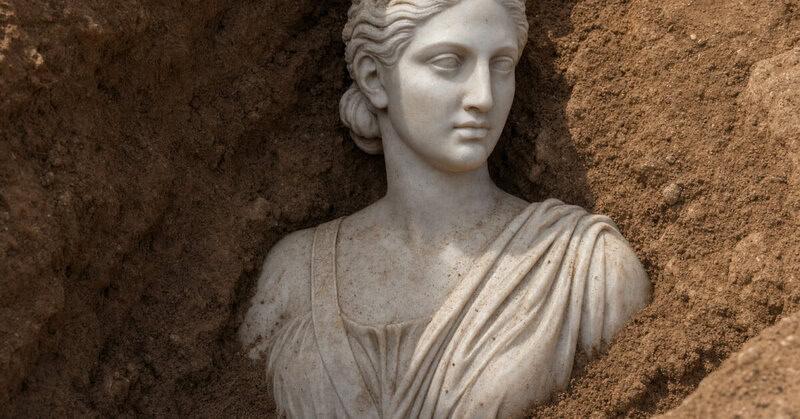
The construction crews breaking ground for a new high-speed railway near Binyamina, Israel, were not looking for history — they were building toward the future. But the earth had other plans. When archaeologists moved in to conduct the legally required survey before work could continue, they found two marble faces staring downward into the dark soil of a long-forgotten Roman-era winepress, exactly where someone had left them roughly 1,700 years ago. Not dropped. Not lost. Placed.
The Discovery That Stopped a Railway

The site sits in the coastal lowlands of northern Israel, close to Binyamina and within reach of ancient Caesarea — once one of the Roman Empire’s most impressive Mediterranean cities, a place of harbors, a hippodrome, and imperial ambition. This landscape has always been layered with the past, which is precisely why Israeli law requires archaeological survey work before major infrastructure projects break ground. In this case, the requirement paid off dramatically.
What excavators from the Israel Antiquities Authority uncovered was a Roman-Byzantine winepress: a workmanlike structure where grapes had once been trodden and pressed season after season, part of the agricultural machinery of a prosperous estate. Winepresses were not glamorous. They were places of labor, sticky with juice and buzzing with flies in the late summer heat. And yet, tucked inside this entirely ordinary structure, archaeologists found two marble busts of extraordinary quality, their carved faces pressed deliberately into the earth as though shielding themselves — or being shielded — from whatever was happening above ground.
Photographs credited to Assaf Peretz of the Israel Antiquities Authority show the statues as they were found: intact, their features still sharp, the white marble almost luminous against the dark soil. These were not fragments or rubble. These were complete, finely worked human faces, and someone had put them here on purpose.
Two Busts, One Famous Name

The two busts are remarkable by almost any standard of Roman-era archaeology. Intact marble statues are rare enough; intact marble statues found in documented context, with accompanying evidence of intentional placement, are rarer still. Experts described them as magnificent, and the photographs bear that out. The carving is accomplished and the features individualized — these were not mass-produced ornaments but works of genuine craft, the kind of objects that would have commanded attention in any setting.
One detail in particular has drawn the attention of historians and classical scholars: one of the busts carries a Greek inscription reading Lycurgus. That name reaches back to the very foundations of Greek historical memory. Lycurgus is the semi-legendary lawgiver credited with creating Sparta’s famous constitution — the iron code that shaped the warrior society, the communal messes, the brutal agoge training, and the ethos of discipline over comfort that made Sparta a byword for martial virtue across the ancient world. Whether Lycurgus was a real historical figure or a largely mythologized one remains debated by scholars, but his symbolic weight in Greek and Roman culture was immense.
By the third and fourth centuries CE, when these busts were likely produced, educated Romans and Romanized provincials throughout the Mediterranean were deeply nostalgic for the Greek heroic tradition. Decorating a villa with busts of legendary Greek figures — philosophers, poets, statesmen, lawgivers — was a statement of intellectual sophistication and cultural prestige. A wealthy estate owner near Caesarea displaying a bust of Lycurgus was signaling something about himself: his education, his taste, his participation in the broader world of Greco-Roman culture.
Scholars note that the inscription may identify the subject depicted, or it may record the name of the patron who commissioned the work, or even a local notable who bore the name. The precise relationship between the inscription and the carved face above it is one of the questions that will keep researchers occupied for years. What matters is what came next: that face, with that name, ended up pressed into the floor of a winepress and left there for seventeen centuries.
The World These Statues Were Made For — and Why It Changed

To understand why someone might bury marble busts face down in a winepress, it helps to understand the world that was ending around them. The third and fourth centuries CE were among the most convulsive in Mediterranean history. The Roman Empire, which had for centuries maintained a loose but functional pluralism toward religious practice, was fracturing politically and transforming spiritually. Christianity, once a persecuted minority faith, was ascending toward official imperial favor — Constantine’s conversion in the early fourth century CE was the pivotal moment — and with that ascent came mounting pressure on the polytheistic order that had sustained temples, festivals, public sacrifice, and marble images of gods and heroes for generations.
The landscape around Caesarea in this period was prosperous and cosmopolitan. Wine production was a serious economic enterprise, and the region’s agricultural estates were embedded in Mediterranean trade networks stretching from North Africa to the Aegean. The winepress where the statues were found was almost certainly part of a larger villa or estate complex — the kind of place where decorative marble busts would naturally reside, displayed in a courtyard, a garden, or a reception hall. They were status objects, and culturally loaded ones, connected to the pre-Christian Greco-Roman world by both their imagery and their craftsmanship.
As Christian authorities and communities increasingly moved against pagan imagery — pulling down statues, closing temples, repurposing sacred spaces — owners of such objects faced a genuine dilemma. An exquisite marble bust of a legendary Greek lawgiver was either a treasure to be protected or a provocation to be feared, depending entirely on who was looking at it and from what position of power.
What Face Down Actually Means: The Archaeology of Deliberate Burial

Archaeologists are careful about the word deliberate, and they use it here with confidence. The face-down orientation of these statues is not what you see when objects are accidentally broken, casually discarded, or lost in a structural collapse. When buildings fall and objects tumble, they land randomly — face up, face down, on their sides, at odd angles. What the evidence does not typically produce is two complete marble busts, both oriented the same way, their faces pressed carefully into the floor of a working winepress. That pattern requires human intention.
The leading interpretation among the excavators is that the statues were deliberately hidden — most likely by someone who owned them and wanted to protect them from destruction. The winepress made a sensible hiding place: it was a working agricultural structure rather than an obvious vault, and objects buried beneath its floor might escape notice during any search or purge of pagan imagery. This kind of protective concealment is well documented across the late Roman world, where owners hid valuables or religiously sensitive objects during periods of upheaval, intending to retrieve them once the danger had passed.
The face-down orientation, however, opens a second and more unsettling reading. In the symbolic vocabulary of the ancient world, a statue’s gaze was not merely decorative — it carried presence, even power. To bury a face downward is to blind it, to sever its connection to the world above. There are precedents across multiple ancient cultures for this kind of ritual neutralization: rather than destroying an image outright, you disable it, cutting off its animating gaze. Whether the face-down placement was a protective gesture by a devoted owner, or an act of symbolic subjugation by someone hostile to what the busts represented, it was a deliberate choice loaded with meaning.
Concealed deposits of this kind are not unique to this site. Similar deliberately buried caches of Roman-era artifacts have been found across the former empire, from Britain to North Africa, from Spain to the Levant. Each one contributes to a larger archaeological conversation about how people in antiquity ended their relationships with images — not always through iconoclasm and smashing, but sometimes through something quieter, stranger, and more ambiguous: burial, concealment, a kind of material farewell.
What the Intact Condition Tells Us

Perhaps the most telling detail of all is the condition in which the busts were found: intact. Iconoclasts throughout late antiquity were not generally in the habit of careful preservation. The archaeological record of the period is littered with deliberately smashed statues, defaced reliefs, and decapitated figures. When someone wanted to eliminate pagan imagery, they made sure to eliminate it. The fact that these two busts arrived in the ground whole — their features undamaged, their marble unbroken — strongly suggests that whoever placed them there valued them, or at least respected them enough not to shatter them first.
That points firmly toward the protective burial theory. Someone, probably the owner of the estate or a person acting on the owner’s instruction, chose to hide rather than surrender these objects. They were laid carefully in the floor of the winepress, faces down, and covered over. The presumed plan was to return — to dig them up when the danger had passed, when the religious climate had shifted, when it was safe again to display a marble Lycurgus in a courtyard without fear of what neighbors or authorities might think.
That person never came back. We do not know why. Death, displacement, the grinding momentum of historical change that made the world those statues belonged to feel not just distant but irretrievably gone — any of these could explain the silence. What the record shows is that the busts lay undisturbed through the late Roman period, through the Byzantine centuries, through the Arab conquests, through the Crusades, through the Ottoman era, through the founding and growth of the modern state of Israel, through decades of railway planning — until a team of archaeologists with legally mandated survey equipment finally looked at the right patch of ground.
What Comes Next, and Why It Matters Beyond the Headlines

The statues are now in the care of the Israel Antiquities Authority, where they will undergo conservation and detailed scholarly analysis. The Greek inscription on the Lycurgus bust will be studied further, and the marble itself will likely be subjected to isotopic or petrographic analysis to determine its geological origin — a process that can identify ancient quarrying sites and illuminate the trade networks that moved raw materials across the Mediterranean, helping researchers understand where these objects were made before they found their way into a winepress near Binyamina.
The discovery also makes a vivid argument for the value of infrastructure-driven archaeological survey. Some of the most significant ancient finds of the modern era have come not from dedicated excavation campaigns but from the legally required pause before a road is built, a pipe is laid, or a railway takes shape. Cultural heritage law mandating pre-construction survey work is sometimes characterized as bureaucratic friction. Finds like this are a reminder of what that friction is actually protecting — and what it occasionally reveals.
The open questions are numerous and genuinely compelling. Who owned this winepress estate? Were the statues buried by the owner, by a servant acting on instruction, by a later occupant who found them already stored in the building, or by someone with entirely different motives? Was the Lycurgus inscription original to the bust or added at a later point? How did Roman-era marble statues of this quality travel to this particular corner of the ancient Levant, and what does their presence tell us about the economic and cultural life of the region in its final prosperous centuries before late antiquity’s upheavals reshaped everything?
These are the threads that scholars will pull on for years. But underneath all the academic questions, there is something simpler and more human: two marble faces, pressed into the dark earth of a forgotten winepress, outlasted the empire that made them, the religious transformation that may have threatened them, and every single person who ever knew they were there. Someone hid them carefully, with every intention of returning. The statues kept their vigil in the dark for seventeen centuries, faces to the ground, waiting. Now, finally, they have been found.

 English
 Arabic
 French
 Spanish
 Portuguese
 Deutsch
 Turkish
 Dutch
Dutch
 Italiano
 Russian
 Romaian
 Portuguese (Brazil)