


In the autumn of 539 BC, something happened that the ancient world had almost no template for: a conquering king rode into one of history’s greatest cities and told its people they were free.
The Day a King Freed a City

The Processional Way into Babylon was lined not with the bodies of the defeated but with crowds watching Cyrus the Great enter in something closer to a triumph of welcome than a march of conquest. Priests of Marduk — the supreme god of the Babylonian pantheon — performed ritual greetings. The city’s gates had opened before his army even arrived. And within weeks of his entry, Cyrus was doing something no emperor before him had bothered to do: he was writing down what he promised his new subjects.
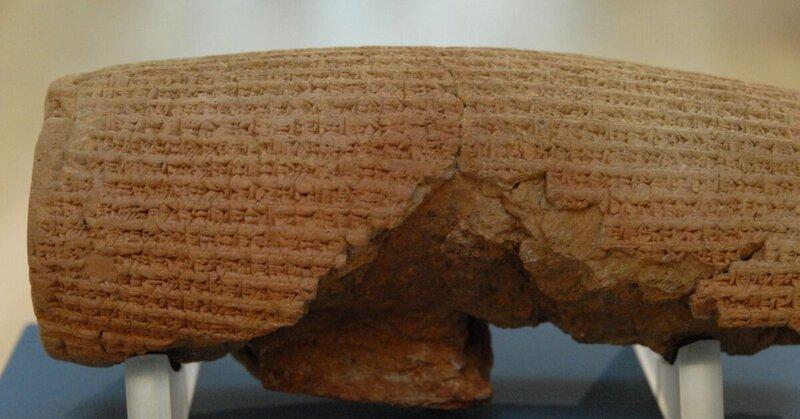
The result was a baked-clay cylinder, roughly the size of a man’s forearm, packed with 45 lines of Akkadian cuneiform. It declared that forced labor would end, that peoples displaced and deported against their will would be allowed to go home, that looted temple statues would be returned to their sanctuaries, and that local customs and religions would not simply be tolerated but actively protected. More than two and a half millennia before the United Nations drafted its Universal Declaration of Human Rights, an ancient Persian king had written something that carried its moral DNA.
The visceral contrast with what came before matters here. The Assyrians, who had dominated the region before Babylon’s rise, had perfected deportation as a tool of imperial control — entire peoples uprooted, scattered, stripped of identity. Even Babylon’s own king Nabonidus, whom Cyrus displaced, had alienated his priests and citizens through coercive religious policies. Against that backdrop, Cyrus’s declaration was not merely generous. It was revolutionary. Whether it reflected genuine moral vision or extraordinarily sophisticated political marketing — and serious historians argue both — the world had produced nothing quite like it before. And it would not see anything comparable again for an uncomfortably long time.
An Empire Unlike Any Before It — The Scale of Achaemenid Power

To understand why the cylinder mattered, it helps to grasp just how large the stage was. The Achaemenid Empire, founded by Cyrus the Great in 550 BC when he united the Medes and Persians under a single crown, grew within a generation into the largest empire the world had yet seen. Its territory stretched from the Indus Valley in the east to Northern Greece in the west, from the steppes of Central Asia to the deserts of Egypt. It contained dozens of distinct peoples, languages, legal traditions, and religious systems.
Ancient Iran — the land history would call Persia — would remain the dominant power of western Asia for over twelve centuries, across three successive native dynasties: the Achaemenids, the Parthians, and the Sassanids. No other regional civilization maintained that kind of cultural and political continuity across so long a span. But sheer longevity alone does not explain what made the Achaemenid moment so distinctive.
What contemporaries and modern historians alike point to is ambition of a different kind. Most ancient empires extracted. They took grain, gold, and labor, and they used violence to keep subject peoples compliant. The Persians, at least in their administrative ideal, tried something harder: they attempted to actually govern a multi-ethnic empire rather than simply loot one. It was the first empire to have genuine ambition: to bring together many peoples under one rule. For roughly half a millennium, Persia was the center of the world — and its innovations in administration, infrastructure, and diplomacy shaped every large empire that followed.
The Royal Road — approximately 2,700 kilometers running from Sardis on the Aegean coast to the Persian capital at Susa — was equipped with relay stations that allowed royal messages to travel at speeds no army could match. Herodotus, a Greek who was hardly inclined to flatter the Persians, marveled at the system. The Achaemenids introduced standardized coinage across vast territories, maintained a multilingual civil service capable of writing in Old Persian, Elamite, Aramaic, and Babylonian, and developed a satrapy system of regional governors who were required to uphold Persian law while leaving local customs, languages, and religions largely intact. It was, in essence, a devolved model of imperial governance, and later empires — including Rome — would borrow elements of it for centuries.
The Cylinder in the Rubble — Discovery and What It Said

The object that would eventually carry all this historical weight spent roughly 2,400 years underground. In 1879, a British Museum excavation team digging through the ruins of ancient Babylon recovered a small clay cylinder from the soil near the foundations of Esagila, Babylon’s great temple complex. It had been placed there as a foundation deposit — buried in the walls not to be read by future generations, but to communicate the king’s piety to the gods themselves. The Cyrus Cylinder was never meant to be discovered. That it was changes everything about how we understand the ancient world’s moral vocabulary.
Its 45 lines announce, in the bureaucratic lingua franca of the ancient Near East, that Cyrus is freeing the inhabitants of Babylon from what the text describes as a yoke that was not proper for them — direct language targeting the coerced-labor policies of his predecessor. The inscription states that displaced and deported peoples are free to return to their homelands, and it promises the restoration of looted divine statues to their original sanctuaries. It frames Cyrus’s authority not through military conquest alone but through divine legitimacy and the claim that he governs with the consent of the people — a rhetorical move that, crucially, obligated him to behave justly in order to maintain that mandate.
The references to deported peoples returning to their homelands are corroborated by Hebrew scripture: the Book of Ezra records that Cyrus permitted Jewish exiles — deported to Babylon by Nebuchadnezzar — to return to Judah and rebuild the Temple in Jerusalem, with Persian financial support. The cylinder and the biblical account tell the same story from different directions, making this one of the best-attested policy decisions in the entire ancient world.
Scholars are careful about the word “charter” — the cylinder is not a legal code in any modern sense, and its language is unmistakably that of royal self-promotion. But the scholarly consensus is equally clear: as an articulated, written policy of religious tolerance, freedom of movement, and prohibition of arbitrary enslavement, it has no known predecessor. The object now lives in the British Museum. A replica stands in the United Nations headquarters in New York — a quiet institutional acknowledgment that the moral architecture of what we now call human rights has roots far older than 1948.
The Machinery Behind the Mercy — Ancient Persia’s Governing Genius

The cylinder was not a one-off performance. Ancient Persia’s achievements in governance and culture were systematic and durable in ways that tend to get lost when the conversation turns to Greek wars and Alexander’s conquests. Darius I, who came to power in 522 BC after a contested succession, carved his own extraordinary document into a cliff face at Behistun in what is now western Iran: a trilingual inscription in Old Persian, Elamite, and Babylonian explaining his actions, asserting his legitimacy, and addressing his entire multilingual realm simultaneously. It functioned as something like a public accountability statement — a king explaining himself to his subjects in their own languages.
The satrapy system Darius refined allowed local elites to govern their own regions within a Persian legal and fiscal framework, a model of devolved administration that balanced central authority with local autonomy. Tax collection was systematized and regular. Infrastructure — roads, way stations, irrigation networks — was maintained as an imperial responsibility. Administrative correspondence across the empire was conducted primarily in Aramaic, a Semitic language that served as a neutral bureaucratic medium across dozens of distinct ethnic communities. The contributions of the Persian Empire to later civilizations — including the administrative templates adopted by Alexander’s successor states, by the Parthians, by the Sassanids, and indirectly by the early Islamic caliphates — are enormous, and remain underappreciated in most Western curricula.
Persian art and architecture tell a parallel story of confident synthesis. Persepolis, the great ceremonial capital begun by Darius and expanded by Xerxes, drew on Egyptian columns, Mesopotamian glazed-brick reliefs, and Greek sculptural conventions while producing something unmistakably its own: a visual language of imperial inclusivity in which delegations from every corner of the empire were depicted bringing tribute, each rendered in their own distinct dress and custom, none degraded or trampled. Conquest and cultural absorption, the Achaemenids seemed to argue in stone, were not the same thing.
Why the West Forgot — And Why It Matters Now
The short answer is Greece. Greek historians and dramatists — Herodotus, Thucydides, Aeschylus — wrote the Persian Empire as the great eastern “other,” the despotic foil against which Greek democratic ideals could shine. Their version of events proved extraordinarily durable. Western education spent centuries treating the Achaemenid Empire primarily as a backdrop antagonist in the stories of Marathon, Thermopylae, and Salamis, rather than as a civilization with its own intellectual and moral achievements worth examining on their own terms.
The cylinder’s rediscovery in 1879 arrived just as Victorian scholars were beginning to systematically excavate the ancient Near East, but it took another century — and Iran’s own public embrace of the cylinder as a national symbol in the 1970s — for its human-rights significance to enter mainstream historical discourse. The debate that followed was not merely academic. The origin story of human rights shapes who receives credit for universal values. If tolerance, freedom of conscience, and limits on state power first appeared as articulated policy in ancient Persia rather than in Athens or Magna Carta, the master narrative of where civilization’s best ideas come from shifts considerably.
Contemporary scholars increasingly argue that the cylinder is best understood not as a modern human-rights document magically transported to antiquity, but as evidence that the underlying moral impulse — the idea that the power of the state over the individual has limits — is older, more widely distributed, and more cross-cultural than any single tradition has claimed. That argument is still very much unsettled. But it is no longer possible to ignore it.
Legacy in Clay — What Persia Left the World
The fingerprints of ancient Persia on the modern world are everywhere, even when they go unlabeled. The three great Abrahamic religions all carry Persian traces: Judaism’s Second Temple was rebuilt with Achaemenid funding and Persian political authorization; Zoroastrian theology — the Persian religion of cosmic struggle between truth and falsehood, light and darkness — shaped Jewish apocalyptic thought during and after the Babylonian exile, and through that influence touched the foundations of both Christian and Islamic eschatology. The very concept of a cosmic moral order, of history as a purposeful struggle toward justice, carries Persian freight that is rarely acknowledged in Western religious education.
Every time a modern government formally guarantees freedom of religion, protects the languages of its minorities, or articulates that its authority derives from service to the people rather than from sheer force, it is working — knowingly or not — within a framework that Cyrus first sketched in Akkadian cuneiform in the sixth century BC. The Achaemenid Empire fell to Alexander in 330 BC, but Persian culture, administrative genius, and language outlasted Greek and Roman dominance alike, re-emerging and flourishing under the Parthians and Sassanids for centuries more. Ancient Iran’s cultural thread is one of the longest unbroken continuities in human history.
Which brings us back to that forearm-sized cylinder of baked clay. Buried beneath a temple wall for nearly two and a half millennia, placed there to speak to gods rather than people, it nonetheless survived. It sits now behind museum glass in London while its copy stands in the building where nations convene to argue about the rights of human beings — the oldest written argument we possess that power has limits, that rulers owe something to the ruled, and that people taken from their homes deserve to return to them. Cyrus may or may not have believed every word he had his scribes inscribe. But he wrote it down. And across 2,500 years of war, conquest, and forgetting, the world kept it.

 English
 Arabic
 French
 Spanish
 Portuguese
 Deutsch
 Dutch
Dutch
 Italiano
 Russian
 Romaian
 Portuguese (Brazil)
 Greek
Greek