


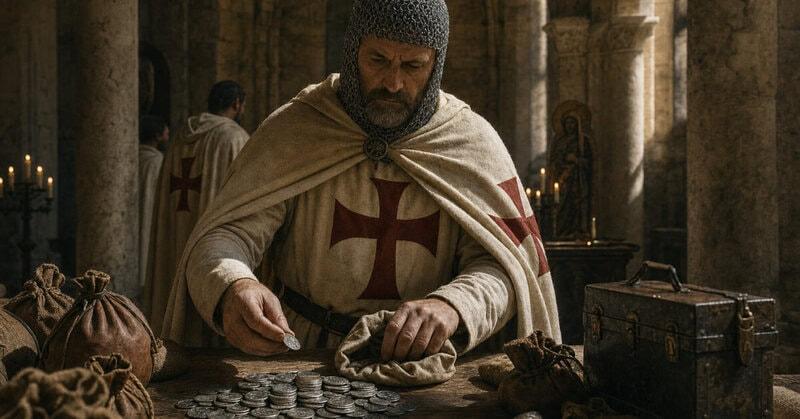
Imagine carrying your life savings in silver coins across a thousand miles of bandit-haunted roads, mountain passes stalked by thieves, and desert tracks where a pilgrim’s corpse might lie unnoticed for days. In the middle of the twelfth century, that was the reality facing any Christian who answered the Church’s call to visit Jerusalem — until a brotherhood of warrior-monks invented a solution so elegant it would quietly rewire the financial architecture of the Western world. Their story spans crusading zeal, institutional genius, royal betrayal, and a bonfire on the Seine — and it still echoes in the way money moves across borders today.
A Pilgrim’s Problem, a Banker’s Solution

The system worked like this. A pilgrim — or a crusading lord raising an army — walked into a Templar preceptory in London or Paris, deposited his silver, and received in return a coded document: a letter of credit recording the value of his deposit in a form that a cutpurse could not spend. He then traveled to Jerusalem, presented the document at the Templar house there, and withdrew an equivalent sum. No coins had crossed the Mediterranean. No armed escort had been required. The transfer existed, essentially, as information — protected by cryptography, the order’s iron reputation, and the brute fact that stealing the letter gained a thief precisely nothing.
It was, by most historians’ reckoning, the first functioning international banking transfer in Western history. And it was invented by men who had each individually sworn a vow of poverty. That collision between personal renunciation and institutional wealth is the central, dizzying irony of the Knights Templar — and it is what made them, in the end, impossible for the kings of Europe to tolerate.
Origins: Born From the Chaos of the First Crusade

To understand how warrior-monks became bankers, you have to start with the mess they were created to clean up. The First Crusade of 1096 to 1099 was a brutal, barely coordinated military campaign in which armies from across Europe marched into the Holy Land, fought their way to Jerusalem, and seized the city in a storm of violence. The goal had been accomplished: Jerusalem was in Christian hands. What nobody had fully planned for was what came next.
Pilgrims began flooding toward the Holy City almost immediately, drawn by faith and the promise of spiritual reward. But the roads were catastrophically dangerous. The Crusader states were a thin sliver of territory ringed by hostile forces, and the routes from the coastal ports to Jerusalem functioned as hunting grounds for bandits and raiding parties. Pilgrims were robbed, killed, and enslaved with routine frequency. Contemporary chroniclers recorded massacres of entire pilgrim columns within sight of the city walls.
Into this chaos stepped a French knight named Hugues de Payens. Around 1118, he and a small group of companions approached King Baldwin II of Jerusalem with a proposal that sounded, on its face, slightly mad: they would form a brotherhood of knights who would simultaneously take monastic vows — chastity, poverty, obedience — and dedicate themselves to military service, specifically the protection of pilgrims on the roads. Baldwin, who understood exactly how badly that protection was needed, gave them his support and, crucially, their headquarters: a section of the royal palace on the Temple Mount, the most sacred and symbolically loaded piece of real estate in the Christian world, traditionally identified with the site of Solomon’s Temple. The name wrote itself. They became the Poor Fellow-Soldiers of Christ and of the Temple of Solomon — the Knights Templar.
The strange dual nature baked into their founding would define everything that followed. These were men trained to kill, hardened by combat, who also attended daily prayers, fasted, and submitted to monastic discipline. It was a combination Christendom had never quite seen before, and it fascinated people. The order was, from its earliest days, magnetic.
Church Recognition and the Flood of Donations

For roughly a decade after their founding, the Templars existed in an informal state — recognized by the king of Jerusalem but lacking official sanction from Rome. That changed at the Council of Troyes in 1129, where the Church formally recognized the order as a military brotherhood and granted it a written rule governing everything from daily prayer to the cut of a knight’s beard. The rule was shaped in large part by Bernard of Clairvaux, the most influential theologian of the age, whose endorsement carried something close to papal authority in the minds of European nobles.
Bernard also wrote a treatise called In Praise of the New Knighthood, arguing that killing in defense of the faith was not murder but an act of Christian virtue. It was a theological argument that gave the military order concept its intellectual legitimacy — and it opened the floodgates. Across Europe, nobles gifted the Templars land, castles, mills, vineyards, and money. Younger sons of good families joined the ranks, bringing fighting ability and family connections. Within decades, what had started as a handful of knights on the Temple Mount had grown into a transnational institution operating across the entire Christian world, from the British Isles to the edges of the Holy Land.
Structure: How the Order Was Built to Last

The Templars were not simply a military force. They were a sophisticated institution with a clear hierarchy, a rule of law, and a geographic network that gave them capabilities no secular organization could match. At the top sat the Grand Master, elected for life by a council of senior brothers, with authority over both military and financial operations. Below him, regional commanders called Masters governed the order’s affairs in different kingdoms. At the base were the knights themselves — along with sergeants, who fought but were of lower social rank, and chaplains, who administered the order’s religious life.
Their most extraordinary structural advantage was political. The Templars answered to no king, no bishop, no local lord — only to the Pope. This papal immunity, confirmed and expanded through a series of papal bulls, meant they could move money, men, and information across political borders that stopped everyone else. A French king could not tax them. An English bishop could not discipline them. They occupied a legal category entirely their own, and they used that freedom with remarkable sophistication. It also meant that when they accumulated enemies, those enemies had no ordinary legal mechanisms to use against them. The only tools that could reach the Templars were extraordinary ones.
The Banking System: How Warrior-Monks Rewired Medieval Money

The Templar financial system emerged organically from the order’s unique position. They maintained fortified houses across the entire Christian world, connected by their own internal communications network. They had a reputation for absolute honesty — an essential quality in any institution that asks strangers to trust it with their wealth. And their papal immunity allowed them to operate across borders without the interference that hobbled secular competitors.
The letter of credit was the keystone, but only the most visible piece of a much larger financial architecture. The Templars also held deposits for clients, managed estates and property on behalf of nobles and monarchs, and extended loans on a scale that dwarfed anything a local moneylender could offer. Louis VII of France borrowed from the order. Henry II of England relied on the Templars to manage significant portions of the royal finances. The Templar house in Paris functioned, for a period, as something very close to a royal treasury and a proto-central bank rolled into one, holding the crown jewels and royal archives alongside its financial ledgers.
There was one theological problem: charging interest on loans was usury, which the Church classified as a mortal sin. The Templars navigated this with what can only be described as financial creativity. They charged fees for services rendered, took profits through currency exchange margins, and embedded their returns in the management of landed estates — arrangements that were technically distinct from interest but economically equivalent. The money flowed; it simply traveled under different names. The techniques were recognizable ancestors of practices that Italian merchant bankers would later systematize and that modern financial institutions still use today.
The Templars at War: What They Actually Did in Battle

It is easy, given how much of the Templars’ legacy concerns finance, to lose sight of what they were primarily built to do: fight. At their height, the order maintained one of the most professional standing armies in Europe — disciplined, well-equipped, and experienced in the particular brutality of Crusader warfare. They garrisoned a network of castles across the Holy Land, including some of the most formidable fortifications of the medieval world. Château Pèlerin on the Palestinian coast and Krak des Chevaliers — though the latter was primarily a Hospitaller fortress — represent the scale of stone and engineering the military orders put into the landscape of the Crusader states.
Templar knights fought under strict battlefield discipline. The rule forbade them from retreating unless outnumbered more than three to one and the order’s banner had fallen. That combination of professionalism and almost suicidal commitment made them shock troops of choice in major engagements throughout the Crusades. They suffered accordingly: the order lost enormous numbers of men in battles including the catastrophic defeat at the Horns of Hattin in 1187, where Saladin destroyed the main Crusader field army and captured Jerusalem. The Templars who survived Hattin were executed on Saladin’s orders — an indication of how seriously Muslim commanders took the military threat they represented.
The order rebuilt, as it had rebuilt before, drawing recruits and resources from its European network. But Hattin marked a turning point. Jerusalem was lost, and though later crusades recovered territory and briefly returned access to the city, the Crusader position in the Holy Land never fully stabilized again.
Power, Enemies, and the Seeds of Destruction
Wealth on the Templars’ scale, combined with political independence and a reputation for secrecy, is a slow-acting poison in any environment where kings are trying to consolidate authority. By the end of the thirteenth century, the order had accumulated enemies with the same efficiency it had accumulated assets.
The fall of Acre in 1291 was the turning point that exposed them completely. Acre was the last major Crusader stronghold in the Holy Land, and when it fell to Mamluk forces after a siege of brutal intensity, the Templars lost not just a fortress but their entire operational justification. They had been founded to defend pilgrims and the Holy Land. With the Holy Land gone, what exactly were they for? The answer that most European rulers settled on was uncomfortable: they were a massively wealthy, politically untouchable private army with no remaining mission that a king could point to and call necessary.
Discussion of a possible merger with the rival Knights Hospitaller went nowhere. Proposals for a new crusade never materialized into action. The Templars retreated to Cyprus, administered their European holdings, and waited for a political environment that never improved. Meanwhile, in France, the man who would destroy them was already doing the arithmetic.
Philip IV and the Architecture of a Frame
Philip IV of France — known to his contemporaries as Philip the Fair, a title that referred to his looks rather than his character — was deeply in debt, much of it owed to the Templars. He was also a monarch of cold, methodical ruthlessness, and he possessed a critical strategic advantage: the papacy had, under sustained French pressure, relocated to Avignon in 1309, making Pope Clement V far more susceptible to French royal influence than any pope had business being. The combination of financial motive, political leverage over Rome, and personal temperament made Philip uniquely dangerous to the order.
He spent years building his case. Agents were planted among the Templars, testimony was collected, and a set of accusations was assembled that struck every nerve of medieval religious anxiety: heresy, sodomy, blasphemy, and the worship of an idol called Baphomet. The charges were almost certainly fabricated wholesale, or at best grotesquely distorted from whatever internal rituals the order had developed over two centuries of institutional life. But they were explosive, and in an age when the charge of heresy could reduce any reputation to ash overnight, they were enough to set the mechanism in motion.
The Fall: Friday the 13th and the Fires of Paris
On Friday, October 13, 1307 — a date some historians have cautiously connected to the later superstition about Friday the 13th, though the link remains debated — Philip’s agents arrested every Templar in France simultaneously at dawn. It was a logistical operation of remarkable precision for a medieval government, suggesting both the planning that had gone into it and the secrecy with which it had been maintained. Overnight, one of the most powerful institutions in Christendom became a population of prisoners.
What followed was an interrogation process that used torture freely and recorded confessions selectively. Knights confessed to spitting on the cross, denying Christ, and obscene initiation rites. Most recanted the moment physical pressure was removed, insisting the confessions had been extracted by pain and fear. The recantations rarely made it into the documents that mattered. The machinery of a medieval inquisition, once set moving, was not engineered to stop.
The Council of Vienne formally dissolved the order in 1312, at Philip’s insistence and with Clement’s compliance. The Templars’ assets were officially transferred to the rival Knights Hospitaller, though Philip ensured a meaningful portion remained in French royal hands. The debt that had helped motivate the entire operation was conveniently erased along with the creditors.
The fate of Grand Master Jacques de Molay became the order’s defining final image. After years of imprisonment and a tortured confession, de Molay publicly recanted in 1314, insisting on the order’s innocence before whatever audience he could reach. Philip’s response was immediate and permanent. De Molay was condemned as a relapsed heretic and burned alive on the Île des Juifs, a small island in the Seine, that same day — before any appeal could be lodged, before any hearing could be convened, before the moment could be lost. Contemporary accounts record that he died maintaining the order’s innocence and his own faith. He was the last Grand Master the Templars would ever have.
Legacy: The Ghost in the Machine of Modern Finance
The order died. The innovations did not. The techniques the Templars had developed — deposit banking, letters of credit, international fund transfer, the separation of physical assets from the documents representing their value — passed into the practices of Italian merchant banking families such as the Bardi and the Peruzzi, and from there into the financial systems that underpin the modern world. When money moves electronically across an international border today, it does so in a tradition whose medieval prototype was a coded document handed to a pilgrim at a London preceptory.
The history of the Knights Templar has also generated a second life entirely separate from the historical record. Freemasons claimed descent from the order in the eighteenth century. Novelists filled imagined Templar vaults with impossible treasures. Conspiracy theorists mapped their supposed survival onto secret societies across seven centuries. The mythological Templars and the historical ones parted ways long ago, though they still share a name and an iconic image: the red cross on a white mantle, and the famous seal depicting two knights sharing a single horse — traditionally interpreted as representing the poverty of the original brotherhood, though some scholars have suggested the image carried other meanings within the order’s own visual culture.
What historians find most striking, looking back across seven centuries, is the sheer sophistication of what the Templars built. These were medieval people, operating without computers or telecommunications or any of the institutional infrastructure that modern finance takes for granted — and they constructed a system of international credit transfer that actually worked, reliably enough that kings trusted it with their treasuries and their crown jewels. The Middle Ages were not, it turns out, a simple time inhabited by simple minds.
The sharpest irony of the whole story is also the most elegant. The order was founded to protect poor pilgrims — people with nothing, traveling on faith alone, vulnerable on every road they walked. The solution it invented to solve that problem made it so wealthy and so powerful that the most powerful men in Europe could not sleep soundly while it existed. The pilgrims survived their journeys. The order that protected them did not survive its own success.
For a broader overview of the order’s full arc, the World History Encyclopedia’s entry on the Knights Templar offers a well-sourced scholarly summary, while the Wikipedia article on the Knights Templar provides a thorough guide to the primary sources historians use to reconstruct their story. The Mystery & History documentary on the Knights Templar traces their rise and fall in considerable visual detail for those who prefer their history narrated.

 English
 French
 Spanish
 Portuguese
 Deutsch
 Turkish
 Dutch
Dutch
 Italiano
 Russian
 Romaian
 Portuguese (Brazil)
 Greek
Greek