


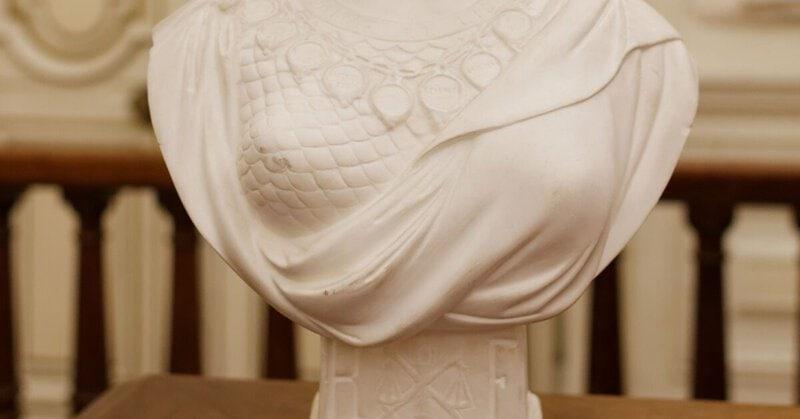
Step into almost any town hall in France — a mairie in a sun-bleached Provençal village, a grand civic building on a Parisian boulevard, a modest office in a grey northern market town — and the same face meets you from behind the mayor’s desk. Ceramic, composed, with a red Phrygian cap tilted forward and a gaze that neither pleads nor commands, she simply watches, as she has watched for more than a century. Her name is Marianne, and almost nobody who passes her can tell you her full story.
The Most Reproduced Face in History — and the Most Misunderstood

That same profile appears on French postage stamps, on euro coins minted by the tens of millions, on courtroom walls, and on the official seals of the French Republic. By sheer volume of reproduction, Marianne is arguably the most reproduced female face in human history. And yet she remains strangely anonymous — a familiar piece of visual furniture that most people slide past without a second thought.
What makes her story extraordinary is the gap between that quiet ubiquity and what she once was: a banned, underground symbol, dangerous enough that her image was passed hand to hand like a revolutionary pamphlet and her name whispered in back rooms as a password among conspirators. The woman who is today France’s official national emblem was, for long stretches of her existence, a wanted outlaw.
To trace Marianne’s journey from seditious legend to national icon is to trace the birth of the modern French Republic itself. The two stories are not merely parallel — they are the same story, told in paint and ceramic and coin rather than in blood and decree.
Born in Paint and Protest: The Origins of a Symbol

The roots of Marianne reach back to the decades before the Revolution. The origins of the Marianne “goddess of liberty” symbol date back to 1775, when a French artist first painted her as a symbol of French liberty. European artistic tradition, rooted in classical antiquity, had long personified abstract ideals — Justice, Victory, Truth, Fortune — as female figures. Liberty was a natural heir to that visual vocabulary. But choosing a woman rather than a crowned monarch or a male hero did something more than follow convention: it gave the idea warmth and democratic immediacy. A goddess could be approached. A goddess could be loved. A king could only be obeyed.
The red cap placed on her head — the bonnet phrygien, or Phrygian cap — was already saturated with meaning long before the first barricade was built. In ancient Rome, freed slaves had worn that soft, forward-tilting cap as a visible mark of their new status. To place it on the head of France’s allegorical Liberty was to reach back through two thousand years and say plainly: this is what emancipation looks like. The visual vocabulary of the Revolution was being assembled in studios and salons before a single cobblestone had been pried from a Parisian street.
As revolution erupted in 1789 and the years of upheaval that followed, the painted allegory fused with popular legend. Stories circulated — the kind that travel faster than facts — of a brave, beautiful woman moving through the chaos of revolutionary battles, tending the wounded, offering water and comfort to men dying for the Republic. She was mythic in the way that folk heroes always are: no one could quite say where they had seen her, only that she had been there. The allegory and the legend merged in the popular imagination, and something more powerful than either emerged from the combination.
The name itself was a masterstroke of democratic symbolism, whether or not it was consciously designed as such. Marianne — a combination of Marie and Anne — was among the most common women’s names in eighteenth-century France. This was deliberately not an aristocratic muse with a gilded pedigree. She was every man’s mother, sister, and neighbor. She belonged to every village and every family. As the Élysée Palace notes, Marianne embodies the permanent values at the foundation of the Republic’s identity: liberty, equality, fraternity, and reason.
When Marianne Was Forbidden: The Underground Years

Here is the detail that most civic portraits leave out: Marianne was not always welcome in France. As political winds shifted — during the Napoleonic Empire, during the royalist Restoration that followed, and during each subsequent period of censorship and reaction — the symbol was actively suppressed. Her image was stripped from public buildings. Her name was branded seditious. To display her was to declare yourself an enemy of the regime in power.
And so she went underground, which is precisely where symbols sometimes find their deepest strength. Republican secret societies kept her name and her face alive, using Marianne as both a password and a rallying cry. There is a particular charge that attaches to a symbol when it is forbidden — an urgency that no official decree can manufacture. The underground Marianne was worth more to the republican cause precisely because she was dangerous. Displaying her image during the wrong regime could mean arrest, exile, or worse. People took those risks willingly. That willingness is compressed inside every bust that now sits on every mayor’s desk.
The suppression-and-resurrection arc of Marianne is also, strikingly, the arc of the French Republic itself. The Republic rose, fell under Napoleon, rose again, fell under the Restoration, strained through the turbulent Second Republic, and finally consolidated under the Third. Marianne followed exactly that rhythm — banned when the Republic was banned, revived when it revived. This structural identity between symbol and nation is precisely why she became, as historians have noted, the defining allegory of the French Republic. She did not merely represent the Republic. She survived alongside it — the way France itself survived.
Official at Last: From Outlaw Icon to Mandated Presence

The great turning point came in the 1870s with the consolidation of the Third Republic. The new government did something bold and precisely symbolic: it ordered Marianne’s bust placed in every mairie — every town hall — across France. Not suggested. Mandated. A nationwide act of visual governance, carried out in ceramic and plaster from the Pyrenees to the Channel coast.
The act of placing her bust was inseparable from the act of removing what had stood there before — a crucifix, a royal portrait, an image of someone who derived authority from God or from blood. Replacing those images with Marianne was not decoration. It was a declaration, made in the language of objects rather than legislation, that sovereignty now resided in the people. The Republic was not God’s France or the king’s France. It was Marianne’s France — which meant it was everyone’s France.
One of the most quietly radical decisions the Republic made was to leave her face deliberately undefined. There was no single official model issued from Paris. Every sculptor, every region, every generation was free to reimagine her features while preserving her cap, her bearing, and her allegiance. The result is a democratic portrait gallery that has refreshed itself across decades without erasing continuity. She has worn hundreds of different faces across France’s municipalities, and she has remained unmistakably herself throughout.
Her reach extended further still when she appeared on postage stamps — an extension that may sound mundane until you consider what it means. Every letter sent, every package posted, every transaction sealed placed Marianne physically in the hands of every citizen, every day. She became something people literally touched without thinking about it, which is perhaps the highest form of symbolic success: presence so complete it becomes invisible.
What She Carries: Reading the Allegory

Marianne is not, despite appearances, merely decorative. Every element of her traditional iconography is doing specific work. The Phrygian cap speaks of emancipation — freedom from tyranny, from inherited servitude, from the divine right of kings. The torch, when she carries one, invokes Enlightenment in its most literal sense: bringing light into darkness, reason into superstition. The bared breast in some of her most celebrated depictions — most powerfully in Eugène Delacroix’s 1830 painting Liberty Leading the People, now held at the Louvre — speaks of nature, nourishment, and an emphatic refusal of courtly artifice.
There is also the dimension of Reason, which the Revolution pursued with sometimes terrifying sincerity. During the most radical phase of the Revolution in 1793 and 1794, the Republic briefly replaced Christian worship with a Cult of Reason, and Marianne was its face. Living women were dressed in her image for public ceremonies, processing through the streets as embodied allegories, deliberately collapsing the line between revolutionary myth and revolutionary womanhood. As educational materials on the symbol explain, she stands as an allegory of both liberty and reason — the twin pillars of the Enlightenment project the Revolution sought to build into stone.
And then there is the dimension that circles back to the folk legend: care, solidarity, fraternity. The woman of the barricade myth was not a warrior. She was a neighbor doing what neighbors do in extremity — kneeling beside the wounded, offering water, refusing to abandon the fallen. That nurturing thread runs through Marianne’s iconography as steadily as the martial one, and it is precisely what makes her a symbol of community rather than merely of defiance. Liberty, equality, fraternity — the three words of the Republic’s motto are all legible in her image, if you know where to look.
Still Watching: The Argument That Never Ends

The surest sign that a symbol remains alive is that it still generates genuine argument. Marianne generates argument. In modern France, periodic debates have erupted over whose likeness should inspire the official bust — controversies touching on questions of what contemporary French womanhood looks like, what secular republican values require of their embodiment, and who has the authority to decide. These are not trivial disputes about aesthetics. They are the Republic arguing with itself about its own identity, using Marianne as both the arena and the stakes.
Most national symbols age into wallpaper. They become familiar enough to stop being seen at all. Marianne refuses that fate with a consistency that borders on the remarkable. She keeps pulling France into disagreement about identity, about representation, about what the Republic actually means and who it actually belongs to. That is not the sign of a symbol in decline. It is the sign of a symbol still doing real and necessary work.
So the next time you stand in a French town hall, hold a euro coin up to the light, or peel a stamp from its backing, look at her properly. That ceramic face is not decoration. It is compressed history: a painted allegory born in an age of mounting pressure, an underground password passed between republicans risking arrest, a folk legend of a woman kneeling beside the wounded on the barricades, and a national mandate handed down to ten thousand mayors at once. She was banned before she was celebrated, whispered before she was proclaimed, dangerous before she was official.
Every country has symbols. Very few have one whose biography so perfectly mirrors the country’s own. Marianne did not merely represent the French Revolution and the Republic it built — she survived them both the way France did: by going underground when she had to, by enduring what she could not change, and by emerging, cap still tilted and gaze still level, ready to be argued over again.

 English
 Arabic
 French
 Spanish
 Portuguese
 Deutsch
 Dutch
Dutch
 Italiano
 Russian
 Romaian
 Portuguese (Brazil)
 Greek
Greek