


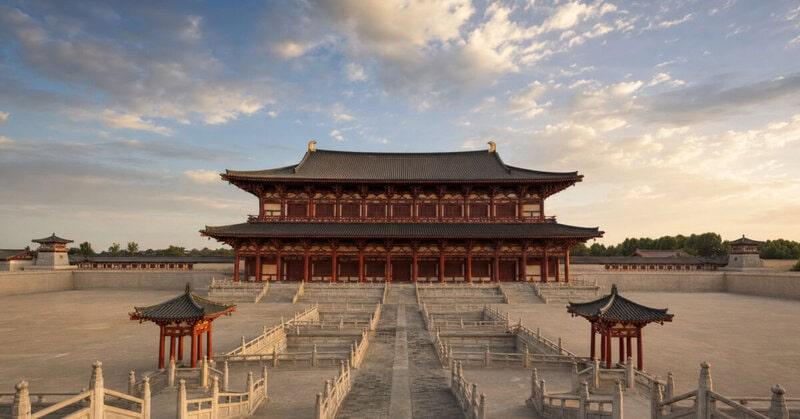
Imagine standing inside a walled complex so vast that the famous Parthenon — Greece’s most celebrated ancient monument — could have been swallowed whole by its main audience hall, with courtyard space to spare. That was Daming Palace in Chang’an, the imperial heart of Tang dynasty China, and today almost nothing of it remains above ground except a ghost of rammed earth slowly dissolving back into the Xi’an plain.
The Palace That Swallowed a City

In the 720s AD, Emperor Xuanzong would have walked through Daming Palace’s Xuanwu Gate — a threshold contested in blood during the dynastic struggles that put his family in power — and entered a compound whose footprint dwarfed anything being built in the contemporary Islamic caliphates, the Byzantine Empire, or Carolingian Europe. The numbers are difficult to absorb: Daming Palace covered roughly 3.2 square kilometres, making it several times larger than what would eventually become the Forbidden City. Its great halls rose on elevated earthen platforms, their sweeping eave-curves lifting toward the sky, their columns cut from timber hauled across hundreds of kilometres of Tang China’s road network.
Chang’an itself, the Tang capital laid out on a strict grid of walled residential wards, housed roughly a million people at its height — the largest planned city on earth at the time. Daming Palace was the jewel set into its northern edge, made vivid in the poems of Du Fu and partially mapped by modern archaeologists, yet almost entirely invisible to the visitor who goes to Xi’an today. That gap between historical record and physical survival raises a question that runs through the entire field: how did a civilisation that built on such a staggering scale leave so little standing — and what can we still read in the ruins, the paintings, and the poetry left behind?
Five Thousand Years in Wood and Rammed Earth

To understand what was lost, you have to understand how long the conversation had been running. Ancient Chinese architecture traces a continuous design tradition spanning roughly 5,000 years, from Neolithic pile-dwellings built on stilts above marshy ground to the great dynastic capitals whose foundations are still being excavated. That is a longer unbroken architectural lineage than Rome’s entire history from the first mud-brick huts on the Palatine Hill to the fall of Constantinople.
The tradition’s foundational choice — the choice that explains almost everything about why so little survives — was the deliberate preference for wood over stone. This was not poverty or ignorance. Chinese builders quarried stone extensively for walls, plinths, bridges, and tombs. The decision to raise great halls on timber columns was philosophical. Where Mediterranean builders reached for permanence in marble, Chinese master-builders embraced wood as an expression of cosmological renewal: structures were meant to be rebuilt, restored, and reimagined as each generation took responsibility for the living world, rather than frozen as relics for a future they would never inhabit.
The architectural grammar that emerged from this philosophy is immediately recognisable once you know what to look for. Traditional Chinese architecture organised walled compounds along a north-south axis, raised pavilions on earthen or stone platforms, carried roof loads through an intricate bracket system, and covered every major roof with glazed tiles curving up at the eaves. Feng shui principles and codified town-planning rules governed every major site. A commoner’s house and an imperial palace shared the same structural DNA; the difference lay in scale, material richness, and the number of roof ridges permitted by law — a visible hierarchy written in timber and tile.
The Logic of the Layout: Symmetry, Enclosure, and the Horizontal Sky

The defining visual language of ancient Chinese architecture is bilateral symmetry along a central north-south axis, a principle so consistent across five millennia that it functions almost like a law of nature. Enclosed courtyards channel procession and concentrate power; the architecture spreads deliberately across the earth rather than thrusting upward. This horizontal emphasis is not timidity — it is a statement about the relationship between human order and landscape, between the emperor’s authority and the flat, fertile plains that sustained his empire.
Enclosure creates meaning in ways that no isolated monument can. The walled compound is not a prison but a world. Each gate crossed is a threshold of status; each courtyard is a measured breath between ceremonies, calibrating the visitor’s sense of awe before the next revelation. A landscaped garden at the rear of a great compound offers a curated version of nature — rocks, water, and carefully shaped trees arranged to suggest wilderness while remaining entirely under human control.
Ancient Chinese architectural philosophy produces an experience utterly unlike that of a Greek or Roman temple, which is fundamentally an object to be admired from the outside. A Chinese palace is something to move through, its grandeur revealed incrementally, courtyard by courtyard, gate by gate, until the audience hall finally appears at the end of a long axis like the resolution of a sentence.
Within that spatial sequence, builders drew on four fundamental structural categories — pavilions, terraces, towers, and lofts — as a design vocabulary that allowed them to compose complex spatial experiences the way a poet arranges lines. A pavilion offers shelter and framed views; a terrace elevates and commands; a tower punctuates the skyline; a loft creates layered interior volumes. Combined within the walled compound, these elements produce architecture that is simultaneously monumental and intimate, public and deeply personal. These four building types recur across every dynasty and every region, forming the stable skeleton beneath centuries of stylistic variation.
Tang Dynasty Architecture: The High-Water Mark

If ancient Chinese palace-building has a golden age, it is the Tang dynasty, which ruled from 618 to 907 AD. Chang’an under the Tang was the greatest planned city on earth, its rectangular grid of wards a masterclass in applied urbanism that influenced city planning as far away as Nara and Kyoto in Japan. Daming Palace, begun in the early Tang and expanded over successive reigns, was its crown.
The complex contained a vast northern lake that served both as a pleasure garden and a firebreak, the great Linde Hall used for imperial banquets and diplomatic audiences, and the Xuanwu Gate — where the Xuanwu Gate Incident of 626 AD, a violent act of succession by the future Emperor Taizong, had been played out in blood before the complex was even fully built. Tang court poets described these spaces in enough sensory detail that modern architectural historians can begin to reconstruct what they looked like: enormous column-halls open to courtyards, bracketed eaves throwing deep shadows in summer heat, the smell of lacquered wood and incense drifting through gateways.
Tang architecture is consequential far beyond China’s borders precisely because of what was copied and what survived elsewhere. Japanese builders of the seventh and eighth centuries imported the Tang bracket system and sweeping eave curves almost wholesale — which is why temples like Tōdai-ji in Nara and the older structures at Hōryū-ji give modern visitors their best physical sense of what Tang dynasty construction actually looked and felt like. The Chinese originals burned; the Japanese copies endure.
There is, however, one surviving miracle on Chinese soil. The main hall of Foguang Temple on Mount Wutai, dated by inscription to 857 AD, is the oldest largely intact timber structure remaining in China. It is modest by Tang imperial standards — a Buddhist assembly hall serving a remote mountain monastery. That obscurity saved it. Hidden from the wars and dynastic purges that consumed Chang’an’s palaces, Foguang Temple’s hall outlasted the entire Tang dynasty and everything the dynasty built at its most ambitious.
Why Wood Burns and Dynasties Fall: The Survival Problem

The central tragedy of ancient Chinese architectural history was built into the system from the beginning. Fire, warfare, and deliberate demolition each played a role, but the most systematic destroyer was political intention. Each new dynasty frequently razed the capital buildings of its predecessor as an act of symbolic erasure. To rule from the ruins of the old was unthinkable, so the ruins were removed and new foundations laid. Grandeur was cyclical and impermanent by ideological design.
The material itself compounded the problem. Timber-frame construction is vulnerable to fire in ways stone construction simply is not, and the Chinese climate — hot, humid summers followed by cold, dry winters — accelerates insect damage and the moisture cycling that eventually splits and warps even carefully seasoned wood. Without constant maintenance, a great timber hall begins to fail within decades. With it, a building can last indefinitely, but sustained maintenance across dynastic collapses and civil wars is an aspiration rather than a guarantee.
There is also a philosophical dimension. The same Confucian tradition that prized ritual renewal over static preservation meant that later generations felt genuine virtue in rebuilding rather than conserving unchanged. To restore a hall was to honour it; to freeze it in its original form would have seemed a refusal to participate in the living world. The result is that of the thousands of palatial structures raised across five millennia of Chinese architectural history, only a handful of pre-Song timber halls survive today, making each extant example almost miraculously precious.
Reading Ghost Architecture: Poems, Paintings, and Archaeology

The loss of the buildings does not mean the loss of the knowledge. Scholars have assembled a remarkably detailed picture of what ancient Chinese palaces looked and felt like through three parallel streams of evidence.
The first is literary. Tang court poets, including Du Fu, described palace halls with enough concrete sensory detail — courtyard dimensions, roof-tile colours, the sound of wind through bracketed eaves — that architectural historians can use their verses as rough surveys of spaces that no longer exist. Poetry was not decoration in Tang China; it was documentation.
The second is pictorial. Song dynasty painters, working within living memory of Tang-style buildings or trained by those who were, froze courtyard arrangements and roof silhouettes with a documentary precision that goes beyond artistic convention. The horizontal panoramas of palace complexes surviving in museum collections worldwide function, in effect, as architectural drawings dressed in brushwork.
The third is the written code. The Song dynasty architectural manual known as the Yingzao Fashi, compiled in 1103 AD, is a bureaucratic codebook that survived even when the buildings it described did not. It specifies proportions, materials, joinery techniques, and decorative standards in exhaustive detail — precise enough that modern builders have used it to reconstruct lost structural details with reasonable confidence. It reads today like a love letter to a vanished material culture.
Beneath the ground, ongoing excavations at the Daming Palace site and at Han dynasty Weiyang Palace have revealed the literal archaeology of grandeur: rammed-earth foundation platforms stretching wider than a football field, column bases indicating timbers as thick as a man’s armspan, sophisticated ceramic drainage systems, and fragments of imperial yellow roof tiles. China’s architectural history across its major dynasties is increasingly being reconstructed not from texts alone but from the earth itself. Chinese and international research teams are now deploying LiDAR scanning, photogrammetry, and AI-assisted modelling to build virtual reconstructions of Tang palaces — achieving the ancient Chinese ideal of architecture as an immersive, sequential experience through entirely modern means.
The Dougong Bracket: Engineering as Philosophy
No survey of ancient Chinese architecture is complete without a close look at its most distinctive structural invention: the dougong, or bracket set. This is a layered, interlocking array of wooden arms and load-bearing blocks positioned between the tops of columns and the underside of the roof structure. At Foguang Temple’s 857 AD hall, the bracket sets are enormous relative to the columns beneath them — a proportion characteristic of early Tang and pre-Tang construction, when the system was doing serious structural work rather than serving primarily as ornament.
The dougong solves a specific engineering problem with unusual elegance. A large timber roof exerts not only downward load but outward thrust; it also moves seasonally as wood expands and contracts with moisture and temperature. The bracket set absorbs and distributes these forces across multiple interlocking members, none of which is glued or nailed at the critical joints. The assembly is held together by gravity, friction, and the precision of its carpentry. In seismic zones, this flexibility is an asset: the joinery can rack and return rather than fracturing under lateral force, which partly explains why some timber structures in earthquake-prone regions of China and Japan have outlasted stone buildings nearby.
The system’s influence travelled. Japanese temple carpenters adopted and refined it. When Frank Lloyd Wright encountered Japanese architecture — itself a direct descendant of Tang Chinese practice — he absorbed the underlying logic of organic structural honesty into his own design philosophy. The dougong never appears in Wright’s work literally, but its insistence that structure and expression should be the same thing is present throughout his career.
What the Survivors Tell Us — And Why It Still Matters
The design principles that produced Foguang Temple’s hall — bilateral symmetry, courtyard sequencing, feng shui-informed site selection, the insistence on horizontal spread — flow directly forward into the Forbidden City, into contemporary Chinese civic architecture, and into diaspora buildings worldwide. The tradition was never interrupted, only periodically devastated and then rebuilt, which is perhaps the most authentically Chinese thing about it: the willingness to begin again without abandoning the grammar.
What was lost is almost unimaginable in scale. A palace several times the footprint of the Forbidden City, vivid in poetry and invisible on the ground. Thousands of dynastic halls, audience chambers, and Buddhist sanctuaries consumed by fire and political ambition across five millennia. But the logic survived, the philosophy survived, and the aesthetic DNA survived in manuals, in copies built by Japanese carpenters, and in the quiet mountain hall on Wutai that nobody thought important enough to burn.
Ancient Chinese architecture is not, in the end, a field of ruins. It is a conversation still in progress. The rammed-earth platform where Daming Palace’s great hall once stood, stretching under the Xi’an sky, is simply the longest pause in that conversation — waiting, as such platforms always have, for the next generation to continue it.

 English
 Arabic
 French
 Spanish
 Portuguese
 Deutsch
 Turkish
 Dutch
Dutch
 Italiano
 Russian
 Romaian
 Portuguese (Brazil)