


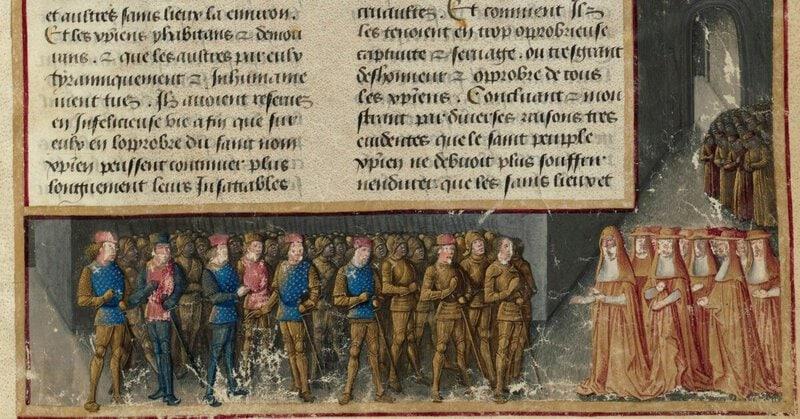
In the autumn of 1095, a letter arrived at the papal court — a plea from Byzantine Emperor Alexios I Komnenos asking for a few hundred mercenary soldiers to help push back the Seljuk Turks pressing against Constantinople’s borders. What Pope Urban II did with that letter would set the medieval world on fire in ways neither man could have predicted, controlled, or fully survived.
A Letter Arrives, and the World Shifts

Alexios was a pragmatist in a desperate situation. The Seljuk Turks had carved deep into Byzantine territory following their crushing victory at the Battle of Manzikert in 1071, and Constantinople — the eastern heart of Christian civilization — felt the pressure closing in. His appeal to Urban was calibrated and specific: he needed soldiers, professionals, men who could fight. He was not issuing a theological call to arms. He was filing a military requisition.
Urban read something else entirely. The pope in 1095 presided over a fractured Christendom — a church still reeling from the Great Schism of 1054 that had split Eastern and Western Christianity, and an institution locked in bitter conflict with European monarchs over who held ultimate authority. In Alexios’s plea, Urban saw the outline of something transformative: a campaign that could reunite the churches, redirect the chronic violence of European knights into holy purpose, and place the papacy at the center of a continent-wide moral project. The letter asked for mercenaries. Urban began planning a crusade.
The central irony of the entire enterprise was already baked in before a single soldier marched. One emperor wanted a limited military solution. One pope wanted a grand historical moment. What they actually produced was a mass movement that would answer to neither of them.
The Speech That Changed Medieval History

On November 27, 1095, at the Council of Clermont in France, Urban II stepped outside the packed council chamber into an open field because no building could contain the crowd that had gathered. What followed was, by most historians’ reckoning, perhaps the most influential speech of the Middle Ages.
Picture the scene: a cold late-autumn day in the Auvergne, frost still on the grass, thousands of clergy and nobles pressed together in the open air, breath clouding in the chill. Urban wove together several urgent threads — reports of Christian pilgrims being persecuted in the Holy Land, the suffering of Eastern Christians under Turkish rule, and the spiritual stakes for everyone listening. He offered a plenary indulgence — remission of the temporal penalties for sin — to all who took up the cross and fought. The crowd’s response erupted in a chant that would echo through centuries: Deus vult. God wills it.
Urban’s vision, though, was precise and controlled. He envisioned a disciplined, knight-led military campaign departing on August 15, 1096 — the Feast of the Assumption — under the command of his personal legate, Bishop Adhemar of Le Puy. This was meant to be an organized military operation with clear leadership, clear purpose, and a chain of command that ultimately ran back to Rome. He was launching a campaign, not a popular movement. The crowd had other ideas.
The Crowd He Could Not Control: The People’s Crusade

Urban’s call was directed at trained warriors — the knights and lords who formed the military backbone of European society. But the speech, and the wave of popular preachers who carried its message across Europe in the months that followed, ignited something far rawer and harder to contain. Tens of thousands of peasants, minor clergy, and desperately poor men and women attached themselves to the charismatic wandering preacher Peter the Hermit, who set off eastward in the spring of 1096 — months before the official campaign was scheduled to begin.
What historians call the People’s Crusade became a catastrophe before it even left Europe. As these loosely organized bands surged through the Rhine Valley, they turned on Jewish communities in a wave of brutal pogroms — massacres in cities including Worms, Mainz, and Cologne that represented the first major organized anti-Jewish violence of the crusading era. Urban had neither planned nor sanctioned this. It was the movement cannibalizing itself before it had fought a single battle, unleashing hatreds that had nothing to do with Jerusalem and everything to do with fear, desperation, and the dangerous energy of a crowd that had been told God was on its side.
Peter’s ragged army eventually crossed into Anatolia, where it was virtually annihilated by the Seljuk Turks at the Battle of Civetot in October 1096. The first military chapter of the First Crusade ended not in glory but in slaughter, the bodies of thousands of pilgrims left in the dust of a field far from the Holy Land. Urban had written the opening line of the story. The story was already rewriting itself.
The Princes March: The Military Campaign Begins

By late 1096, the military force Urban had actually envisioned began to assemble — and it was formidable. Great lords converged on Constantinople from across Europe: Godfrey of Bouillon from Lorraine, Raymond IV of Toulouse from the south of France, Bohemond of Taranto from Norman southern Italy, Robert of Normandy from the duchy neighboring England. Each carried his own mixture of motives — genuine piety, hunger for land, the lure of adventure, the pressure of debt, the pull of glory — and none of them was fully under anyone’s control, including the pope’s.
The armies converged on Constantinople in late 1096, creating immediate friction with Alexios, who had wanted mercenaries and instead found himself hosting an independent army of European nobility with its own agenda. Before advancing, Alexios required the crusade leaders to swear oaths that any former Byzantine territory they recovered would be returned to the empire — oaths that would soon prove deeply contentious. The Siege of Nicaea in May and June of 1097 succeeded, but the city was surrendered to Byzantine forces rather than the crusaders, stoking resentment that would fester for years. Then came Antioch.
The Siege of Antioch, lasting from October 1097 to June 1098, nearly destroyed the entire enterprise. Disease, starvation, desertion, and a brutal Turkish countersiege pushed the crusading army to the edge of annihilation. When Antioch finally fell — aided by a secret arrangement that Bohemond had negotiated with a sympathizer inside the walls — the fractures Urban had never resolved burst open completely. Bohemond refused to hand the city over to the Byzantines as the sworn oaths required. He kept it for himself, establishing his own principality and shattering the alliance with Constantinople. The crusade had produced its first crusader state, and its first act of naked self-interest dressed in holy clothing.
By the time the exhausted, disease-ravaged, drastically reduced army finally turned south toward Jerusalem in the spring of 1099, it was a fundamentally different creature from the force that had departed Europe. Three years of war, starvation, political betrayal, and raw improvisation had shaped it into something Urban had not launched and could not have recognized.
Jerusalem Falls: Glory, Grief, and Atrocity

The Siege of Jerusalem ran from June to July 1099 — the climax the entire terrible journey had been building toward. On July 15, 1099, the crusaders breached the walls. After three years of marching, dying, and enduring, they were inside the city that had been the spiritual destination of every sermon, every prayer, every desperate mile.
What followed was a massacre. Contemporary accounts — from crusaders, from Muslim chroniclers, from Jewish sources — describe the killing of a large portion of the city’s Muslim and Jewish inhabitants. The soldiers who had wept on the road to Jerusalem wept again at the Church of the Holy Sepulchre, believing they had fulfilled God’s command. The emotional truth of their journey and the brutal reality of what they had done occupied the same moment, in the same city, in apparent coexistence — a tension that would haunt the Crusades’ legacy for centuries.
The First Crusade’s military arc closed with the Battle of Ascalon on August 12, 1099, where the crusaders defeated a Fatimid relief army and secured their hold on the conquest. Godfrey of Bouillon, who declined the title of king on the grounds that no Christian should wear a crown of gold where Christ had worn a crown of thorns, became the first ruler of Jerusalem under the title Advocate of the Holy Sepulchre. The Latin East had been established.
Pope Urban II never learned any of this. He died on July 29, 1099 — fourteen days after Jerusalem fell — without ever receiving word of the victory his speech had set in motion. The man who started everything died before the story ended.
What Urban Actually Wanted — and What He Got Instead

Return to the letter. Urban had wanted a controlled military expedition that would heal the Great Schism, elevate papal authority above the quarrelsome kings of Europe, and redirect knightly violence into something holy and manageable. He got a transformation of European civilization that answered to none of those ambitions.
The crusade produced the Crusader States — the Kingdom of Jerusalem, the County of Tripoli, the Principality of Antioch, and the County of Edessa — independent polities in the Levant governed by European lords who answered to no pope and acknowledged no unified Christian authority. It deepened the very schism it was meant to heal: Byzantine-crusader relations were poisoned by broken promises, beginning at Antioch and accelerating through generations of mutual suspicion that would culminate, catastrophically, in the sack of Constantinople during the Fourth Crusade of 1204. It launched nearly two centuries of further crusading — a cycle of holy war that reshaped the Mediterranean world, accelerated the exchange of ideas, goods, and technologies between Islamic and European cultures, and left wounds in interfaith relations that remained visible long after the last crusader state fell in 1291.
For anyone tracing the First Crusade back to its roots, the deeper story was never just about sieges and saints. It was about the moment medieval Europe discovered it could mobilize mass emotion across an entire continent — and discovered simultaneously that it had no way to put that force back in the bottle once it was out.
Why a Single Speech Still Echoes Nine Centuries Later
The First Crusade is a masterclass in unintended consequences. A desperate emperor wrote a practical letter. An ambitious pope heard a historic opportunity. A crowd in a cold French field heard a divine command. Three parties, three different messages from the same words — and the result was a movement that reshaped the world’s map, its faiths, and its collective memory.
Urban’s speech at Clermont on November 27, 1095, is still studied today not merely as a moment in religious history but as a case study in rhetoric, crowd psychology, and the impossible gap between a leader’s intentions and a movement’s momentum. He crafted a call carefully aimed at specific people for specific purposes. What he actually released was something no one had yet developed language for — a continent-wide mobilization of belief, fear, ambition, and violence that operated by its own logic from the moment the crowd first shouted Deus vult.
The First Crusade, from its chaotic launch in 1096 to the blood-soaked morning of July 15, 1099, was not the unfolding of a plan. It was a spark that became a wildfire, lit by a letter whose author died before he could see — or answer for — what it had burned.

 English
 Arabic
 French
 Portuguese
 Deutsch
 Turkish
 Dutch
Dutch
 Italiano
 Russian
 Romaian
 Portuguese (Brazil)
 Greek
Greek