


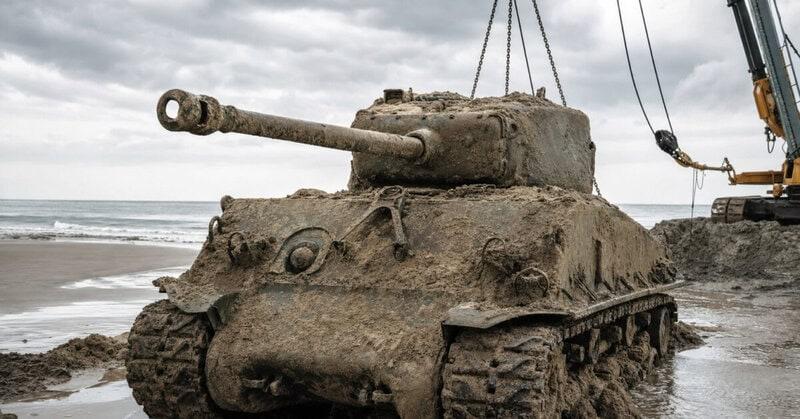
The machine that emerged from the sand near Germany’s North Sea coast was not supposed to be there — not anymore, not after eighty years, not after the war that swallowed it whole had long since been folded into history books and museum exhibits and the careful grammar of remembrance. But there it was: roughly 29 metric tons of Wehrmacht steel, dark with moisture, its hull unmistakable once the earth gave enough of itself away to let the shape speak.
The Sand Gave Something Back

Construction workers operating near a German naval air base were doing what construction workers do — pushing through resistance, following a schedule, thinking about the job rather than the ground beneath it — when their machinery struck something that did not behave like soil or bedrock or buried infrastructure. The resistance had a quality to it, a deliberate geometry, the kind that only comes from manufactured things. When they stopped to look, they were looking at armor plating. They were looking at steel road wheels. They were looking at a combat vehicle that had simply ceased to exist as far as the postwar world was concerned, and had spent eight decades becoming part of the coastline instead.
This was no museum piece rescued from a collection, no monument erected to mark a battle. It was a StuG III assault gun — a Sturmgeschütz III, in the Wehrmacht’s precise terminology — a workhorse of the German armored forces, half-swallowed by coastal sand within reach of the North Sea’s grey horizon. The emotional weight of a find like this is not the rarity of the object itself. It is the ordinariness of its disappearance. No dramatic burial ceremony, no deliberate concealment — just a heavy machine settling into soft ground near a losing coast while the war moved on without it, and the sand doing what sand does: covering, absorbing, forgetting.
The question that hangs over the discovery is the same one the workers must have asked as they stood at the edge of the excavation, looking down at something that last moved when the world was at war: how does an armored fighting vehicle disappear so completely that it takes a routine construction project — not archaeologists, not historians with ground-penetrating radar, not a deliberate search — to bring it back into the light?
What Exactly Is a StuG III — and Why Did Germany Build So Many of Them?

To understand why this vehicle ended up on a German coastline rather than in a museum, it helps to understand what it was and why Germany built so many of them. The StuG III is not a tank in the classic sense — it has no rotating turret, no commander’s cupola rising above the hull. It is low-slung in profile, built on the Panzer III chassis but stripped of height in favor of concealment, its gun fixed forward in a superstructure that kept a minimal silhouette on the battlefield.
The design logic was simple and brutal: infantry needed mobile artillery that could move with them into battle, eliminate fortified positions at close range, and survive long enough to do it again. The StuG III delivered all of that and was cheaper and faster to produce than a full tank. German factories responded accordingly, manufacturing more than 9,300 of them between 1940 and 1945 — making it the single most-produced German armored fighting vehicle of the entire war. More StuG IIIs rolled off assembly lines than any Panzer IV, more than any Tiger, more than any of the vehicles that tend to dominate the popular imagination of German armor.
Allied tank crews learned to respect the StuG III’s low silhouette, which made it difficult to spot in hull-down positions and harder to hit than taller contemporaries. German commanders valued its reliability and economics — a vehicle that kept factories productive and front lines supplied without the complexity of heavier designs. With over nine thousand built, StuG IIIs ended up everywhere the Wehrmacht fought: North Africa, the Eastern Front, the hedgerows of Normandy. And apparently on the sand of the German coast, where at least one simply never made it out.
The Atlantic Wall and the Armor It Left Behind

The stretch of North Sea coastline where this StuG III lay buried was not quiet ground during the war. It was part of the Atlantic Wall — Hitler’s vast fortification network stretching from the northern tip of Norway to the Spanish border, a continental defense system built on the assumption that the Allies would eventually attempt an amphibious invasion from the west and that concrete, steel, and sufficient German determination could stop them.
Along this coast, the defenses were layered and deliberate. Concrete bunkers housed artillery that could sweep the approaches to shore. Anti-tank obstacles bristled from beaches. Minefields extended inland. Mobile armored units — including StuG IIIs positioned to respond rapidly to any landing — waited in reserve, part of a defensive doctrine that understood static fortifications alone could not hold a beachhead if the enemy established one. The assault guns were the mobile fist behind the concrete wall.
What happened to all of that hardware as Germany’s position collapsed in 1944 and 1945 is a story the history books tend to summarize quickly: retreat, abandonment, destruction. Retreating armies disabled vehicles to prevent capture. Fuel ran out and machines were left where they stopped. The chaotic geography of defeat — contested roads, broken supply lines, units dissolving under Allied pressure — meant that equipment was lost not in dramatic last stands but in the mundane entropy of an army coming apart. Some vehicles were burned. Some were driven into rivers or marshes. Some, apparently, settled into soft coastal ground and stayed there.
The StuG III found near the naval air base is, in this sense, an Atlantic Wall remnant hiding in plain sight — or rather, hiding beneath it. The concrete bunkers crumbled over decades. The minefields were cleared by patient engineers in the postwar years. But this StuG III found a more intimate concealment, surrendering to the sand one centimeter at a time over eight decades while the world above it rebuilt itself and forgot it was there.
A Construction Project Becomes a History Lesson

The moment of discovery near the naval air base had the quality of something that should not be happening but unmistakably was. Routine excavation work ground to a halt when workers realized the resistance beneath them had a shape — not the shapelessness of natural obstruction but the deliberate geometry of engineered metal. As excavation continued and the sand gave way, the StuG III emerged in a state of reluctant resurrection: half-risen from the earth, its hull dark with decades of absorbed moisture, its form unmistakable to anyone who had ever seen one in a museum or a wartime photograph.
The location itself raises questions that historians will spend considerable time working through. A German naval air base is a specific kind of place with a specific kind of mission, and the presence of a StuG III there is not self-explanatory. Was this vehicle assigned to the base for coastal defense, part of the mobile reserve intended to respond to an Allied landing? Was it abandoned in the final chaotic weeks of the war when the logic of organized defense had already collapsed? Did it sink into soft ground during a maneuver — the North Sea coastline is not forgiving terrain for heavy armor — and prove impossible to recover with the resources available to a losing army?
None of those questions have definitive answers yet, and some may never be answered fully. What is answerable, standing at the edge of that excavation, is the strange vertigo that comes from touching something that last moved when the men inside it were young, when the outcome of the war was still being decided, when the world that would eventually find it buried here had not yet been built.
How Does an Armored Vehicle Vanish for Eight Decades?

The question every reader arrives at eventually is the same one: how does a vehicle of this size — weighing roughly 29 metric tons — vanish so completely that no one finds it for eighty years?
The answer lies partly in the nature of North Sea coastlines, which are not static landscapes but dynamic systems in constant negotiation with weather, tide, and time. Dunes migrate. Storm surges deposit sediment in quantities that can bury substantial objects within years rather than decades. Ground near water — particularly the soft, sandy terrain common to this stretch of coast — can swallow heavy machinery with surprising efficiency, especially if the vehicle was already disabled, already partially dug in for defensive purposes, or already listing into soft ground when it was abandoned. A StuG III that entered the sand at a shallow angle in 1945 might have been invisible to surface inspection within a decade.
This is not an isolated phenomenon. Europe and the Pacific are still surfacing the physical debris of the Second World War with quiet regularity. Tiger tanks have been pulled from French fields where they settled during the fighting in Normandy. Landing craft emerge from British coastlines when storm erosion scours the right stretch of beach at the right angle. Aircraft wrecks appear in French and German rivers during summer droughts when water levels drop. The buried and submerged WWII vehicles found in these circumstances are not rare anomalies — they are evidence of just how much the war deposited in the earth, and how patient the earth has been about returning it.
There is also a human dimension to the forgetting. The soldiers who knew exactly where this StuG III sat — who drove it, who abandoned it, who watched it settle into the sand — either died during the war’s final convulsions, were captured and dispersed into the postwar prisoner-of-war system, or scattered across a shattered Europe with more urgent concerns than the location of hardware on a coast they would never see again. Memory is a resource, and in the aftermath of catastrophic defeat, it gets allocated to survival rather than inventory.
What Happens to a Tank After the Cameras Leave?

A discovery of this kind triggers a process considerably more complex than the moment of finding. Military authorities, heritage specialists, and historians must first assess the vehicle’s condition and determine whether it poses any immediate safety risk — unexploded ordnance in the fighting compartment, deteriorated fuel or lubricants, structural instability that makes close approach dangerous. A WWII armored vehicle that has spent eight decades in a coastal environment may have shed its obvious dangers, but it has not necessarily shed all of them.
Once the immediate safety questions are resolved, the longer conversation begins: what does this vehicle become now? The options are not simple. Full restoration for display in a military museum requires resources, expertise, and a receiving institution willing to commit to the object’s long-term care. Preservation in place as a memorial might honor the site’s significance but raises its own maintenance challenges in a coastal environment. Partial conservation — stabilizing the structure against further deterioration without attempting full restoration — is sometimes the most honest acknowledgment of what time has done to an object and what can realistically be undone.
What the vehicle represents to researchers, regardless of its ultimate physical fate, is something distinct from its value as a display object. A StuG III recovered from a documented location near a specific naval air base is a data point in the history of German coastal defense — evidence about how armored assets were deployed, how they were abandoned, and where the Atlantic Wall’s mobile component ultimately came to rest. That information has value that survives whatever happens to the steel itself.
What will almost certainly not be recovered is the human layer of the story: the names of the crew who last drove this machine, the unit designation stenciled on its hull before the paint weathered away, the exact sequence of decisions and circumstances that put this vehicle into this particular patch of sand. Those details have dissolved as surely as salt water dissolves iron, and the decades have been thorough in their work.
The Shore Remembers What the History Books Forgot
Europe is still exhaling the debris of the Second World War, and it will be doing so for generations. Belgian farmers plow up artillery shells every spring — the phenomenon has a name, the Iron Harvest, because it recurs with agricultural regularity. Rivers across France and Germany reveal crashed aircraft during summer droughts when water levels drop below the sediment that has protected wreckage for eight decades. Beaches surrender armor when storms scour sand from the right depth. The buried WWII artifacts still being discovered across Europe are not anomalies in this pattern — they are the pattern, the slow-motion return of a continental catastrophe’s physical residue.
What a find like this StuG III means for our understanding of the Atlantic Wall is something historians are still assembling, piece by piece and vehicle by vehicle. The Wall’s concrete infrastructure has been studied extensively — the bunkers that survive as tourist curiosities along the French and Belgian coasts, the gun emplacements that have become memorial sites, the anti-tank obstacles that occasionally emerge from shifting dunes. The mobile component of those defenses — the armor that was supposed to reinforce the static fortifications when the invasion came — is less well documented, partly because it moved, and partly because it disappeared in the way this StuG III disappeared: not dramatically, but quietly, swallowed by terrain and time.
These remnants are not relics of victory or defeat in the clean, binary sense that war narratives prefer. They are the physical residue of a continental catastrophe, morally and historically complex, still present in the ground beneath ordinary construction projects, still capable of stopping work and demanding attention eighty years after the events that put them there.
The image that stays with you is the one from the excavation: the StuG III half-emerged from the sand near the North Sea, not triumphant, not tragic in any dramatic sense, simply there — an object that outlasted the ideology that built it, the army that drove it, and the war that consumed both. The sand kept its secret for eighty years, and when it finally let go, it handed the present a question the past never got to answer: what do you do with the things war leaves behind?

 English
 French
 Spanish
 Portuguese
 Deutsch
 Turkish
 Dutch
Dutch
 Italiano
 Russian
 Romaian
 Portuguese (Brazil)
 Greek
Greek