


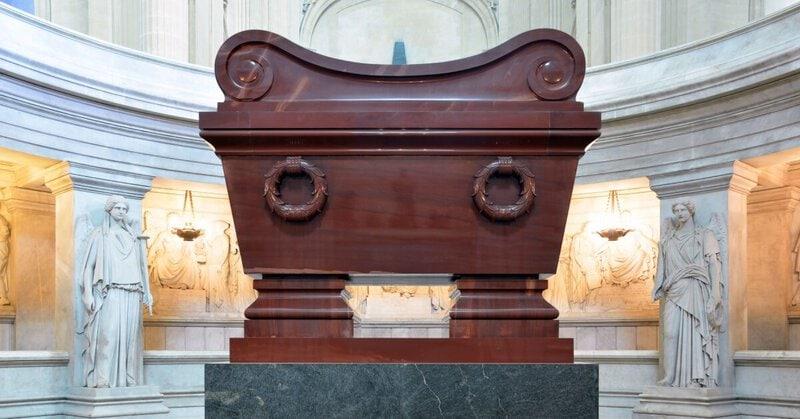
You descend a short flight of stairs, and the noise of Paris disappears. Below you, sunk into the floor of a circular crypt as though the earth itself swallowed him, lies a sarcophagus so enormous — so darkly, imperially red — that for a moment the architecture seems to be holding its breath around it.
The Emperor Beneath the Golden Dome

The first thing most visitors feel standing at the balustrade above Napoleon Bonaparte’s tomb is not reverence, exactly. It’s something closer to vertigo. The outer sarcophagus, carved from deep red quartzite and resting on a base of green Vosges granite, is not merely large — it seems to generate its own gravity. Twelve colossal female figures, sculptor James Pradier’s marble Victories, ring the pit in a slow stone procession, their heads bowed. The mosaic floor gleams. The silence has weight.
And then the central irony settles in, quiet and persistent: this breathtaking monument — one of the most elaborately conceived funerary spaces in the Western world — was not built by Napoleon’s own empire. It was commissioned and ultimately completed by the very regimes that replaced Bonapartist France. The July Monarchy of King Louis-Philippe initiated the project. Napoleon III, the first emperor’s nephew, saw it finished in 1861, decades after the man himself had died in exile on a remote Atlantic island. The tomb of one of history’s most powerful rulers is, at its core, a political instrument built by governments that feared him even from the grave.
Which raises the question that haunts every stone in that crypt: why would rulers who worked to suppress Napoleon’s legend spend a fortune enshrining it?
A Death Far from Home — and a Body That Wouldn’t Stay Buried

Napoleon Bonaparte died on May 5, 1821, on the island of Saint Helena — a British-controlled outpost in the South Atlantic, selected with surgical precision by his captors for its remoteness. The nearest significant landmass was Africa, more than a thousand miles away. The island’s selection was not incidental. It was a message: this man, who had redrawn the map of Europe, would end his days where no admirer could easily reach him, and where no martyr’s death in battle could burnish the legend further.
His first burial suited the circumstance. He was interred in a quiet valley on the island, under weeping willows beside a spring. The name on the headstone was disputed even at the time — a final bureaucratic indignity. For a man who had slept in the palaces of conquered kings and whose coronation at Notre-Dame had been staged to dwarf every European ceremony before it, the ending was almost comically modest. Napoleon’s death and burial were, by design, meant to be forgettable.
France’s restored Bourbon monarchies understood this and worked to keep it that way. For nearly two decades after 1821, successive French governments refused to repatriate his remains. The corpse was treated as a dangerous relic, a smoldering ember that, if brought home, might reignite the revolutionary and Bonapartist fires that constitutional Europe had spent so much blood extinguishing. Better to leave him under his willows in the South Atlantic.
By 1840, however, King Louis-Philippe had run the calculation in reverse. Napoleon’s legend, rather than fading, was growing in his absence — fed by veterans’ memoirs, romantic literature, and the persistent mythology of the Hundred Days. Leaving the body abroad was no longer strategically safe. The risk of Napoleon as an absent martyr, a symbol available to every radical and Bonapartist who wanted to destabilize the July Monarchy, had become greater than the risk of bringing him home and attempting to manage the story.
The Return of the Ashes — A Political Gamble in 1840

The operation was called the Retour des Cendres — the Return of the Ashes — and it was staged with the full theatrical resources of the French state. The frigate Belle Poule, commanded by the Prince de Joinville, Louis-Philippe’s own son, sailed to Saint Helena in the autumn of 1840. When the coffin was exhumed, those present reported finding the body remarkably preserved after nineteen years underground — a detail that spread through France with an almost supernatural charge, as though even corruption had declined to touch him.
The procession through Paris on December 15, 1840 was one of the great spectacles of the nineteenth century. Temperatures were brutal and snow had fallen. Yet hundreds of thousands of Parisians lined the Champs-Élysées to watch the gilded funeral carriage pass beneath the Arc de Triomphe — a monument Napoleon had commissioned but never lived to see completed. Veterans of the Grande Armée, their uniforms decades out of date, wept without shame. A city that had officially moved on had privately never done so.
Louis-Philippe’s logic was nakedly strategic. By staging a grand state funeral and absorbing Napoleon into the official pageantry of the constitutional monarchy, he hoped to nationalize the myth — to transform a revolutionary symbol into a shared French inheritance that no single faction could weaponize. It was a classic maneuver of co-optation: if you cannot kill the legend, put it in uniform and march it down the avenue yourself.
The remains were placed temporarily at Les Invalides while a permanent tomb was designed and constructed — a project that would stretch across two decades and two regimes, its final form shaped as much by dynastic ambition as by architectural vision.
The Building That Was Already There — and What It Meant

The Hôtel National des Invalides was not built for Napoleon. Louis XIV commissioned the complex in the 1670s as a residence and hospital for veterans of his wars — men who had given their bodies to the Sun King’s campaigns and needed somewhere to end their days with dignity. The chapel now known as the Dôme des Invalides was added at the end of the seventeenth century, designed by Jules Hardouin-Mansart, its gilded dome rising to become one of the most recognizable silhouettes on the Paris skyline — a landmark of royal absolutism and Baroque confidence, of France at the height of its ancien régime grandeur.
The decision to place Napoleon here was itself an act of interpretation. Hardouin-Mansart’s royal chapel, built to honor soldiers of a monarchy, was being repurposed to consecrate a different kind of greatness — military, yes, but also meritocratic and post-revolutionary, earned rather than inherited. The choice made an argument: that Napoleon was not an aberration in French history but its culmination.
The engineering of the space underscored this argument. A large area was excavated in the floor of the crypt to accommodate the sarcophagus, so that visitors approaching from the gallery above would be compelled to look down — a carefully calculated spatial relationship that forces a posture of contemplation, almost of obeisance, from everyone who enters. The building itself bows its head. The Dôme des Invalides is now considered the very emblem of the Hôtel National des Invalides, a status the Napoleon tomb has only deepened over more than a century and a half of continuous pilgrimage.
The Tomb Itself — A Monument Designed to Overwhelm

Napoleon’s remains were finally placed in the finished tomb in 1861, under Napoleon III — the first emperor’s nephew, who had ridden his uncle’s legend to power and had obvious dynastic reasons to make the monument as spectacular as possible. By then, the project had become something larger than a burial. It was a legitimizing act: a dynasty constructing its own mythology in marble and stone.
The materials were chosen with the precision of a diplomat selecting words. The outer sarcophagus is carved from red quartzite — frequently described as red Finnish porphyry — quarried in Finland. The choice was deliberate and historically literate: porphyry was the stone of Roman emperors, its deep crimson reserved by ancient tradition for imperial burials. By wrapping Napoleon in it, the designers were making a direct claim to that lineage. The sarcophagus rests on a base of green Vosges granite, the two colors together suggesting both martial severity and something almost liturgical.
Around the pit, Pradier’s twelve Victory figures maintain their eternal vigil. The mosaic floors catalogue the campaigns. Relief carvings on the surrounding walls depict not battles but achievements — the Napoleonic Code, the Concordat with the Church, the founding of the Legion of Honor, the reorganization of the French educational system. This was a deliberate reframing embedded in stone: the tomb presents Napoleon less as the conqueror of Austerlitz than as the architect of modern France. The sword is present, but so is the law book.
The psychological effect on the visitor is not accidental. Every element of the tomb’s design — the descent, the scale, the enforced hush, the circling figures — works together as theater. You are meant to feel small. You are meant to feel the weight of history pressing down from the gilded dome above. Whether you admire Napoleon or distrust him, the space insists that you take him seriously.
The Irony Built Into Every Stone

Return, finally, to the central paradox. The magnificence of Napoleon’s tomb is inseparable from the political calculations of governments that were his ideological heirs only by necessity. Louis-Philippe did not build the monument out of admiration. He built it as a containment strategy — and it failed almost immediately. The grand spectacle of 1840, rather than absorbing Bonapartism into the July Monarchy, helped stoke the nostalgia and populist energy that carried Louis-Napoleon Bonaparte to the presidency in 1848 and to the imperial throne as Napoleon III in 1852.
Louis-Philippe had lit a controlled fire to prevent a conflagration and lost control of both. Napoleon III then completed the tomb for reasons equally self-interested: a spectacular burial site for his uncle served to legitimize his own reign by sheer proximity to greatness. The man in the red sarcophagus became, in death, a resource that each successive government mined according to its own needs.
This is a recurring pattern in the history of great monuments. They are rarely built by those who loved the figure most. They are built by those who need to borrow the figure’s power — to drape their own authority in borrowed grandeur, to manage a myth too large and too volatile to leave unhoused. The tomb at Les Invalides is a masterpiece of exactly this kind of political architecture. Every beautiful, overwhelming inch of it was paid for by calculation.
Practical Information for Visitors
The tomb sits within the Dôme des Invalides, which is accessible as part of the Musée de l’Armée in the 7th arrondissement of Paris. The museum complex is open year-round, though hours vary by season and some areas require separate tickets. The crypt itself can be viewed from the gallery above without descending to the floor level, though the full spatial effect — the enforced downward gaze, the scale of the sarcophagus — is best appreciated from the balustrade. Plan for at least two hours if you intend to move through the broader military museum as well; the collections surrounding the tomb, covering French military history from the medieval period to the twentieth century, are substantial and reward careful attention.
Why People Still Come — and What They’re Really Seeing
Les Invalides receives millions of visitors each year, and the crypt remains its emotional center — the room people remember longest, the image they carry home. Stripped now of nineteenth-century political urgency, the space communicates something rawer and more durable than any dynastic argument: something about the scale of human ambition, the fragility of empire, and the strange second life that power acquires once it is translated into stone.
Modern visitors arrive from everywhere — France and its former colonies, Russia, Britain, the United States, countries whose histories were shaped, directly or catastrophically, by the man in the sarcophagus. They descend the stairs, look down at the red quartzite, and stand in the silence for a moment longer than they expected to. What they feel resists easy categorization. Awe, perhaps. Or unease. Or simply the vertiginous recognition that a single human life can bend the course of civilization and still end up, after all the noise and blood and glory, in a hole in the floor.
Then they climb back up the stairs into the light. Above them the golden dome catches the Paris sky. The question the whole elaborate monument was built to answer — and never quite does — hangs in the air behind them: whose monument is this, really? Napoleon’s? Or the world’s endless, unresolved need to make sense of what he was?

 English
 Arabic
 French
 Spanish
 Portuguese
 Deutsch
 Turkish
 Italiano
 Russian
 Romaian
 Portuguese (Brazil)
 Greek
Greek