


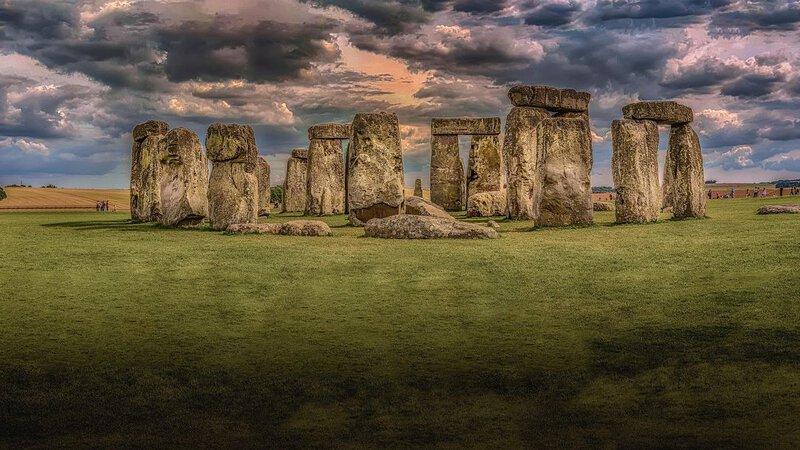
Stand on Salisbury Plain on a clear morning and the stones seem to hold their secrets with a kind of geological patience — as if five millennia of human questions have simply bounced off them. Almost everything the casual visitor thinks they know about Stonehenge turns out to be wrong, and the real story is stranger, older, and more humbling than any of the myths. Here are ten of the most persistent misconceptions, corrected.
1. Stonehenge Was Built All at Once

The monument most people picture snapping into existence in a single heroic effort was actually assembled across roughly 1,500 years, beginning around 3100 BC and continuing until about 1600 BC. That span is not a construction project — it is a civilisation’s slow conversation with itself, passed from grandparents to grandchildren across dozens of generations. Each phase brought different materials, different ambitions, and almost certainly different communities who inherited what came before and decided to keep building.
Calling Stonehenge a single build is a bit like saying Notre-Dame Cathedral was put up in an afternoon. The full archaeological record reveals a monument in perpetual revision — never quite finished, always being reimagined by whoever was alive to reimagine it.
2. The Famous Stone Circle Was the Original Structure

The iconic ring of towering sarsen stones — the image on every postcard, every travel documentary, every phone screensaver — arrived relatively late in the sequence, placed around 2500 BC. The site began as something far more modest: a circular earthwork of ditches and banks, dug with antler picks around 3100 BC, centuries before a single standing stone rose above the Wiltshire skyline. What tourists picture as “Stonehenge” is essentially the monument’s third or fourth act, not its opening scene.
The bluestones, hauled approximately 200 miles from the Preseli Hills in Wales, came before the great sarsens but still long after the earthwork was dug. Each layer of the site represents a different chapter, and the chapter everyone knows best happens to be one of the last ones written.
3. Stonehenge Is Exactly 5,000 Years Old

The “5,000 years old” figure is a satisfying piece of shorthand, but it flattens a sprawling timeline into a single misleading number. The earthwork phase began around 3100 BC; the famous sarsen circle went up around 2500 BC; activity continued until roughly 1600 BC. Depending on which layer of Stonehenge you are measuring, the site is anywhere from about 3,600 to well over 5,000 years old — a range that makes the neat headline figure feel like rounding to the nearest millennium.
The real story is not a single birthday but a centuries-long accumulation of effort and meaning. The British Museum’s Stonehenge timeline traces this layered history with a clarity that the postcard version never quite manages.
4. The Earthwork and the Stone Settings Were Built at the Same Time

It is tempting to picture the whole ensemble — earthwork, bluestones, sarsens — rising together in one coordinated effort. But the circular earthwork was constructed around 2700 BC, while the first stone settings followed later, around 2660 BC, meaning these were distinct construction events separated by generations of people who may not have shared the same intentions at all. The earthwork alone stood as the monument for a stretch before anyone began the extraordinary labour of moving stones across the landscape.
This gap matters because it suggests the site’s purpose evolved over time rather than being fixed from the start. Whoever dug the original ditch was not necessarily building a foundation for what came next — they may simply have been building something complete in itself, and later communities chose to elaborate on what their ancestors had left behind.
5. Stonehenge Is Purely a Bronze Age Monument

The Bronze Age association sticks partly because of the barrows — the burial mounds that cluster around the monument and belong to that era — but Stonehenge’s roots are firmly Neolithic, planted in the Stone Age around 3100 BC. The main sarsen circle went up around 2500 BC, at the very end of the Neolithic period, before bronze had arrived in Britain at all. English Heritage’s account of the monument’s history makes clear that Stonehenge straddles both eras rather than belonging cleanly to either.
Bronze Age communities did continue to use, venerate, and bury their dead around the site until about 1600 BC, which is where the association comes from. But crediting the Bronze Age with building Stonehenge is a little like crediting a later tenant with constructing a house they merely moved into — and then renovated.
6. Human Activity at the Site Began When Construction Did

The ground beneath Stonehenge holds memories far older than any ditch or stone. Mesolithic hunter-gatherers left traces at the site around 7000 BC — roughly 4,000 years before the first Neolithic builders arrived with their antler picks. Among the evidence are large postholes, probably once holding substantial pine posts, whose precise purpose remains a mystery. By the time communities decided to start digging around 3100 BC, the land was already ancient and storied.
Stonehenge was not founded on empty wilderness. It was founded on a place that already meant something to the people who lived there, even if we cannot say precisely what. The British Museum traces the story of the wider Stonehenge landscape back some 9,000 years in total.
7. Stonehenge Was Purely a Place of Worship or Ritual

The single-purpose theory — whether “solar temple,” “druid altar,” or “pagan ritual site” — has always been more satisfying than the evidence allows. Archaeological interpretation describes Stonehenge as a place of worship, meeting, burial, and wonder: a deliberately open-ended list that resists any tidy label. Human remains found at the site span hundreds of years, pointing to sustained use as a burial ground alongside whatever ceremonial or communal function it served at any given moment.
The monument likely meant different things to different generations: a living community’s gathering place in one era, an ancestral cemetery in another, an astronomical marker aligned with solstice sunrises and sunsets in another — possibly all of these things at once, in the way that great sacred spaces tend to accumulate meanings rather than shed them.
8. Burial Activity at Stonehenge Came Long After Construction Ended

The burial mounds visible in the surrounding landscape do belong largely to the early Bronze Age, which can make it seem as though death arrived at Stonehenge as an afterthought, once the builders had moved on. In fact, human cremation deposits inside the monument itself date to the earliest phases of construction, around 3000 BC, making burial a feature of the site almost from the very beginning. English Heritage notes that many burial mounds were eventually raised in the surrounding landscape, tying death and monument together across millennia.
The dead were not an afterthought here; they may have been the whole point. Some archaeologists now argue that Stonehenge was, at its core, a monument to the ancestors — a place where the living came to be near those who had already passed, and where the boundary between the two was deliberately, architecturally, made thin.
9. Stonehenge Is Younger Than the Egyptian Pyramids

This assumption gets the timeline exactly backwards. Stonehenge’s first phase, around 3100 BC, predates the Great Pyramid of Giza — built around 2560 BC — by roughly five centuries. The Roman Empire, which began in 27 BC, postdates Stonehenge’s construction by more than 2,500 years. When Julius Caesar’s forces first arrived in Britain in 55 BC, Stonehenge was already as remote from them in time as the Roman Republic is from us today.
It is one of those rare cases where the seemingly outrageous claim turns out to be the sober historical truth. National Geographic’s overview of Stonehenge facts notes this comparison — and it remains genuinely startling however many times you encounter it. The stones were old before civilisations we think of as ancient had even begun.
10. The Builders Left Some Record Explaining Why They Built It

Of all the myths about Stonehenge, this is perhaps the most quietly devastating to dispel. The people who raised the stones had no writing system. They left no inscription carved into the lintels, no founding myth preserved on clay, no name attached to the vision. Every theory about the monument’s purpose — solar calendar, healing sanctuary, ancestral monument, territorial statement — is inference built on archaeology and careful observation, not testimony from anyone who was actually there.
Five thousand years of human curiosity have produced layers of theory and counter-theory, and the answer remains the same silence the stones have always kept. The builders raised one of the most enduring structures in human history, and then, without a word of explanation, they were gone — leaving the rest of us to wonder.
Stonehenge survives not because we understand it, but precisely because we do not. It is a question mark planted in the English countryside thousands of years ago, still drawing the curious, the reverent, and the simply baffled to stand in its shadow and look up — and to leave, as every generation has, without a definitive answer.

 English
 Arabic
 French
 Portuguese
 Deutsch
 Turkish
 Dutch
Dutch
 Italiano
 Russian
 Romaian
 Portuguese (Brazil)
 Greek
Greek