


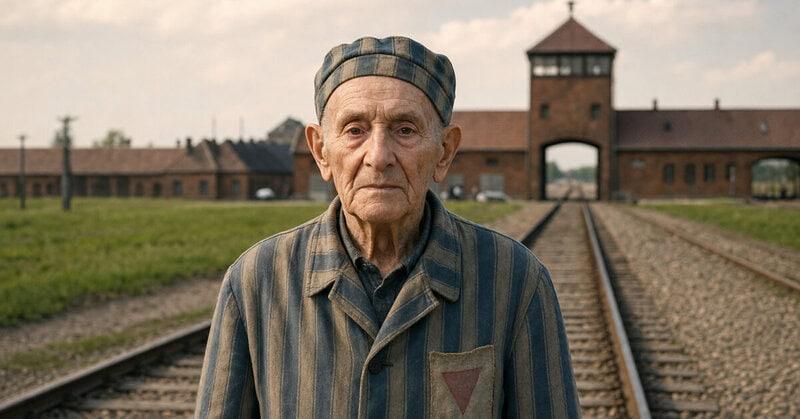
In the spring of 1945, as Allied soldiers threw open the gates of the last concentration camps, they encountered not the broken end of a story but the defiant beginning of a new one. The men and women who walked out of those camps would go on to rebuild synagogues, found nations, raise families, and testify before schoolchildren decades later with voices that refused to go quiet. What follows is an exploration of ten of the most compelling chapters in that half-recorded history — the story of how Holocaust survivors rebuilt lives from almost nothing, and how the memory of their experience is being preserved before the last witnesses are gone.
1. Eugene Black: From Buchenwald’s Forced Labour Tunnels to a Life Reclaimed
Beneath the Harz Mountains, in a tunnel carved by prisoners who were expected to die in the making of it, Eugene Black kept himself alive. He had already survived Buchenwald before being transferred to Mittelbau-Dora and then to the Ellrich sub-camp — a place so lethal that prisoners were routinely worked to death excavating the underground facilities where Nazi engineers assembled V-2 rockets. That Black survived not one but four distinct camps in this network — Buchenwald, Mittelbau-Dora, Ellrich, and finally Bergen-Belsen, where liberation came in April 1945 — defies the cold arithmetic of Nazi camp mortality rates.
His journey through that system was not random. The Nazi administration deliberately dispersed prisoners across multiple sites to extract maximum labour at each stage, meaning that surviving the transfer process itself was a distinct and harrowing ordeal on top of the conditions at each camp. Testimonies like Black’s form the irreplaceable core of Holocaust survivor accounts, giving human texture to an industrial apparatus of suffering that no set of statistics could fully render. To engage with his account is to understand that the Holocaust was not a single place or a single moment but a relentless, engineered process — and that those who endured it carried every stage of it in their bodies for the rest of their lives.
2. Tomi Reichental: The Storyteller Who Refused to Let Memory Die

For decades, Tomi Reichental did something quietly radical: he walked into school gymnasiums and told children exactly what had happened to him. A survivor of Bergen-Belsen who spent his later years in Ireland, Reichental became one of the most recognisable living bridges between the Holocaust and the present, delivering first-hand accounts to young audiences who had never met anyone with direct experience of that history. His conviction was straightforward and unshakeable — that a child who heard his voice would carry the memory in a way that no textbook chapter ever could.
Reichental died aged 90, and his death was felt as more than a personal loss. It marked the closing of a living chapter and served as a stark reminder that the generation of survivors who can speak from direct experience is now departing with accelerating speed. His decades of work in schools stand as a model of what it means to treat personal narrative as a moral obligation — not memoir for its own sake, but testimony as a deliberate gift pressed into the hands of people not yet born when the crimes were committed.
3. Western European Jewish Communities: The Quiet Reabsorption That History Overlooked

When tens of thousands of Jewish survivors from France, the Netherlands, Belgium, and Italy came home after liberation, they encountered something their Eastern European counterparts largely could not: communities that, though damaged, still existed in recognisable form. Neighbours had sometimes protected property; civic institutions had survived; the basic architecture of pre-war life remained standing. This allowed a process of reintegration — quiet, often painful, never simple — that unfolded within existing frameworks rather than in the rubble of total destruction.
Historians have noted that this Western European recovery has received far less scholarly attention than the dramatic displacement and emigration stories of Polish or Hungarian survivors. Survivors who returned to Paris or Amsterdam represent an early and largely under-examined model of Holocaust survivors rebuilding lives through civic reabsorption — a path that was neither straightforward assimilation nor communal reinvention from scratch, but something more complicated and more human than either label captures. Their experience also complicates any single narrative of post-war Jewish life, reminding historians that geography shaped survivorship and its aftermath in profound ways.
4. The Displaced Persons Camps: Makeshift Cities That Became Cradles of Renewal

By the summer of 1945, a vast, unplanned civilisation had taken shape inside former camps and requisitioned barracks across Germany, Austria, and Italy. Hundreds of thousands of survivors who could not or would not return home — because their homes no longer existed, or because returning meant confronting the neighbours who had taken them — gathered in Allied-administered displaced persons camps. Bergen-Belsen itself, where liberation had come just months earlier, became, improbably, a place where people were already building a future.
What happened inside those wire perimeters confounds any image of passive survivors waiting for rescue. Within months, residents had established newspapers printed in Yiddish and Hebrew, theatrical companies staging productions, rabbinical courts adjudicating questions of religious law, and political organisations debating the shape of Jewish life to come. The displaced persons camp experience is central to understanding Holocaust survivor stories not as narratives of rescue but of fierce, immediate self-reconstruction — people insisting, before the world had quite decided what to do with them, that they were already doing it themselves.
5. The Claims Conference: Counting a Generation Before It Disappears

There is something both sobering and strangely hopeful about the fact that an organisation exists whose core task is to locate, count, and support the people who survived the attempt to exterminate them. The Conference on Jewish Material Claims Against Germany — the Claims Conference — has documented that approximately 245,000 Holocaust survivors remain alive across more than 90 countries, a figure that shrinks with every passing year. Many of those survivors live in poverty, particularly in the former Soviet states, and the Conference channels reparations and social-welfare funding to ensure that the last survivors are not left destitute in their final years.
The Conference’s demographic work makes visible what might otherwise remain abstract — that the generation of direct witnesses is finite, that their needs are material as well as historical, and that the window for honouring both obligations is measurably and urgently closing. The data functions simultaneously as a moral ledger and a countdown, framing care for ageing survivors not merely as welfare provision but as one of the final chapters of the Holocaust’s own history.
6. The She’erit Hapletah: Survivors Who Declared Themselves a People, Not a Problem

Within months of liberation, something remarkable occurred in the displaced persons camps: survivors stopped waiting to be defined by the Allied administrations and defined themselves. They reached into biblical Hebrew and reclaimed a phrase — She’erit Hapletah, meaning “the surviving remnant” — that recast their collective identity from refugee status into something older and more purposeful. It was a conscious act of collective will, a decision to be a people with political standing rather than a humanitarian problem to be managed.
The She’erit Hapletah movement elected its own representative committees, which then negotiated directly with Allied commanders, the Jewish Agency, and international bodies, turning refugee encampments into something that functioned, in embryo, like a provisional government. The political voice that survivors built in those camps fed directly into the international pressure that contributed to the founding of the State of Israel in 1948, making the displaced persons camps not merely a transit point but a crucible of modern Jewish political history. This dimension of Holocaust survivor history — collective mobilisation, agency, and self-determination — is one that mainstream commemorative culture has often underplayed in favour of the more familiar grammar of victimhood and rescue.
7. Survivor-Founded Kibbutzim in Israel: Rebuilding the World Through Agriculture and Collective Memory

Some of them were teenagers who arrived in the new State of Israel having lost every member of their families. They had no childhood homes to return to, no parents to correspond with, no inherited property or traditions passed through normal generational channels. What they had was each other and, in some cases, a piece of semi-arid land that needed draining, planting, and defending. The collective agricultural settlements — kibbutzim — that survivor groups established in the late 1940s and early 1950s were, at one level, economic necessities. At another, they were acts of deliberate defiance: the conscious construction of new worlds in the place of destroyed ones.
Several of these survivor-founded kibbutzim did something that distinguished them from other agricultural collectives: from their earliest years, they built memorial rooms and archives alongside their communal dining halls and children’s houses, weaving remembrance into the rhythms of daily life rather than reserving it for occasional ceremony. These settlements represent one of the most tangible examples of Holocaust survivors rebuilding lives not merely as individuals but as deliberately constituted communities — ones whose shared historical identity was not a burden to overcome but the very foundation on which something new was being built.
8. Survivor Testimony Projects: The Race to Record Before the Last Witnesses Are Gone

The USC Shoah Foundation holds more than 55,000 recorded testimonies. The Fortunoff Video Archive at Yale holds thousands more. Behind each recording is a conversation — sometimes halting, sometimes torrential — in which a survivor agreed to sit before a camera and speak about experiences that many of them had spent decades not speaking about at all. The cumulative archive those conversations have produced is among the most extraordinary historical documents of the twentieth century, a library of testimony spanning dozens of languages and as many countries as Jews happened to be living in when the war ended.
The work has grown more urgent, and more technologically ambitious, as the surviving cohort shrinks. Linguists and digital archivists are deploying computational tools to translate, index, and make searchable testimonies recorded in Yiddish, Hungarian, Polish, and other languages, so that a researcher in São Paulo or Seoul can access an account recorded in a community centre in Melbourne or Montreal. With approximately 245,000 survivors still living but the cohort diminishing every year, those working in this field describe the current decade as the final window in which living voices can still be heard — and the last opportunity to ask questions that only the people who were there can answer.
9. Jewish Survivors Who Rebuilt Communities in North and South America

They arrived in Buenos Aires and Montreal, in New York and São Paulo and Toronto, often with nothing beyond the clothes issued at liberation. Within a single generation, many of those same people had founded synagogues, established landsmanshaftn mutual-aid societies, opened Yiddish-language schools, and built cultural organisations that recreated — imperfectly, necessarily differently, but recognisably — the textures of the Eastern European Jewish communities that had been destroyed. Some of those institutions still operate today, decades after their founders are gone, anchoring Jewish communal life in cities that survivors had never imagined as home.
Their stories push back firmly against the comfortable narrative that Holocaust survivors simply assimilated quietly into their new countries, grateful and private. The documentary record — meeting minutes, membership rolls, theatre programmes, school photographs — tells a different story: one of active, deliberate community construction undertaken as a direct response to destruction, and as a repudiation of the assumption that what had been annihilated in Europe could simply be allowed to vanish from the world. To build a synagogue in Montreal in 1952 was, for many survivors, a political act as much as a religious one.
10. The Second Generation: Inheritors of Silence Who Became Keepers of the Flame

They grew up in households where the Holocaust was simultaneously the defining event and the unspoken presence — the thing that explained everything and was explained almost never. The children of survivors learned to read silences as fluently as they read the rare, fragmentary stories that escaped their parents’ lips at the dinner table, in the middle of the night, or not at all. Psychologists and memoirists have documented this inheritance extensively, tracing the way that trauma travels across generations not always through explicit narrative but through anxiety, hypervigilance, and an intensity of feeling about Jewish identity and continuity that can be difficult to explain to those who did not grow up in such households.
As the last direct survivors die, the second generation has stepped into the public role their parents occupied, appearing in schools, parliaments, and documentary films to speak of what they were told, what they intuited, and what they pieced together from documents and silences over a lifetime. Organisations such as the World Federation of Jewish Child Survivors of the Holocaust and their Descendants have formalised this custodial role, recognising that the transmission of Holocaust history now depends on those who heard the stories at kitchen tables rather than in the camps themselves. Increasingly, it is the third generation — the grandchildren — who are picking up the same weight, understanding that the question of how memory survives the disappearance of its first witnesses is not an academic matter but a task that has been handed to them personally.
What runs through all ten of these stories is the same insistent current: survival was never simply endurance. The generation that lived through the Holocaust spent the decades that followed not resting in the relief of having lived but building — schools, settlements, archives, communities, testimonies — as if construction itself were the most complete answer possible to destruction. The race to record that effort, in every form it took, remains the most urgent work still to be done.

 English
 Arabic
 French
 Spanish
 Portuguese
 Deutsch
 Dutch
Dutch
 Italiano
 Russian
 Romaian
 Portuguese (Brazil)
 Greek
Greek