


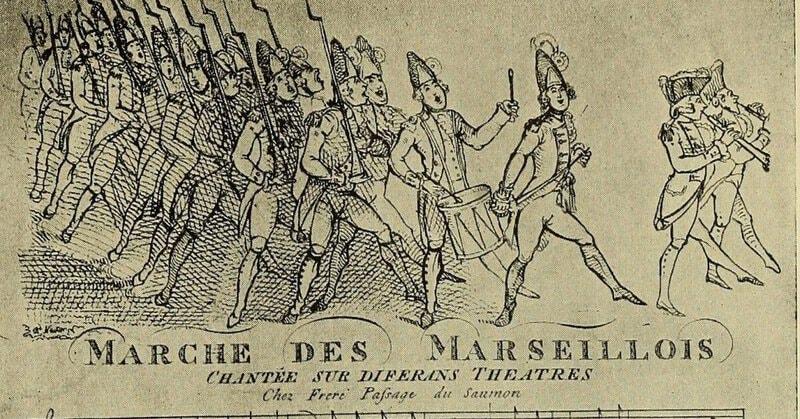
On the night of April 25, 1792, a young French army engineer sat down by candlelight in Strasbourg and, before sunrise, handed the world one of the most electrifying pieces of music ever written. What he could not have known — what neither he nor his small, delighted first audience could have imagined — was that the song would outlive kingdoms, survive three separate government bans, and still be raising the hairs on the backs of necks more than two centuries later.
One Candle, One Night, One Song That Changed History

The city of Strasbourg in late April 1792 was vibrating with something between excitement and terror. France had declared war on Austria just five days earlier, on April 20, and the mood in the garrison town was that of a place bracing for catastrophe. It was in this atmosphere that Philippe-Frédéric de Dietrich, the mayor of Strasbourg, reportedly encouraged a guest at his table to do something about the problem of morale. The guest was Claude Joseph Rouget de Lisle, a captain of engineers with a sideline in poetry and music. The challenge, more or less, was this: write us something worthy of the moment.
Rouget de Lisle did not disappoint. Working through the night — tradition holds it was a single, unbroken creative session — he composed both the words and the melody of what he called the Chant de guerre pour l’Armée du Rhin, the War Song for the Army of the Rhine. By morning, he performed it for Dietrich and his household, the first audience of what would become France’s national anthem. The room was reportedly moved. History, in its quiet way, had just been made.
The irony that followed is almost too neat to believe. The man who wrote France’s most enduring symbol of revolution was himself a royalist sympathizer — someone who believed in constitutional monarchy, not the radical republic his lyrics seemed to demand. Within a year, Rouget de Lisle would be arrested as a counter-revolutionary during the Terror and come within a breath of the guillotine. The song, meanwhile, would go on to be suppressed by three separate French governments. A piece of music designed to be unstoppable had a habit of making those in power very nervous indeed.
The World Rouget de Lisle Was Writing Into

To understand why the song hit its first listeners like a thunderclap, you have to feel the pressure-cooker atmosphere of spring 1792. The French Revolution was three years old and deeply unstable. The monarchy was crumbling from within. On France’s eastern borders, the professional armies of Prussia and Austria — among the most powerful military forces in Europe — were massing with the explicit aim of crushing the revolutionary experiment before it could spread. The threat was not rhetorical. It was real, it was imminent, and ordinary French citizens knew it.
The lyrics Rouget de Lisle wrote that night are a direct, almost journalistic response to this terror. The “ferocious soldiers” of the opening verse are not a poetic abstraction — they are the coalition armies that French men and women genuinely feared would march into Paris and restore the old order at bayonet-point. This is a song born from genuine existential dread, not committee-room patriotism, and listeners in 1792 felt every syllable of it. When Rouget de Lisle wrote about the enemy coming to slit the throats of sons and companions, he was describing what his audience believed was actually about to happen.
That proximity to real catastrophe is part of what gives the anthem its almost uncomfortable urgency. It was not written at a safe distance from events. It was written five days into a war that France was not confident it could win, by a soldier who might himself have marched toward those Austrian lines. The melody surges upward in a way that sounds less like celebration than like adrenaline — because that is exactly what it was.
How a Strasbourg War Song Became La Marseillaise

Rouget de Lisle’s original title, Chant de guerre pour l’Armée du Rhin, tells you everything about his intentions and nothing about his song’s destiny. It is a functional, military name — the kind of thing you stamp on sheet music and distribute to regiments. The transformation began with a journey.
The song spread through printed copies and word of mouth, moving south through France over the spring and early summer of 1792. It reached Marseille, where a battalion of volunteers was preparing to march north to Paris to defend the revolution. They adopted it as their marching anthem and sang it the entire way — hundreds of miles on foot, through summer heat, the same verses over and over. When these southern volunteers, known as the Fédérés de Marseille, finally marched into the capital, Parisians who had never heard the song before heard it for the first time coming from the throats of men from the south. The assumption was instant and logical: it must be a song from Marseille. The name La Marseillaise attached itself immediately and has never let go.
What is less well known is that the anthem contains seven full verses, not the single verse and refrain most people recognize today. The complete song moves through a dramatic narrative arc — from the initial call to arms and the terror of invasion, through verses targeting aristocrats and tyrants, to a closing verse that speaks of peace. It is, in its entirety, a piece of republican ideology set to music. Most citizens today have never heard it in full, which means most have never quite grasped how radical the whole document really is.
The Bloody, Radical Lyrics That Made Governments Nervous

The refrain the world knows — Aux armes, citoyens!, “To arms, citizens!” — is stirring enough. But the lines that follow it into the chorus are what have troubled critics, monarchs, and schoolteachers for generations. The call for “impure blood” to “water our furrows” is among the most violently explicit imagery in any national anthem on earth. It was not accidental, and it was not metaphor. It was a battle cry written for soldiers about to fight, by a man who understood that softness would not serve the moment.
For the monarchies of Europe, singing La Marseillaise was an act of political defiance as much as patriotism. The full seven verses contain explicit denunciations of aristocrats, tyrants, and those who would restore royal power. Set to a melody that propels itself forward like a charge, the combination made the song genuinely dangerous — not dangerous in any vague cultural sense, but dangerous in the way that things which inspire people to question and overthrow governments are dangerous.
The deepest irony belongs to Rouget de Lisle himself. The man who wrote the radical republican anthem was a royalist. He supported a constitutional monarchy, believed in reform rather than revolution, and grew increasingly horrified as the Terror consumed the moderate voices around him. The song he created in a single night was used to justify executions he found abhorrent. He was arrested in 1793, his politics deemed insufficiently revolutionary, and came extraordinarily close to sharing the fate of Philippe-Frédéric de Dietrich — the Strasbourg mayor who had first encouraged him to write the song, and who was guillotined that same year.
Three Times France Tried to Silence Its Own Anthem

The first suppression came from an unlikely source: Napoleon Bonaparte. Napoleon understood music’s power over crowds better than almost any ruler of his era, which is precisely why he did not want La Marseillaise anywhere near his regime. A song that celebrated the destruction of kings had no place in an empire built by a man who intended to become one. He suppressed it in favor of stately, imperial compositions that evoked grandeur without the awkward suggestion that tyrants deserved to be overthrown.
The second ban was, if anything, more predictable. When Napoleon fell in 1815 and the Bourbon monarchy was restored, the anthem that had soundtracked the revolutionary years was banned outright. That the Bourbons would not want to hear the song that had accompanied the end of the old regime played at state occasions is hardly surprising. That they believed banning it would make people forget it was a catastrophic misreading of how forbidden music works.
The third suppression arrived under Napoleon III, who came to power in 1851 after a coup that dismantled the Second Republic. A song explicitly written to rouse citizens against authoritarian rulers had, once again, no useful role in an authoritarian ruler’s cultural programme. It was replaced, shelved, officially discouraged.
Each ban achieved the opposite of its intention. Forbidden music does not disappear — it goes underground, where it acquires the additional power of being contraband. By the time of each restoration, La Marseillaise carried not just its original revolutionary charge but the accumulated weight of suppression itself. It had become the sound of resistance, and every government that tried to silence it handed it another layer of meaning.
Restoration, Reinvention, and the Anthem’s Strange Modern Life

La Marseillaise was officially restored as the French national anthem in 1879, under the Third Republic — a deliberate political act, a reclamation of revolutionary values after decades of rule by men who preferred those values forgotten. The restoration was itself a statement: France was choosing a side in its own long argument about what it was and what it wanted to be.
Its most famous moment in twentieth-century popular culture came not in France but on a Hollywood soundstage. The 1942 film Casablanca contains a scene in which French exiles in a Moroccan café drown out a group of Nazi officers by rising to sing La Marseillaise, their voices breaking with emotion. The scene is fiction. But it works — it has always worked, on audiences seeing it for the first time and on audiences who have seen it dozens of times — because it is built on something true. The anthem’s meaning under occupation, under oppression, under the boot of exactly the kind of force Rouget de Lisle was writing against in 1792, requires no explanation. It is felt immediately.
In modern France, the anthem remains a living argument rather than a settled question. Debates surface regularly about its violent imagery and whether a contemporary republic should be comfortable with its most prominent cultural symbol calling for blood. Athletes are occasionally criticized for failing to sing it at international competitions. Politicians invoke it and argue about what invoking it means. It is not a museum piece. It is a document that France is still, in some sense, in the middle of reading.
Rouget de Lisle, who survived imprisonment during the Terror and lived to see his song become famous, died in 1836 in relative poverty and obscurity — aware of what he had created, but never receiving the full honors his creation might have suggested he deserved. They came eventually: in 1915, his remains were transferred to Les Invalides, where France keeps its most distinguished dead. It took more than a century, but the country finally acknowledged what one sleepless night in Strasbourg had produced.
Why a Song Written in Hours Has Lasted Two Centuries
The paradox at the heart of La Marseillaise is the paradox of the best art made under pressure: it was written fast, in crisis, by a man who did not fully share its politics — and it captured something so primal about the desire for freedom and survival that no government could permanently extinguish it. The history of the French national anthem is, in miniature, the history of France itself — revolutionary, contested, suppressed, restored, and always slightly uncomfortable for whoever is currently holding power.
Music historians have long noted that the surge of Rouget de Lisle’s melody, combined with imagery drawn from immediate, lived terror, creates a visceral urgency that anthems written by committee almost never achieve. That quality cannot be manufactured. It comes from a specific man, in a specific city, on a specific night, genuinely afraid of what the morning might bring and channeling that fear into something that transcends it.
Somewhere in France tonight — at a football stadium, at a civic ceremony, in a classroom where children are learning what the words mean — someone is singing a song written by candlelight during a single April night in 1792. The governments that tried to silence it are gone. The man who wrote it died uncertain of his legacy. The song is still there, and the adrenaline built into every note still functions exactly as designed: to make the people singing it feel, for a moment, as though they are capable of anything.

 English
 Arabic
 French
 Spanish
 Portuguese
 Turkish
 Dutch
Dutch
 Italiano
 Russian
 Romaian
 Portuguese (Brazil)
 Greek
Greek