


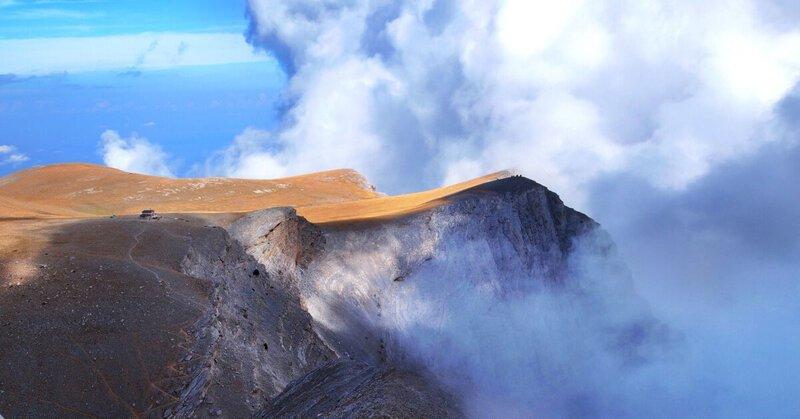
On a clear morning on the Thessalian plain, a traveler looked north and saw a mountain so tall its summit had already disappeared — swallowed by cloud before the sun had fully risen. It happened every day, to real people, for thousands of years. And for most of those years, nobody thought it was a weather phenomenon. They thought it was a door.
The Mountain the Greeks Could Actually See

Mount Olympus rises to 2,918 meters — just over 9,573 feet — making it the highest peak in Greece. That number alone doesn’t capture what it looks like from below. Standing on the flat agricultural land of Thessaly, the mountain erupts from the horizon with an almost theatrical abruptness, its upper reaches perpetually tangled in cloud and shadow, its lower flanks green and ordinary-looking by comparison. The contrast is jarring even now. In antiquity, without a shred of meteorological vocabulary to explain it, the sight must have felt like a proclamation.
The mountain sits on the border between Thessaly and Macedonia in northern Greece — a specific, locatable, measurable place. You can find it on a map today in the same position ancient cartographers placed it. That geographical precision matters enormously when trying to understand how ancient Greek religion actually worked. Olympus wasn’t a symbolic elsewhere, a vague heaven floating above the clouds in the imagination. It was a real landmark that farmers, sailors, and soldiers navigated by. The gods lived there the way a king lived in Pella or a magistrate lived in Corinth — not metaphorically, but as a statement of physical fact.
This is the central tension that makes the story of Olympus so compelling: for most ancient Greeks, the divine was not an abstraction. It was located. It was north-northwest, behind those clouds, right now. The mountain’s chronic shroud of mist didn’t undermine the belief — it confirmed it.
Why a Mountain? How the Greeks Mapped the Sacred onto the Physical World

Ancient cultures across the world independently arrived at the same architectural metaphor: the mountain as a vertical axis between the human world and whatever lay above it. Sinai, Fuji, Ararat — the pattern repeats. But the Greeks were unusually explicit in insisting that Olympus was a literal address rather than a symbolic one. When Homer’s characters in the Iliad refer to the gods “going up to Olympus,” they use the same directional language they would use for traveling to any city. Athena descends to the battlefield and returns. Hera borrows Aphrodite’s girdle and makes plans on the mountainside. The gods argue, scheme, and eat — and the mountain is where all of it happens.
The cloud-barrier was theologically convenient in a way that required no theological engineering. Nature provided the explanation for why no mortal could simply hike up to Zeus’s hall and start asking uncomfortable questions. The boundary between human and divine was not invisible; it was the cloud line, visible from any village in Thessaly on any given afternoon. Greek cosmological texts went further, specifying that the gods dwelled not merely on the mountain’s peak but above the weather entirely — in a zone of perpetual calm and golden light untouched by the storms that regularly battered the lower slopes. This wasn’t poetic license; it was a genuine cosmological claim, and it mapped neatly onto what any observant Greek actually saw: a peak that disappeared into violent weather while, on clear days, something serene and still seemed to exist above the turbulence.
The Olympian Pantheon: Who Lived There and What They Did All Day

The canonical twelve Olympians — Zeus, Hera, Poseidon, Demeter, Athena, Apollo, Artemis, Ares, Aphrodite, Hephaestus, Hermes, and Dionysus (with Hestia sometimes counted in Dionysus’s place) — were not a tidy, harmonious committee. They were a community riven by jealousy, ambition, and ancient grudges, crammed into a divine palace court and forced to share a mountain. What makes Homer’s treatment of them so enduringly strange and brilliant is precisely this mundane domesticity. Hephaestus, lame from a fall, limps between the gods serving as cupbearer. The assembled Olympians drink nectar and eat ambrosia. They bicker. Zeus sulks. Hera schemes. The whole enterprise reads less like an account of heaven than like dispatches from a particularly dysfunctional aristocratic household.
That domestic texture was not accidental. It served to make the geography of Olympus feel inhabited and immediate. The gods weren’t static icons enthroned on a distant peak — they had itineraries. They descended to intervene in the Trojan War, in the voyages of Odysseus, in the fates of individual mortals who had caught their attention for good reasons or bad. Then they returned to Olympus to report, argue about what had happened, and be overruled or supported by Zeus, whose authority was always contested and never quite absolute. The mountain was a parliament as much as a paradise, and the business conducted there had direct consequences for the world below.
Conflict was, in a sense, the point. Ares and Athena backed opposing sides at Troy. Hera maintained a decades-long campaign of harassment against Heracles. Poseidon pursued a vendetta against Odysseus. All of it originated on Olympus, descended into the human world, and returned to Olympus to be processed. The mountain’s narrative function was to be the place where divine decisions were made — and then unmade, revisited, and argued over again.
The Real Mountain: What Climbers and Ancient Visitors Actually Found

Ancient Greeks did not attempt to summit Olympus. This wasn’t purely religious inhibition, though that was real — the upper zones were considered sacred territory, off-limits to mortals in the same way that the inner sanctum of a temple was restricted. It was also that the mountain is genuinely brutal. The upper ridges are jagged limestone, exposed to sudden violent storms that can materialize within minutes. The summit zone — the cluster of peaks around Mytikas, the highest point at 2,918 meters — is a place of vertiginous drops, unstable rock, and weather that shifts between blazing clarity and impenetrable fog in the time it takes to eat lunch. Even with modern equipment, the summit demands serious respect.
The first recorded modern ascent of Mytikas was made in August 1913 by Swiss climber Frédéric Boissonnas and his Greek companion Christos Kakkalos. For virtually the entire span of ancient Greek civilization — and for millennia before it — the actual summit remained unvisited by documented human presence. That fact did extraordinary work in preserving the mountain’s mystique. No one could come back from the top and report that there was no palace up there, no nectar-drinking assembly of gods. The cloud remained intact, literally and theologically.
What ancient Greeks could do — and did, regularly — was approach the mountain’s base. Archaeological evidence confirms cult activity at sanctuaries and shrines on the lower slopes, places where ordinary worshippers could make offerings and address the gods of Olympus without trespassing on divine territory. The mountain was sacred in a graduated way: approachable at its feet, awe-inspiring on its flanks, and absolutely forbidden at its crown. That tiered sacredness mapped the social logic of ancient temples onto vertical geography.
How “Olympus” Became Bigger Than the Mountain

As Greek colonists spread across the Mediterranean world and into Asia Minor, they carried the name with them. At least eighteen other mountains in the ancient world were called Olympus — in Cyprus, in Lycia, in Mysia, among other locations. This wasn’t casual naming. It was an act of sacred geography: a way of planting the belief system in new soil, of saying that the gods were here too, behind these clouds, not only behind those ones in Thessaly.
The word “Olympus” itself may be pre-Greek in origin, possibly descending from an earlier Aegean or Anatolian language root. If so, that suggests something remarkable — that the mountain’s sacred status could predate the Olympian religion that would eventually be constructed around it. An earlier people may have looked at the same cloud-wreathed peak and concluded, in their own language, that something extraordinary lived there. The Greeks may not have invented the mountain’s power so much as inherited and elaborated it.
When Rome absorbed Greek religion, the gods migrated conceptually upward and inward, becoming less specifically located and more diffusely celestial. “Olympus” began its long transformation from a proper noun into a common one — a word for heaven in general, for wherever the divine happened to reside. That linguistic drift continued. Today, Mount Olympus appears as a place name on four continents, including peaks in Washington State in the United States and in Cyprus. The name has been adopted by technology companies and other enterprises alike, each borrowing the mountain’s ancient association with precision, aspiration, and something reaching toward the sky. The specific limestone peak in northern Greece still draws hundreds of thousands of visitors each year, the mythology continuing to function as it always did: pulling people toward a real place in pursuit of something they can almost, but not quite, see.
What the Belief Actually Meant for Ordinary Greek Life

For the average person living in ancient Greece, the gods on Olympus were not a comforting abstraction or a poetic convention. They were watching, and they were close. The mountain’s physical presence in the landscape — visible on clear days from considerable distances — meant that divine attention was not a metaphor but a spatial reality. You lived below the gods. You could point at where they lived. That proximity created a spiritual urgency that shaped daily behavior, ritual practice, and civic life in ways that are difficult to fully reconstruct but easy to underestimate.
The great Panhellenic festivals made the connection explicit. The Olympic Games, held at Olympia in the western Peloponnese, were dedicated specifically to Zeus — the chief deity of Olympus — binding athletic competition, civic identity, and the geography of divine residence into a single recurring institution. When athletes competed, they were performing before an audience that included, at least in principle, the god himself. The stakes were understood to be more than athletic.
The concept of hubris — one of ancient Greek culture’s most sophisticated and persistent ideas — was partly defined by the spatial logic of Olympus. The gods were above; humans were below. The gap between them was not an invitation but a warning. Sisyphus, Tantalus, Ixion — the mythological figures punished most catastrophically were those who had attempted, in various ways, to close that distance uninvited. The mountain made the prohibition geographic. You could see the boundary. You knew not to cross it.
Philosophers eventually pushed back against the literal interpretation. Xenophanes, writing in the sixth century BCE, mocked the idea of anthropomorphic gods feasting on a mountaintop, and Plato reimagined the divine as something abstract and eternal rather than locally resident. But popular Greek religion didn’t follow the philosophers with any speed. Olympus remained literally populated in the imagination of ordinary Greeks well into the classical period and beyond.
Practical Guide: Visiting Mount Olympus Today
Mount Olympus was designated Greece’s first national park in 1938, and the designation has held through every subsequent decade of development pressure. The park encompasses approximately 240 square kilometers of protected landscape, including dense pine and beech forest, deep gorges, and the exposed limestone ridgelines of the summit zone. The biodiversity within the park is considerable — over 1,700 plant species have been recorded on the mountain, including dozens of endemic species found nowhere else.
The most popular approach for hikers targeting the summit begins at the village of Litochoro on the mountain’s eastern flank, a small town that has organized its identity almost entirely around its position as the gateway to Olympus. The Enipeas gorge trail winds upward through pine forest and past cold streams, and even in summer the air changes quality as you climb — cooler, quieter, with the sound of the plains dropping away behind you. The trail leads to the refuge huts at around 2,100 meters, where hikers typically spend the night before pushing for Mytikas in the early morning hours, before the afternoon storms arrive.
Those storms are not a minor inconvenience. They are the same sudden, violent weather events that have defined the mountain’s character for thousands of years, and they remain genuinely dangerous for anyone caught in the summit zone unprepared. The standard advice — start before dawn, be below the treeline by early afternoon — is not conservative overcaution. It reflects the mountain’s actual rhythms. Mytikas requires scrambling on exposed limestone and is graded as a non-technical climb, but it demands sure footing, appropriate footwear, and close attention to the weather.
For those not pursuing the summit, the lower trails through the Enipeas gorge offer exceptional scenery with considerably less exposure. The gorge itself — carved by snowmelt and centuries of erosion — is dramatic in its own right, the kind of landscape that makes it easy to understand why the ancient Greeks saw the divine everywhere they looked in this particular stretch of northern Greece.
Standing at the Base: What the Mountain Still Tells Us
The sacred status of Olympus outlasted the religion built around it. Christian monks established monasteries on its slopes after the Olympian religion had officially ceased. The modern Greek state’s decision to make it the country’s first national park was a secular act that nevertheless acknowledged the mountain’s enduring special status in the landscape and the national imagination. Olympus has been continuously recognized as extraordinary — by pre-Greek peoples, by ancient Greeks, by Byzantine monks, by the modern Greek state — for longer than any single civilization has existed.
The name’s reach into contemporary life is difficult to overstate. It appears on camera lenses designed to capture the world with exceptional precision, on medical equipment manufacturers, on product lines across multiple industries — each borrowing, whether consciously or not, the ancient association between Olympus and something elevated, exact, and aspirational. The mountain has become a permanent metaphor, so thoroughly embedded in the language of ambition and altitude that most people using the word have forgotten there is an actual limestone peak behind it.
But the peak is still there. And when the afternoon clouds close over Mytikas — as they will today, as they did the day Homer was composing, as they did before Homer was born — the experience of watching that summit disappear is essentially unchanged across three thousand years. The ancient Greek standing on the Thessalian plain and the modern hiker watching from the treeline are having, at the level of sheer instinctive awe, almost exactly the same moment. The mountain takes something visible and makes it invisible. It suggests, with great authority, that something is up there. And it declines, with equal authority, to let you see exactly what.

 English
 Arabic
 French
 Spanish
 Portuguese
 Deutsch
 Turkish
 Dutch
Dutch
 Italiano
 Russian
 Romaian
 Greek
Greek