


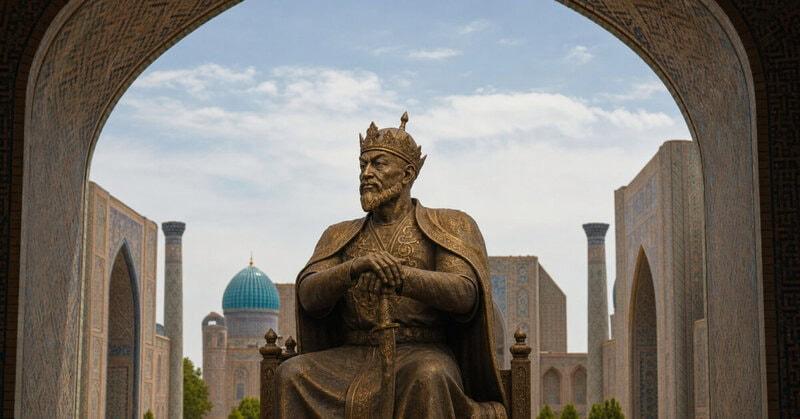
They built towers of skulls and libraries of stars — sometimes within a generation of each other. The Timurid Empire remains one of history’s most dizzying contradictions: a dynasty born in apocalyptic violence that became the greatest patron of art, science, and poetry the medieval Islamic world had ever seen. Here is how it happened, moment by moment — and why it still matters.
1336: Birth of Timur in the Dust of a Dying Mongol World

Somewhere around 1336, in the provincial town of Kesh — modern Shahrisabz in Uzbekistan — a boy was born into the Barlas tribe, a clan of Mongols so thoroughly absorbed into Central Asian life that they had already become Turkic in language and Muslim in faith. The great Mongol Empire of Genghis Khan had shattered into feuding fragments, and the world young Timur inherited was one of ceaseless warlord politics, where a man’s bloodline mattered far less than his willingness to take what he wanted. He absorbed that lesson with terrifying completeness.
A wound sustained early in life — the exact circumstances remain disputed among historians — left him with a permanent limp and possibly an injured right arm. Persian speakers began calling him Timur-i-Lang, Timur the Lame, a nickname that travelled west and warped into the name Europeans whispered with dread: Tamerlane. Few monikers in history have carried such a weight of fear, yet the man behind it started life as a minor tribal figure in a backwater of a broken empire, with nothing but ambition and extraordinary ruthlessness to recommend him.
1370: Timur Seizes Samarkand and Names It the Center of the Universe

After two decades of bloody maneuvering — forging alliances, betraying them, fighting on horseback across the steppes of Transoxiana — Timur finally consolidated control over the region in 1370 and chose Samarkand as his imperial capital. The city sat at the crossroads of the Silk Road, and Timur intended it to reflect his own idea of the cosmos: a place so magnificent that every traveller who passed through it would understand, instinctively, where power lived.
There was a legal complication. Timur could not claim descent from Genghis Khan, and in the political culture of the Central Asian steppe, only Chinggisids possessed the full authority to rule as khan. His solution was characteristically bold: he married a Chinggisid princess and governed under the title Güregen — Son-in-Law of the Great Khan’s line — a fiction elegant enough to legitimize everything that followed. He also kept a puppet Chinggisid khan on the throne beside him throughout his life, never taking the title of khan himself. This is the founding moment historians point to when they speak of the Timurid dynasty as a distinct political entity.
From Samarkand, the conquests radiated outward in every direction. Persia, the Caucasus, Mesopotamia, Anatolia, northern India — all would feel the shadow of his armies. Yet even as he burned and looted, Timur was already dragging craftsmen, architects, and scholars back to his capital like a man furnishing a palace with the world’s finest furniture. Destruction and creation were never separate impulses for him; they were the same imperial gesture, and understanding that duality is the key to understanding everything the dynasty became.
1398-1399: The Sack of Delhi and the Pyramid of Skulls

In late 1398, Timur’s army crossed the Indus and met the forces of the Delhi Sultanate on the plains outside the capital. Sultan Mahmud Tughluq had hoped his war elephants would terrify the Timurid cavalry; instead, Timur’s commanders reportedly used burning material carried by camels to panic the great beasts back into their own lines. The battle was over quickly. What followed was not. Contemporary sources record massacres of prisoners on a massive scale, and Delhi was left so thoroughly ruined that it took the better part of a century for the city to recover anything resembling its former population and commerce.
The towers and pyramids of skulls that Timurid armies erected outside conquered cities were not acts of madness — they were calculated psychological policy. Terror, efficiently delivered, reduced the cost of future sieges by discouraging resistance before it began. Timur understood this with a clarity that was, in its own cold way, almost rational. Whether the calculation reduced total suffering in the long run is a question historians continue to debate, and the honest answer is that it almost certainly did not.
1402: Tamerlane Captures an Ottoman Sultan at the Battle of Ankara

On July 20, 1402, on a hot Anatolian plain near Ankara, the two most powerful rulers in the western Islamic world collided. Sultan Bayezid I of the Ottomans had recently humiliated a crusader coalition at Nicopolis in 1396 and was tightening his siege of Constantinople. Timur shattered his army, scattered his sons, and took Bayezid himself prisoner — one of the most stunning military upsets of the medieval period. Its consequences rippled outward for decades, and historians have argued, with reasonable evidence, that the defeat disrupted Ottoman momentum long enough to delay the fall of Constantinople by several decades.
The story of the golden cage — that Timur kept the captured sultan inside one as a living trophy — almost certainly belongs to the realm of colourful legend, and no reliable contemporary source confirms it. What is not legend is that Bayezid died in Timurid captivity within months of his capture, and that Timur subsequently dictated peace terms to Bayezid’s surviving sons with the ease of a man who had simply run out of worthy opponents. At the height of his power, Timur occupied a geopolitical category of his own.
1405: Timur Dies on the Road to China, and the Empire Pivots

In February 1405, at Otrar — a garrison town on the Syr Darya river in what is now Kazakhstan — Timur died of illness while preparing what would have been the most audacious campaign of his career: a full-scale invasion of Ming Dynasty China. The army was assembled, the logistics were in motion, and then the man at the centre of it all was simply gone. History is left to wonder what a Timurid clash with the Ming might have meant for Eurasia; instead, it got something almost as consequential: the dynastic struggle that followed his death.
His sons and grandsons immediately began fighting each other for control of the empire’s pieces. The unified Timurid state fragmented into principalities centred on Samarkand, Herat, and other great cities. And here the defining paradox of the dynasty emerges in full: the competition that tore the empire apart politically also ignited one of the most extraordinary cultural flowerings in Islamic history. Each Timurid prince now had to prove himself not just on the battlefield but in the library, the garden, and the atelier. The dynasty’s most enduring achievements were still ahead of it.
Mid-15th Century: Shah Rukh and Herat’s Transformation Into an Artistic Capital

Timur’s son Shah Rukh ruled from 1409 to 1447 and made a deliberate, programmatic choice to redirect the dynasty’s energy. He moved the effective capital from Samarkand to Herat — in present-day Afghanistan — and set about building something his father never had: a civilization comfortable with its own sophistication. His wife Gawharshad was herself a patron of legendary ambition, commissioning mosques and shrines whose tilework still draws scholars and visitors from around the world. Together they presided over what many historians call the Timurid Renaissance — a cultural moment that rivalled anything happening in contemporary Florence, though the two flowerings developed in almost complete ignorance of each other.
The royal atelier in Herat became the epicentre of Timurid manuscript production, generating illustrated editions of Ferdowsi’s Shahnameh and Nizami’s Khamsa of astonishing delicacy. The painting style that emerged there wove Chinese landscape conventions — recession into depth, atmospheric mist, stylised rocks — into the sinuous compositional grammar of earlier Islamic book art. The results were something genuinely new: a visual language that belonged wholly to no single tradition and yet felt inevitable, as though the confluence had always been waiting to happen.
1420s-1449: The Astronomer-Prince Ulugh Beg and His Samarkand Observatory

Timur’s grandson Ulugh Beg was perhaps the most remarkable individual the dynasty produced — not a conqueror but a scientist, a man who looked at the night sky and decided to measure it with unprecedented rigour. His observatory in Samarkand, constructed during the 1420s, housed a meridian arc of such scale that its track was carved directly into the bedrock of a hillside, allowing celestial measurements of exceptional accuracy. The star catalogue he produced, the Zij-i-Sultani, mapped over a thousand stars and calculated the length of the sidereal year to within about a minute of the modern value — an achievement so precise that European astronomers were still consulting his tables well into the seventeenth century.
Ulugh Beg assumed sole rule as sultan in 1447, and almost immediately the contradictions of the Timurid world closed in on him. In 1449, he was assassinated — on the orders of his own son, Abd al-Latif, who seized power briefly before being killed himself. The observatory Ulugh Beg had built was eventually demolished. His scientific work survived only because the manuscripts had already spread to other libraries. It is one of the more melancholy ironies in the history of the Timurid Empire that its greatest scientist was destroyed by the same dynastic violence that had created the conditions in which he could flourish.
1469-1506: Husayn Bayqara’s Herat — The Last Blaze of Timurid Glory

Sultan Husayn Bayqara’s long reign over Herat is where many historians plant the flag of peak Timurid cultural achievement. His court assembled talent on a scale almost without parallel in the medieval Islamic world. The poet, statesman, and polymath Alisher Navoi worked there for decades, championing the Chagatai Turkic language as a literary medium fully equal to the prestige of classical Persian — a cultural argument with enormous consequences for Central Asian literary identity that resonates to this day. The painter Kamal ud-Din Behzad flourished under Husayn’s patronage, producing miniatures of such psychological aliveness and compositional daring that later generations called him the Raphael of the East — a comparison that, for once, does not feel like mere flattery.
It ended with startling speed. In 1507, the Uzbek Shaybanid confederation sacked Herat, and the world Husayn had cultivated was scattered. Artists, scholars, calligraphers, and poets dispersed across the Islamic world, carrying Timurid aesthetic sensibilities to Ottoman Istanbul, Safavid Isfahan, and the courts of northern India. The diaspora of a defeated dynasty seeded new cultural movements across half a continent — which is, in its way, a kind of victory more durable than any military one.
1483-1526: Babur, the Last Timurid, Founds the Mughal Empire

Born on February 14, 1483, Zahir ud-Din Muhammad Babur carried in his veins the genealogical prestige of both Timur and Genghis Khan — a lineage so formidable it functioned almost as a burden. His early life was a saga of loss and recovery: he captured Samarkand as a teenager, lost it, retook it, and lost it again before the Shaybanids finally expelled him from Central Asia altogether. Rather than accept permanent defeat, he turned south, establishing himself first in Kabul and then setting his sights on India. In 1526, on the very plains of Panipat where Timur had campaigned 128 years earlier, Babur defeated the Delhi Sultanate and founded what history would call the Mughal Empire — the last and most enduring expression of the Timurid political and cultural inheritance.
Babur was, in temperament, every inch the Timurid prince: a man who planted formal char-bagh gardens in the Indian heat because they reminded him of the rivers of Central Asia, who wrote memoirs — the Baburnama — of such candour and literary quality that they remain required reading for anyone interested in the period, and who bequeathed to his descendants an aesthetic inheritance so powerful that it would eventually produce the Taj Mahal. The dynasty Timur had founded in blood and calculated terror had, across two centuries and a continent-wide diaspora, transformed itself into something the world still travels to see and scholars still struggle to fully explain.
From a limping warlord navigating a fractured steppe world to the architects of some of the most beautiful buildings ever constructed, the Timurid dynasty traced one of history’s most unlikely arcs — and offers a lasting, uncomfortable reminder that catastrophic violence and transcendent beauty are not always separated by very much time, or very many miles.

 English
 Arabic
 French
 Spanish
 Portuguese
 Deutsch
 Turkish
 Dutch
Dutch
 Italiano
 Russian
 Romaian
 Portuguese (Brazil)