


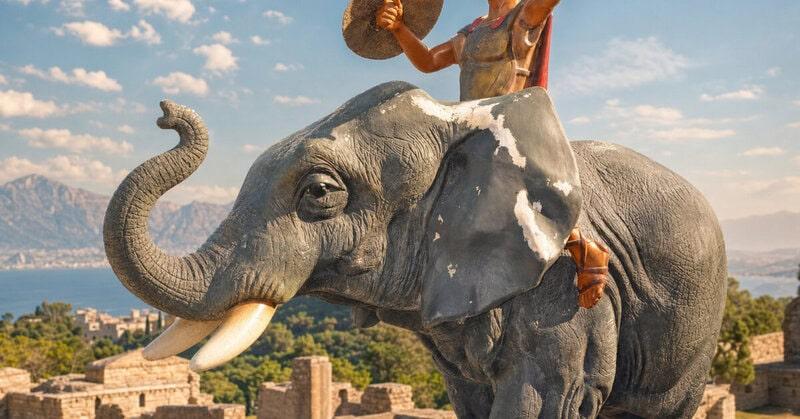
For more than two thousand years, one of history’s most extraordinary civilizations has been understood almost entirely through the accounts of the people who destroyed it. Carthage was older, richer, and more commercially powerful than Rome for much of the classical era — yet most people today can barely name a single fact about it beyond Hannibal and his elephants. The ten myths below explain how that happened, and what the full story actually looks like.
1. Carthage Was Just a Minor Ancient Backwater

Picture a city whose merchant ships threaded every major sea lane in the Mediterranean, whose warehouses overflowed with Spanish silver, Sardinian grain, and African ivory, and whose influence made Roman senators genuinely afraid. That city was Carthage — and “minor backwater” could not be further from the truth. At its height, Carthage controlled a commercial empire stretching across North Africa, the Iberian Peninsula, Sicily, and Sardinia, making it arguably the dominant economic power of the classical western Mediterranean.
The fear Carthage inspired in Rome is perhaps the clearest measure of its importance. Roman senators reportedly ended speeches with the phrase Carthago delenda est — “Carthage must be destroyed” — a rhetorical drumbeat that only makes sense if the city felt like an existential threat. Carthage was not on the margins of ancient history; for centuries, it was at the very center.
2. Rome and Carthage Were Founded Around the Same Time

There is a common mental image of Rome and Carthage as twin rivals who rose together, but the chronology tells a different story. Carthage was founded by Phoenician settlers traditionally dated to around 814 BCE — roughly six decades before Rome’s conventional founding date of 753 BCE — making it the elder civilization by at least two full generations. By the time Rome was still a loose cluster of hilltop settlements, Carthage already had established trade routes threading the Mediterranean and a functioning urban infrastructure built on centuries of Phoenician maritime knowledge.
That chronological head start was not trivial. It gave Carthage time to accumulate wealth, build ships, develop legal institutions, and cement diplomatic relationships long before Rome became a serious rival. When the great contest between them finally came, Rome was in many respects the upstart — however improbably it eventually prevailed.
3. Carthage Was a Greek or Roman City

Because so much of what survives about Carthage was written in Greek or Latin, it is easy to assume the city belonged to one of those worlds. It did not. Carthage was a Phoenician foundation — established by Semitic seafarers from the coastal city of Tyre in what is now Lebanon, a people who had already spread colonies and commerce across the Mediterranean long before their most famous settlement was built. As Britannica notes, the Phoenicians were legendary navigators whose cultural and commercial reach was remarkable for their era.
This distinction matters enormously. Carthaginian culture, language (known as Punic), religion, and art were rooted in the Semitic Levantine world, not in the Greek or Latin traditions that dominate popular imagination of antiquity. When Rome erased Carthage and Roman writers became the primary source of information about it, a fundamentally non-European civilization came to be understood almost entirely through a foreign — and hostile — lens.
4. Carthage Was Founded by a Warrior-King

Most ancient foundation myths center on a powerful male conqueror: Rome has Romulus, Thebes has Cadmus. Carthage’s legend is strikingly different. According to tradition, the city was founded not by a warrior-king but by Queen Dido — a woman who fled her home city of Tyre to escape her murderous brother Pygmalion, who had killed her husband for his wealth. As recorded in Dickinson’s account of Carthage’s early history, Dido arrived on the North African coast as a refugee, not a conqueror.
The story of how she secured land is one of antiquity’s great moments of recorded cleverness: she bargained for as much territory as an ox-hide could cover, then cut the hide into impossibly thin strips and used them to encircle an entire hilltop. Like the tale of Romulus and Remus, this founding legend blends myth with historical memory — but it is remarkable that Carthage, unlike so many ancient civilizations, placed a resourceful woman rather than a violent man at the moment of its creation.
5. Carthage Was Located Somewhere in the Middle East or Europe

Given that Carthage was founded by Levantine Phoenicians and spent centuries in conflict with European Rome, it is easy to mentally misplace the city — somewhere in Lebanon, perhaps, or on a European coastline. In fact, Carthage was located in North Africa, on a peninsula in what is now northern Tunisia, overlooking the Gulf of Tunis. Its African position is precisely what made it such a powerful crossroads: it sat at the narrow waist of the Mediterranean, ideally placed to monitor and profit from sea traffic flowing between the eastern and western halves of the ancient world.
Today the ruins of ancient Carthage lie within the suburbs of modern Tunis, recognized as a UNESCO World Heritage Site — its extraordinary remains hiding in plain sight among residential streets and apartment blocks. Visitors can look out over the same gulf that Phoenician traders once filled with merchant ships and realize that this quietly remarkable place has been overlooked in the modern world almost as thoroughly as it was erased in the ancient one.
6. Carthage Had No Particular Geographic Advantage

Some cities grow powerful despite their location; Carthage grew powerful because of it. The site was strategically brilliant: perched on a hill dominating the Gulf of Tunis and the surrounding plain, it commanded sweeping views of approaching vessels from virtually every direction and could project naval power across a broad arc of open water. As NASA’s Earth Observatory imagery of the site of Carthage, Tunisia illustrates, the peninsula’s geography made it naturally defensible while simultaneously opening it to maritime trade in every direction.
The Carthaginians also engineered their advantage rather than merely inheriting it. The city was equipped with two artificial harbors — one military, one commercial — designed to handle hundreds of warships and merchant vessels simultaneously. Control of the chokepoint between the Mediterranean’s eastern and western basins meant Carthage could effectively tax, toll, or simply threaten almost every major trade route in the region, which is exactly what it did for centuries.
7. Carthage Was Primarily a Military Empire
Hannibal’s war elephants crossing Alpine snow passes make for a vivid image — vivid enough to overshadow what Carthage actually was at its core: a merchant civilization. Its primary identity was mercantile, not martial, built on Phoenician traditions of seafaring commerce that predated the city’s founding and remained the engine driving everything else, including its famous armies. Carthaginian merchants reached as far as West Africa and the British Isles in their pursuit of gold, tin, and other commodities, constructing one of the most far-ranging commercial networks the ancient world had ever seen.
Military power existed largely to protect and extend those trade interests rather than as an end in itself. Carthage typically hired professional soldiers and mercenaries rather than fielding citizen armies in the Roman style — a reflection of a society that valued commerce and treated warfare as a tool of economic policy rather than a source of civic glory. Understanding this mercantile identity is essential to grasping why Rome’s eventual destruction of Carthage was so total: it was not just a city that fell, but an entire system of trade and exchange that was deliberately extinguished.
8. The Punic Wars Were a Foregone Conclusion in Rome’s Favor
History tends to tell the Punic Wars as a story of inevitable Roman triumph, which makes it easy to imagine Rome as the dominant power throughout. The reality, especially in the early stages, was far more complicated. When the three Punic Wars (264-146 BCE) began, Carthage was in many respects the stronger party — a richer city, a more experienced naval power, and the master of a vast commercial empire Rome had barely begun to rival. Hannibal’s audacious crossing of the Alps and his devastating victories at Lake Trasimene and Cannae — where he annihilated an estimated 50,000 to 70,000 Roman soldiers in a single afternoon — showed just how close Carthage came to ending Rome entirely.
Rome won not through obvious superiority but through extraordinary resilience, deep reserves of manpower, and the eventual generalship of Scipio Africanus, who carried the war to Africa and defeated Hannibal at the Battle of Zama in 202 BCE. Even then it took 118 years of intermittent warfare across three separate conflicts to reach a conclusion. The full arc of Carthage’s struggle with Rome was genuinely in doubt for much of its duration — which makes the final outcome all the more striking.
9. Carthage Was Peacefully Absorbed Into the Roman World
When people think of how Rome dealt with conquered peoples, they often imagine assimilation — the extension of Roman law, culture, and eventually citizenship. Carthage received none of that. In 146 BCE, after a brutal three-year siege that reduced the surviving population to starvation, Rome did not absorb Carthage — it annihilated it. The city was systematically burned over a period of days, its remaining population killed or enslaved, and the site formally cursed so that no settlement could be established there again. The often-repeated detail that Rome salted the earth is almost certainly a later invention, but the total and deliberate destruction of the city itself is thoroughly documented in ancient sources.
The Roman Senate’s decision to erase rather than absorb one of the wealthiest cities in the ancient world reveals something profound about how existentially threatening Carthage had felt across more than a century of conflict. It also explains one of history’s great silences: because Carthaginian libraries, archives, and records were destroyed along with everything else, almost no Carthaginian writing survives in its original form. The civilization’s own voice was erased. What we know of Carthage, we know almost entirely from the words of the people who feared and ultimately destroyed it.
10. Carthage Left Behind Almost No Archaeological Trace
Given Rome’s campaign of destruction, it would be reasonable to assume that Carthage vanished without a physical trace. The archaeological record says otherwise. Despite Rome’s thoroughness, Carthage left an extensive footprint that survives to this day — a fact formally recognized through its UNESCO World Heritage designation, which acknowledges not just the historical significance of the site but the tangible, excavatable remains that still exist there. Excavations have uncovered the famous tophet (a sacred precinct associated with religious offerings), the engineered military and commercial harbors, temples, residential quarters, and thousands of artifacts that illuminate Punic daily life, religion, and art in considerable detail.
There is a particular irony in how some of those remains survived. A Roman city was built directly on top of Carthage’s ruins after 146 BCE, and in doing so it inadvertently sealed and preserved Punic layers beneath it. In a strange and poetic twist, Rome — which tried so hard to erase Carthage from history — ended up acting as an accidental guardian of the very civilization it destroyed. The buried city endured beneath its conqueror, patient and intact, waiting centuries for excavators to begin returning its voice.
Carthage was not a footnote to Rome’s story. It was a rival civilization with its own founding legend, its own commercial genius, its own legal institutions, and its own deeply human history that was very nearly wiped from the record entirely. The more closely we examine what survived — in the ground, in hostile foreign texts, in the harbors carved from living rock — the clearer it becomes that what was lost in 146 BCE was not merely a city, but one of antiquity’s most remarkable experiments in building a civilization on trade, navigation, and the restless pursuit of distant horizons.

 English
 French
 Spanish
 Portuguese
 Deutsch
 Turkish
 Dutch
Dutch
 Italiano
 Russian
 Romaian
 Portuguese (Brazil)
 Greek
Greek