


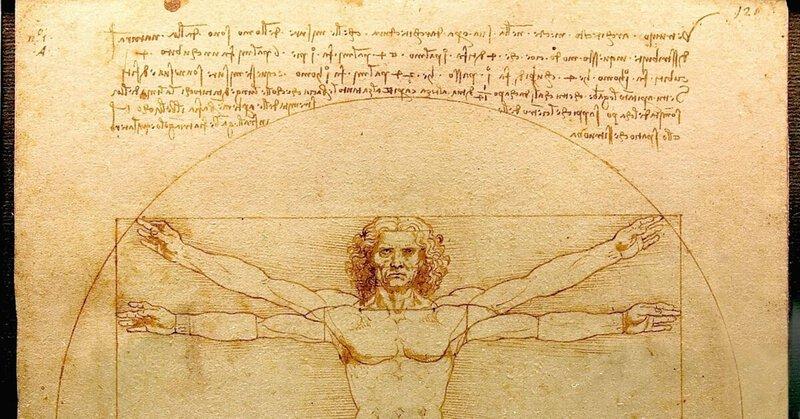
On the day he died in a French château in May 1519, Leonardo da Vinci left behind a paradox: a man considered the greatest genius of the Renaissance had completed barely enough paintings to fill a single museum room, yet had filled thousands of notebook pages with ideas the world wouldn’t catch up to for centuries. These ten facts crack open that paradox — and reveal a figure far stranger and more fascinating than the myth.
1. The 7,000 Notebook Pages That Survived — Out of an Estimated 13,000

Imagine a private library built by one man’s restless hand — filled with mirror-script Italian, detailed anatomical sketches, engineering diagrams, and, tucked between the genius, occasional grocery lists. That was what Leonardo produced across four decades of relentless note-taking. Scholars estimate he originally generated around 13,000 pages, effectively a one-man encyclopedia assembled in real time across his entire working life.
Roughly 7,000 of those pages survive today, scattered across institutions from the Royal Collection at Windsor Castle to the Biblioteca Ambrosiana in Milan. The rest were lost, dispersed, or destroyed after his death, when his notebooks passed to his pupil Francesco Melzi and then began their slow scatter across Europe. What remains of the Leonardo da Vinci notebooks still constitutes one of the most extraordinary intellectual archives in human history — and the pages that vanished may represent an even greater loss than we can measure.
2. Only About 15 to 20 Paintings Are Attributed to Him With Confidence

For a career spanning roughly 45 years, the number is almost absurdly small: art historians accept only around 15 to 20 works as definitively Leonardo’s. The man whose name is synonymous with artistic mastery produced, with confidence, fewer finished paintings than some minor Dutch Golden Age artists turned out in a single decade. Several additional pieces remain hotly contested among scholars, meaning more of his works exist as open questions than as settled certainties.
The reason for the slim total isn’t lack of talent but something closer to its opposite: an obsessive perfectionism that made finishing feel like a kind of defeat. He notoriously abandoned commissions, leaving patrons furious and canvases untouched — including the large Adoration of the Magi ordered by Florentine monks in 1481, which he surrendered in an advanced but incomplete state and never returned to. He simply moved on to the next idea, leaving behind a trail of magnificent beginnings and exasperated clients.
3. He Wrote Almost Entirely in Mirror Script, Right to Left

Hold one of Leonardo’s notebook pages up to a mirror and the cramped, backwards Italian suddenly becomes legible. He wrote right to left across tens of thousands of lines with a consistency so absolute that it clearly wasn’t a cipher or an occasional affectation — it was simply how he wrote. The most practical explanation is straightforward: he was left-handed, and moving his hand from right to left across the page prevented him from dragging it through fresh ink and smearing every word behind him.
Whether he also cultivated the habit for a degree of privacy is a question historians continue to debate, though most conclude it was a natural style developed in childhood rather than a deliberate code. Whatever its origin, the mirror script became so automatic that it persisted across every genre of writing in his notebooks — scientific observation, artistic planning, philosophical reflection, and shopping errands alike. It is one of the most recognizable personal quirks in the entire history of scholarship.
4. His Flying Machine Designs Anticipated the Helicopter and the Hang Glider by Four Centuries

Among the most astonishing of Leonardo da Vinci’s inventions is a sketch from around 1489 showing an aerial screw — a helical surface designed to compress air and lift itself off the ground, conceptually related to the rotor of a modern helicopter. He also designed an ornithopter, a wing-flapping machine modeled closely on bat anatomy, with the pilot lying prone and powering the wings simultaneously with arms and legs. The sheer conceptual audacity, in an era when human flight was pure fantasy, is difficult to overstate.
None of these machines were built in his lifetime, and wind-tunnel tests conducted on reconstructed models in the 20th century confirmed that his aerial screw, as drawn, would not generate sufficient lift to become airborne — the materials available to Leonardo were simply too heavy. But the underlying leap — working out, from first principles and careful animal observation, the mechanical logic of flight — placed him centuries ahead of the engineers who would eventually make it real. The Wright Brothers flew at Kitty Hawk in 1903; Leonardo was sketching flying machines in the 1480s.
5. He Dissected at Least 30 Human Corpses to Draw Anatomy No One Had Ever Depicted Accurately
Working by candlelight in the mortuary of Santa Maria Nuova hospital in Florence and later in Milan, Leonardo dissected human cadavers with the focused intensity he brought to everything. Over the course of his career he worked on at least 30 bodies, producing anatomical drawings of the heart, uterus, fetus, and musculoskeletal system with an accuracy that would not be matched for generations. He was among the first to correctly illustrate the double curvature of the spine, and he depicted the fetus inside the womb in its actual curled position — a sight no artist had ever rendered truthfully before him.
Church authorities eventually curtailed his dissection privileges, cutting short work that might have transformed the history of medicine. His anatomical manuscripts were never published during his lifetime; had they been, they could plausibly have accelerated the field by decades. Instead, they sat in private hands, largely unknown to the physicians who most needed them — a quiet tragedy buried inside one of the greatest careers in Leonardo da Vinci’s history.
6. He Was Apprenticed at Around Age 14 to Verrocchio — and Reportedly Made His Master Quit Painting

Around 1466, Leonardo’s father — a Florentine notary named Ser Piero da Vinci — sent his fourteen-year-old son to the workshop of Andrea del Verrocchio, one of Florence’s leading artists. There Leonardo trained in painting, sculpture, and design alongside other early Renaissance talents, absorbing the full technical vocabulary of his age. The workshop was a serious professional environment, and Leonardo was a serious student — but the story of how his talent first announced itself is almost too good to be true.
According to the Renaissance biographer Giorgio Vasari, Verrocchio invited Leonardo to paint an angel in their collaborative Baptism of Christ. When Verrocchio saw the result, he was so struck by the young man’s luminous superiority that he vowed never to paint again. Modern X-ray analysis of the Baptism of Christ has confirmed that two distinct hands worked on the panel — one considerably stiffer than the other — lending genuine weight to the story’s core, even if Verrocchio, practically speaking, continued to work productively in sculpture for years afterward.
7. The Last Supper Began Deteriorating Almost Immediately After He Finished It

Painted between 1495 and 1498 on a refectory wall in Milan, the Last Supper was an experiment from the moment Leonardo picked up his brush. Rather than working in true fresco — applying pigment to wet plaster, which bonds permanently as it dries — he chose to paint in tempera and oil on a dry plaster surface, a technique that gave him the freedom to revise and refine at leisure. The cost of that freedom became apparent almost immediately: within twenty years of completion, contemporaries were already reporting that the paint was beginning to flake from the wall.
By the 18th century visitors were describing it as a ruin. What followed reads like a catalog of compounding disasters: rising damp, a door cut directly through the lower portion of the painting, Napoleonic soldiers who used the refectory as a stable and reportedly threw objects at the painted figures, and a World War II bomb that destroyed the surrounding building while somehow leaving the painted wall standing. The Last Supper has undergone at least six major restoration campaigns. That it survives in any legible form is its own kind of miracle.
8. He Spent Approximately 16 Years Working On — and Never Fully Finished — the Mona Lisa

Leonardo is believed to have begun the portrait of Lisa Gherardini, wife of a Florentine merchant named Francesco del Giocondo, around 1503. He was still making adjustments to it when he died in France in 1519 — meaning the painting that would become the most famous artwork in human history was, by its creator’s own standards, unfinished. He apparently never delivered it to the man who commissioned it, keeping the small poplar panel close for the remainder of his life.
When King Francis I of France invited Leonardo to spend his final years at the Château du Clos Lucé in 1516, the panel traveled with him, and at his death it passed into the French royal collection — which is why it hangs today in the Louvre rather than in Florence. Modern infrared reflectography has revealed much of the secret behind the painting’s uncanny softness: the celebrated sfumato technique was built up in dozens of ultra-thin glaze layers, some less than a micrometer thick, applied with almost unimaginable patience across those sixteen years. The full scope of Leonardo’s methods is still being uncovered by science.
9. He Was Charged With Sodomy at Age 24 — and the Charges Were Dropped Twice

In April 1476, Leonardo and three other young Florentine men were anonymously denounced to the Officers of the Night — a magistracy established specifically to police sodomy in Florence — for alleged relations with a seventeen-year-old male model named Jacopo Saltarelli. The accusation was submitted via the city’s tamburazione system, an anonymous complaint box, and was serious enough under Florentine law to carry severe penalties including public flogging or imprisonment. The charges were filed twice and dropped twice, possibly because one of the co-accused had connections to the powerful Medici family.
Leonardo never married and left no known romantic correspondence with women. Several historians cite this episode alongside his documented close relationships with male pupils — including Gian Giacomo Caprotti, known as Salaì, who entered his household around 1490 and lived with him for nearly thirty years — as evidence that Leonardo was gay. The historical record is incomplete and certainty is impossible, but the 1476 charges are a documented and significant episode that serious scholarship does not dismiss or overlook.
10. A Rediscovered Leonardo — the Salvator Mundi — Sold for $450 Million in 2017 and Has Since Vanished

In 2005, a painting of Christ as Salvator Mundi — Savior of the World — was purchased at a New Orleans estate sale for $1,175. It was heavily overpainted, damaged, and regarded by most observers as a copy of a lost Leonardo original. What followed was years of painstaking restoration and fierce scholarly debate, at the end of which a significant body of art historians and the major auction house Christie’s attributed it to Leonardo himself. In November 2017, it sold in New York for $450.3 million, shattering the record for the highest price ever paid for a painting at auction.
The buyer acted on behalf of Saudi Crown Prince Mohammed bin Salman. Since the night of the sale, the painting has not been publicly displayed anywhere in the world, and its precise location remains unknown. It was briefly expected to appear at the Louvre Abu Dhabi, but that showing was postponed without explanation and never rescheduled. The most expensive object ever sold at auction — a work by the most celebrated painter in history — is, at this moment, simply missing, making it perhaps the grandest unsolved mystery in the contemporary art world.
Taken together, these facts sketch a portrait more interesting than any legend: a left-handed, mirror-writing, insatiably curious man who left more questions than answers, more beginnings than endings, and more ideas than any single century could fully absorb. Five hundred years after his death, the world is still catching up — and in at least one case, still searching.

 English
 Arabic
 French
 Spanish
 Portuguese
 Deutsch
 Turkish
 Dutch
Dutch
 Italiano
 Romaian
 Portuguese (Brazil)
 Greek
Greek