


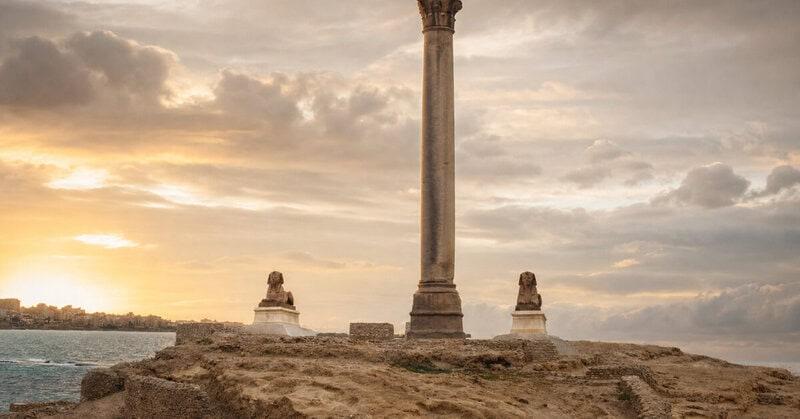
Imagine it: Alexandria harbor, 48 BC, Julius Caesar surrounded by enemy ships, torches thrown, fire leaping across the water — and somewhere in the smoke, the greatest library the ancient world had ever built collapsing into cinders in a single catastrophic night. It is one of history’s most compelling tragedies. It is also, in its most dramatic form, almost certainly a myth.
The Flame That Never Was

The image of a lone, terrible fire consuming the Library of Alexandria has haunted Western imagination for centuries. It gives us everything a tragedy needs: a precise moment, a clear villain, an irreversible loss. But the closer historians look at the actual record, the more that clean story dissolves into something murkier and far more disturbing. The library did not die in a blaze of drama. It died the way most great institutions die — slowly, across generations, through neglect, underfunding, political violence, and the gradual withdrawal of the will to sustain it.
That slower truth raises a harder question than whodunit. If no single villain lit the fatal torch, then what — and who — really destroyed the Library of Alexandria, and why does the honest answer matter so much more than the myth we prefer?
What Alexandria Actually Built

To understand what was lost, you have to understand what was there. The library was not simply a room full of shelves. It was the intellectual core of the Alexandrian Museum, an institution that functioned as something remarkably close to a modern research university, funded by the Ptolemaic kings of Egypt with an ambition that bordered on the obsessive: they intended to own all of the world’s knowledge, physically, under one roof.
They pursued that goal with striking ruthlessness. Every ship that docked in Alexandria’s harbor was subject to having its scrolls confiscated so that copies could be made — sometimes the copies were returned and the originals kept. Emissaries were dispatched across the known world to purchase, borrow, or otherwise acquire texts from Greece, Egypt, Persia, Babylon, and India. The result, at its peak, was a collection believed to have stored over 700,000 scrolls — the most celebrated library of Classical antiquity and, by any reasonable measure, the ancient world’s single greatest archive of accumulated knowledge.
Inside the Museum complex, scholars lived on royal stipend, freed from the ordinary pressures of earning a living so that they could think. Euclid worked out the foundational principles of geometry there. Eratosthenes calculated the circumference of the Earth with remarkable accuracy using shadows, geometry, and the angle of the sun at two different locations. The sciences, philosophies, histories, and literatures of multiple civilizations were not merely stored in Alexandria — they were actively argued over, translated, catalogued, and built upon. Knowledge was a living, collaborative project, and the institution made all of it possible. Losing the institution, as it turned out, meant losing the infrastructure of ancient intellectual life itself.
Caesar’s Fire — The Myth and What It Actually Did

So what about Caesar? In 48 BC, besieged in Alexandria’s harbor and badly outnumbered, he ordered ships set alight to prevent them falling into enemy hands. Fire spread across the docks. Ancient sources — genuinely ambiguous on this point, which is precisely how the legend grew — suggest that a waterfront warehouse holding tens of thousands of scrolls awaiting export may have burned. That is a real and significant loss. But it is not the library itself.
What makes this distinction so important is that the institution kept functioning after Caesar left Egypt. Scholars continued working. Collections continued to grow. Ancient accounts of the fire’s scope are contradictory enough that historians still debate exactly what burned and where, but the evidence that the main library survived Caesar’s visit is substantial. Alexandria also maintained a significant secondary collection — often called the daughter library — housed in the Serapeum, a grand temple complex, which outlasted Caesar’s era by several centuries.
The Caesar story is seductive precisely because it is ancient enough to feel authoritative and dramatic enough to feel true. But seduction is not evidence, and centuries of retelling transformed an ambiguous harbor fire into the founding myth of civilization’s greatest intellectual loss.
The Real Suspects: A Slow Parade of Damage

The actual history of the library’s destruction reads less like a thriller and more like a slow-motion catastrophe with multiple perpetrators — none solely responsible, all contributing to an accumulating wound.
The first serious institutional blow came in the 270s AD, when the Roman Emperor Aurelian crushed a revolt in Alexandria with brutal efficiency. His forces destroyed the royal quarter of the city — the very district where the Museum and main library stood. This was not a targeted burning of books. It was urban warfare that physically obliterated the buildings that housed them. The distinction matters, but the result was the same.
Then came Theophilus. In 391 AD, the Christian bishop of Alexandria led the destruction of the Serapeum — the temple complex that housed the daughter library. This was something different from Aurelian’s military violence: it was deliberate, ideological, a targeted assault on a pagan institution in a city that was rapidly Christianizing. Whatever scrolls remained in that secondary collection were now at serious risk, if not already lost.
The murder of the philosopher and mathematician Hypatia in 415 AD did not directly destroy any scrolls, but it announced something important about what Alexandria had become. The city that once paid scholars a royal stipend to sit and think had transformed into a place where holding the wrong intellectual allegiances could end your life. The library’s physical destruction and the intellectual climate surrounding it were not separate stories — they were the same story, told in different registers.
Later tradition also blamed the Arab conquest of 641 AD, producing a vivid legend in which Caliph Omar supposedly declared that scrolls agreeing with the Quran were redundant and those that disagreed were heretical, condemning the entire remaining collection to be burned as fuel for Alexandria’s bathhouses. Most historians today regard this account as a later fabrication — it appears in sources written centuries after the supposed event — but its persistence reveals how badly posterity needed a single, satisfying villain to blame.
The Darkest Truth: Death by Neglect

Here is the part of the story that tends to get omitted, because it is the most uncomfortable: the most historically plausible cause of the library’s disappearance is not fire, not religious zealotry, not military conquest. It is institutional neglect.
As Roman imperial power weakened and the Ptolemaic royal patronage that had sustained the Museum gave way to indifference from distant emperors, funding dried up. Scholars stopped coming when there was no longer money to support them. Scrolls deteriorated when there was no longer staff to maintain them. Buildings fell into disrepair. The collection scattered. By the time the most famous destruction events occurred, centuries of underfunding had almost certainly already reduced the library dramatically. The fires and the mobs were, in a grim sense, finishing off something that had been dying by degrees for generations.
The parallel for modern readers is sharp enough to sting. Great knowledge institutions do not always fall to enemies. Sometimes they are quietly defunded into irrelevance — their collections dispersed, their staff scattered, their buildings repurposed for something more immediately useful. The absence of a dramatic villain is not reassuring. It is more frightening, because it means the forces that destroyed Alexandria are not exotic historical monsters but ordinary institutional pressures that any society can generate simply by deciding that sustaining knowledge is less urgent than other priorities.
It is also worth acknowledging directly that the history of the library’s decline remains a subject of genuine scholarly debate. The record is fragmentary. Some of the evidence about what happened to the library was itself lost along with the library. We are trying to reconstruct the fate of an archive using the scraps that survived its fate — a situation that should induce as much humility as it does curiosity.
Why We Needed One Villain
The single-night burning myth is psychologically irresistible because it offers a clean before-and-after moment and a specific enemy to blame. It spares us the far more unsettling truth: that knowledge is usually lost not through dramatic malice but through slow indifference, budget cycles quietly redirected, and the gradual collective decision that maintaining the infrastructure of learning is someone else’s problem.
Different eras have assigned blame for Alexandria according to their own cultural anxieties. Enlightenment thinkers reached for religious fanaticism as the culprit, using the library’s destruction as a rhetorical weapon in arguments about reason versus superstition. Nationalist historians blamed foreign conquest. Modern secular writers have often blamed Rome. Each generation has written its own fears into Alexandria’s ruins — which tells us at least as much about those generations as it does about ancient Alexandria itself.
The burned-library myth gained particular force in the 18th and 19th centuries, precisely when arguments about science, religion, and the authority of reason were at their most heated. Alexandria became a symbol, and symbols, once they achieve the right dramatic shape, are extraordinarily resistant to the inconvenience of historical complexity.
None of this diminishes the genuine tragedy. The loss of the Library of Alexandria was a catastrophic rupture in the transmission of ancient knowledge. Understanding how it really happened does not make it less devastating. It makes the lesson more applicable — and more urgent.
What the Ashes Actually Mean
Consider, for a moment, the inventory of what we know we lost. Works by Aristotle that survive only in later summaries. Plays by Sophocles and Aeschylus of which we have only fragments. Medical treatises, astronomical calculations, entire histories of civilizations that left no other written record. And those are only the losses we can name — because we happen to have references to those works in texts that did survive. The full catalogue of what is gone is itself partially gone. We cannot fully inventory our own ignorance.
The real lesson of Alexandria is not that someone evil burned the books in a single night. It is that knowledge infrastructure is fragile in ways that are mundane rather than spectacular. It requires sustained political will. It requires funding that does not get quietly redirected when priorities shift. It requires a social consensus that the work of preserving and extending knowledge is worth the cost — not only in moments of civilizational pride, but in every ordinary budget cycle, in every generation that inherits an institution and must decide whether to sustain it or let it quietly hollow out.
There is one final detail worth holding onto. The desert sands of Egypt have, over the past two centuries, periodically yielded ancient papyri — texts that survived not in any great institution but in dry rubbish heaps, monastery cellars, and sealed jars. Some fragment of what once filled those 700,000 scrolls may still exist somewhere, uncatalogued, waiting in the dark. The story of Alexandria is not only a story about what we lost. It is also, quietly, a story about what we might still find — if we choose to look, and if we choose to fund the looking.

 English
 Arabic
 French
 Portuguese
 Deutsch
 Turkish
 Dutch
Dutch
 Italiano
 Russian
 Romaian
 Portuguese (Brazil)
 Greek
Greek