


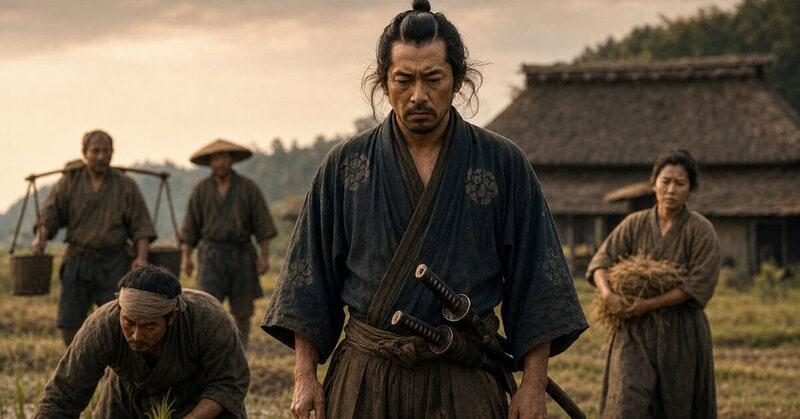
Somewhere in Edo-period Japan, a samurai with two swords at his hip was quietly going hungry — and the farmer he legally outranked was the only man who could save him. For more than two centuries, the feudal Japan hierarchy presented itself as an iron pyramid of divine order, but beneath the lacquered surface ran a contradiction that no shogun could legislate away: the people ranked lowest in the social order held the one resource that kept the entire structure alive — and they knew it.
The System at a Glance: What the Feudal Japan Hierarchy Actually Was

Feudal Japan’s social order reached its most codified form during the Edo period (1603-1868), under the Tokugawa shogunate. At its core was the Shi-Nō-Kō-Shō framework — four hereditary tiers ranking samurai, farmers, artisans, and merchants — overlaid on a political structure in which a shogun wielded real power while an emperor provided ceremonial legitimacy. Below all four tiers sat outcast communities the system refused to formally count. Above them all, in symbolic terms alone, sat a divine imperial family that had not governed in any meaningful sense for centuries.
That architecture was deliberately designed for stability after nearly a century of catastrophic civil war. What its designers could not engineer away was a structural irony running through every level: authority flowed downward, but the material resources that made authority possible flowed upward from the bottom. Understanding the hierarchy means understanding that contradiction at every tier.
The Emperor: Sacrosanct at the Summit, Politically Powerless for Centuries

The imperial family occupied the ceremonial apex of the feudal Japan hierarchy, tracing divine descent from the sun goddess Amaterasu — a lineage that made the Emperor’s person untouchable and his bloodline sacred. In political reality, emperors during the Edo period were confined to the Kyoto imperial compound, financially dependent on shogunal allowances, and forbidden from issuing political edicts without Tokugawa approval. Divinity, it turned out, was no protection against house arrest dressed in silk.
The very mechanism that rendered the Emperor powerless also preserved his indispensability. Because shoguns always ruled formally “in the Emperor’s name,” they needed that name to remain pristine and uncontested. When the Tokugawa system began to buckle under foreign pressure in the 1850s, reformers found a ready-made alternative center of legitimacy sitting in Kyoto — one that had been accumulating symbolic authority for centuries, precisely because no one had allowed it to spend any of it. The Meiji Restoration of 1868 dismantled the shogunate in the Emperor’s name, a revolution carried out, with sharp irony, as an act of tradition.
The Shogun: Japan’s Real Ruler, Hidden Behind an Emperor’s Throne

The shogun was Japan’s military dictator in practical terms — the head of a warrior government called the bakufu — and the Tokugawa shogunate, established in 1603 by Tokugawa Ieyasu following his decisive victory at the Battle of Sekigahara, perfected the art of governing through borrowed legitimacy. The imperial court in Kyoto was kept gilded, isolated, and politically toothless while Edo, the city now called Tokyo, functioned as the true capital of power. It was a masterpiece of sustained political theater.
The shogun’s authority over the daimyo rested on a combination of military supremacy, strategic land allocation, and an elaborate system of controls. The sankin-kōtai system, for instance, required daimyo to spend alternating years in Edo and their home domains — keeping them perpetually mobile, perpetually expensive, and perpetually under the shogun’s eye. The gap between the shogun’s real power and the Emperor’s symbolic power would define the entire political structure of feudal Japan for 250 years.
The Daimyo: Feudal Lords Whose Power Was Measured in Rice, Not Gold

Daimyo were the great regional lords of feudal Japan, granted domains by the shogun in exchange for military service and political loyalty. Their wealth and military capacity were assessed not in currency but in koku — units of rice, with one koku equaling roughly 180 liters, the amount theoretically needed to feed one adult for a year. A daimyo ruling a 100,000-koku domain was a figure of enormous consequence; a daimyo whose domain rating shrank was a man in danger of losing samurai retainers he could no longer afford to pay.
This made every harvest a political event with national consequences. A drought or a wave of peasant flight from the land didn’t just mean empty bellies — it meant a daimyo could no longer fund his retinue, cracking the feudal structure from within. The daimyo commanded warriors and administered vast territories, yet their power was entirely contingent on the labor of the farmers officially ranked just below them and on the weather those farmers prayed would cooperate. The Tokugawa shogunate kept a watchful eye on daimyo finances for exactly this reason, classifying lords into categories — fudai daimyo who were hereditary Tokugawa allies, and tozama daimyo who had submitted after Sekigahara — and treating the two groups with very different degrees of trust.
The Samurai: Warrior Aristocrats Whose Privilege Depended on Taxing the People They Outranked

Samurai occupied the top tier of the Japanese social classes of the feudal era, enjoying the right to wear two swords, bear a hereditary family name, and — under the grim legal doctrine of kirisute gomen — strike down commoners who showed egregious disrespect. These were privileges enforced with deadly seriousness and available to no other class. The samurai were the visible face of the entire feudal order: disciplined, martial, and proudly positioned above commerce.
Yet samurai produced nothing themselves. Their stipends were paid in rice levied from the very farmers ranked just below them, creating a structural dependency they were culturally forbidden to acknowledge. As the peaceful Edo period stretched on across the 17th, 18th, and into the 19th century, many lower-ranking samurai fell into genuine poverty — still legally superior to every commoner they passed on the road, still barred by custom from most commercial work, and increasingly indebted to the merchants they officially disdained. The sword was sharp; the rice bowl was often empty. Some samurai quietly took up side trades — making sandals, teaching calligraphy, tutoring children — while carefully maintaining the appearance of warrior dignity. The gap between the samurai’s official standing and his actual economic situation was one of the Edo period’s most corrosive slow-moving crises.
The Shi-Nō-Kō-Shō: a Four-Word Formula That Locked Millions Into Their Fate at Birth

Shi (samurai), Nō (farmers), Kō (artisans), Shō (merchants): these four characters defined the Japanese social classes of the feudal era and were strictly hereditary — your father’s class was your class, with almost no sanctioned exceptions. The designations were not merely social labels. They determined where you could live, what clothing and colors you were permitted to wear, whom you could legally marry, what weapons you could carry through a city gate, and what occupations were open to you. Class was not background; it was biography, written before you were born.
Escaping your birth rank was not just difficult — it was officially illegal. This was a deliberate design feature, intended to freeze society into a stable, controllable configuration after the chaos of the Sengoku civil war period. The Tokugawa rulers understood that ambition had fueled a century of bloodshed, and their solution was a system so thoroughly codified that upward mobility became structurally indistinguishable from criminality. For most of the 250 years it operated, the system held. The pressure it suppressed did not disappear, however. It accumulated.
The Farmers: the Class That Fed an Empire and Ranked Above Merchants for It

In the Shi-Nō-Kō-Shō framework, farmers sat second in the official order — directly beneath the samurai — because rice was simultaneously currency, calories, and military power. Approximately 90 percent of feudal Japan’s population worked the land, meaning the entire pyramid of lords and warriors rested, quite literally, on the labor of people who could not vote, could not petition effectively, and could not legally leave their villages without permission. Their elevated rank relative to merchants and artisans was not an honor so much as an acknowledgment of raw necessity, dressed in Confucian language.
The taxation burden placed on farming households was severe. Rice tax rates often consumed 40 to 60 percent of a village’s annual harvest — sometimes more — leaving peasants to survive on millet, barley, and whatever they could grow in kitchen gardens. Paradoxically, farmers were frequently forbidden from eating the rice they grew, as it was reserved for tax collection and samurai stipends. The class with the least political voice controlled the one resource that determined whether the ruling class could pay its armies. That tension never fully resolved; it simply awaited the right catastrophe to make itself undeniable.
The Artisans: the Overlooked Middle Tier Who Built the World Everyone Else Inhabited

Craftsmen ranked third in the Edo period social structure — above merchants because Confucian ideology held that transforming raw materials into tangible objects of utility conferred genuine social worth. Swordsmiths, carpenters, potters, weavers, dyers, and lacquerware makers all fell into this tier. Their workshops were tightly organized, with techniques transmitted through family lines in a hereditary craft culture that mirrored the class system’s own rigidity. A master swordsmith’s son was expected to become a swordsmith; the only open question was whether he became a great one.
Like the samurai above them, artisans were quietly squeezed by the Edo period’s long peace. Demand for armor, weapons, and military equipment declined as decades of stability stretched into generations. The growing wealth of the merchant class created new demand for decorative and luxury crafts — lacquerware, ceramics, fine textiles — that artisans had to chase without the social standing to negotiate on equal terms with their increasingly affluent patrons. They built the world that everyone else inhabited — the temples, the tools, the blades, the bowls, the buildings — and remained, for their trouble, comfortably overlooked in the middle of an order that depended on their skills.
The Merchants: Lowest in Official Status, Often Richest in Reality

Merchants occupied the bottom rung of the Shi-Nō-Kō-Shō system, ranked beneath even artisans, because Confucian ideology classified trade as essentially parasitic — profit extracted without producing anything of physical substance. The logic was tidy and the contempt was official. In practice, reality told an entirely different story. Merchant houses such as the Mitsui family, founded in the 17th century, accumulated fortunes that dwarfed the stipends of many daimyo, and they quietly financed the very lords who publicly disdained them. Some merchant families effectively kept indebted samurai and daimyo solvent across generations.
The tension between low official rank and high actual wealth made merchants a slow-burning contradiction embedded in the Edo period social structure. Displaying wealth too openly risked official censure — sumptuary laws periodically restricted the clothes, homes, and entertainments available to commoners — so merchants channeled their resources into art, kabuki theater, woodblock prints, and the vibrant urban culture of cities like Osaka and Edo. That culture, born partly from commercial wealth officially denied, became some of the most celebrated in all of Japanese history. When Western commercial pressure forced Japan to reckon with the power of trade in the 19th century, the class the hierarchy had officially placed last turned out to be anything but.
The Eta and Hinin: the ‘Invisible’ Underclass the Official Hierarchy Refused to Count
Below even the four recognized classes were the eta — a term meaning roughly “abundant filth” — and the hinin, literally “non-persons.” These were outcast groups who performed work considered ritually impure under Buddhist and Shinto belief: butchering animals, executing criminals, preparing the dead, tanning leather, and disposing of animal carcasses. They were excluded from the Shi-Nō-Kō-Shō rankings entirely, required to live in segregated settlements, barred from most temples and markets, and in many periods obligated to wear identifying markers when moving through wider society. The feudal Japan hierarchy, in other words, contained a shadow hierarchy beneath it — one the official system preferred to pretend did not exist.
That pretense had material limits. Samurai armor and footwear depended on leather produced by eta craftspeople. Execution of criminals — a function of the state — was carried out by hinin. The warrior elite that defined the entire social order quietly relied, at the level of its most essential practical needs, on the people it had officially erased from the social ledger. Outcast communities were also internally stratified, with their own headmen and hierarchies, challenging any simple picture of a monolithic underclass. Their formal legal emancipation came with the Meiji government’s 1871 Emancipation Edict, though social discrimination persisted for generations afterward.
The Fatal Arithmetic: Why a Hierarchy Built on Rice Always Risked Collapse from the Bottom

Viewed from a distance, the feudal Japan hierarchy resembled an elegant machine: the shogun granted daimyo land, daimyo commanded samurai, samurai enforced order over farmers, farmers fed everyone. Every sword, every castle garrison, every samurai stipend was underwritten by rice tax extracted from the agricultural base. The system’s designers understood the fragility this created and tried to compensate by ranking farmers second in official prestige — as if Confucian dignity could substitute for political power. It could not.
When famine struck — as it did catastrophically during the Tenmei period of 1782 to 1788 and again during the Tenpō period of 1833 to 1837 — the system’s load-bearing flaw became impossible to ignore. The Tenmei famine alone may have killed more than one million people in the Tōhoku region. Peasant uprisings, known as hyakushō ikki, occurred in the thousands across the Edo period — historians have documented well over 3,000 recorded instances. They rarely toppled lords outright, but each one was a reminder written in fire and hunger: a hierarchy resting entirely on the labor of its lowest recognized class was always one bad harvest away from structural crisis.
The Tokugawa system endured for roughly 250 years — an extraordinary run for any political order — but its fatal arithmetic was embedded from the first day a shogun levied rice from a farmer who had no say in the matter. When it finally collapsed in the 1860s, the proximate causes were Western ships and the political humiliation of the unequal treaties forced on Japan after Commodore Perry’s arrival in 1853. The deeper fault line, however, had been running through the paddies all along. The people ranked lowest fed the empire. The people ranked highest depended on them for everything. That was not a paradox the hierarchy ever solved — it was merely one it managed, with diminishing success, until it couldn’t.

 Arabic
 French
 Spanish
 Portuguese
 Deutsch
 Turkish
 Dutch
Dutch
 Italiano
 Russian
 Romaian
 Portuguese (Brazil)
 Greek
Greek