


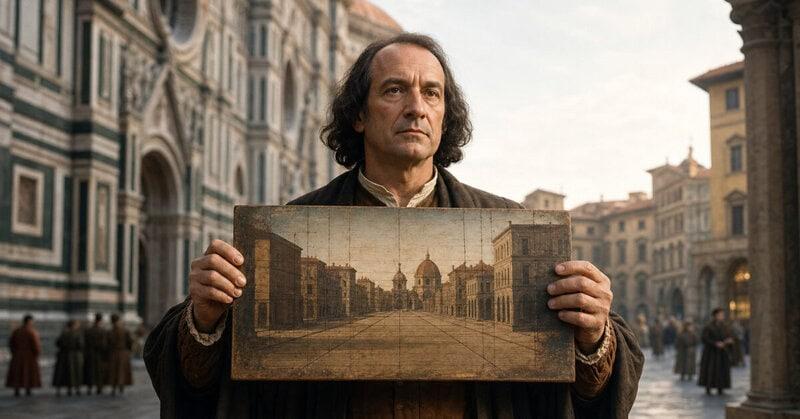
One spring afternoon around 1420, a restless Florentine architect stood at the door of the city’s cathedral, held up a painted wooden panel, and quietly shattered the way humanity would picture the world forever. The story of linear perspective — that mathematical sleight of hand by which a flat surface becomes a window onto infinite space — is really a story about a thousand years of fumbling toward a single, electrifying breakthrough.
Ancient Greeks and Romans Intuited Depth — But Never Systematized It

Long before Renaissance painters puzzled over vanishing points, Greek scene-painters and Roman muralists were already doing something visually clever: making distant objects smaller, overlapping forms to suggest recession, and nudging the eye toward an implied depth that the flat wall never actually possessed. The frescoes at Pompeii glow with this intuitive spatial intelligence, rooms and gardens opening outward with a confidence that still impresses twenty centuries later.
Yet for all their sophistication, these artists were working by feel rather than by formula. There was no fixed horizon line, no single point toward which all receding lines marched in disciplined unison. The result was convincing in patches and inconsistent across a composition — an illusion that couldn’t be taught, only imitated. That missing ingredient, a codified, repeatable geometric rule, would remain absent for more than a millennium.
Medieval Art’s Deliberate Rejection of Pictorial Space (c. 500-1300)

If the ancient world lacked the system, the medieval world didn’t especially want it. Byzantine icon-painters and Gothic manuscript illuminators made a pointed theological choice: the most sacred figures were painted largest, regardless of where they stood in a scene, and the architecture around them sometimes featured lines that spread apart rather than drawing together. Earthly spatial logic was precisely what holy images were meant to transcend.
This was not naivety masquerading as art. It was a deliberate visual theology — an insistence that sacred subjects existed outside the grubby coordinates of time and place. The flat, hierarchical gold-ground icon was a door to the divine, not a window onto the world. A window, as it turned out, was exactly what the next era would demand.
Giotto’s Proto-Perspective Rattles the Old Order (c. 1305)

In a modest chapel in Padua, a painter named Giotto di Bondone began covering the walls with scenes so physically convincing that they seemed to belong to a different artistic universe than anything that had come before. The figures in the Scrovegni Chapel have weight, cast shadow, and occupy space that feels genuinely three-dimensional. Giotto used overlapping forms and relative scale with a consistency no Western painter had previously achieved, and viewers responded as though they were witnessing real events rather than decorated surfaces.
Giotto possessed no geometric formula — his depth was the product of an extraordinary eye and an instinct for human presence in space. But he proved something enormously consequential: that the emotional power of a painted scene depended heavily on spatial believability. He set the problem clearly and urgently for the generation that would finally solve it.
Filippo Brunelleschi’s Piazza Experiment Proves the Theorem (c. 1420)

Filippo Brunelleschi, the restless Florentine architect who would later vault the dome of Santa Maria del Fiore, conducted one of history’s most elegant demonstrations of a geometric principle. Standing at the cathedral’s entrance, he painted the Baptistery opposite on a small wooden panel, drilled a peephole through its center, and invited viewers to hold the panel up to a mirror. The reflected painting aligned with the actual building so precisely that the boundary between image and reality seemed to dissolve.
What made the panel revolutionary was its internal logic: a strict horizon line and a single vanishing point toward which every orthogonal — every line of pavement, every cornice, every receding edge — converged with mathematical exactness. This was the invention of linear perspective as a system, not as an instinct. Brunelleschi never wrote his method down, but word traveled fast in Florence’s compact, competitive artistic world, and nothing would be painted quite the same way again.
Masaccio’s Trinity Fresco Makes a Wall Disappear (1427-1428)

Before the theory was ever committed to paper, it was already being tested on a monumental scale. In the church of Santa Maria Novella in Florence, a young painter called Masaccio applied Brunelleschi’s principles to a fresco of the Trinity and produced something that reportedly stopped visitors in their tracks. The painted barrel-vaulted chapel appeared to recede physically into the stone wall, as if the building had been surgically opened to reveal a hidden room beyond.
Contemporary accounts suggest that some viewers believed the church had actually been structurally altered — a remarkable testament to how total the illusion was. Art historians now recognize the Trinity as the first monumental painting to deploy Brunelleschi’s system with full rigor, and it predated the written treatise that would codify the rules by several years. The geometry worked before anyone had formally explained why.
Leon Battista Alberti Writes the Rules Down for Everyone (1435)

A demonstration and a fresco could inspire; only a book could teach. In 1435, the humanist architect and scholar Leon Battista Alberti published Della Pittura — On Painting — and translated Brunelleschi’s visual breakthrough into prose and diagrams that any trained artist could follow. Alberti described the picture plane as a transparent window through which the viewer gazes at a depicted world, and he laid out the mechanics of the horizon line, the centric point, and the converging grid of orthogonals with the patience of a master teacher.
The impact was immediate and lasting. Linear perspective had been a single genius’s private insight and then a local Florentine marvel; Alberti made it a transferable technology, available to any workshop that could afford a copy of his text. The democratization of the system may be the most consequential turning point in the entire history of Renaissance perspective.
Piero della Francesca Elevates Perspective Into Pure Mathematics (c. 1470s-1480s)

Where Alberti had written for painters, Piero della Francesca wrote for geometers. In his treatise De Prospectiva Pingendi, Piero pushed the mathematical foundations of linear perspective far beyond anything previously attempted, working through the foreshortening of complex geometric solids, the perspective rendering of the human head, and the rigorous treatment of multiple vanishing points. His pages look less like an art manual than like a volume of Euclidean proofs — which, in many respects, they are.
Piero’s achievement reshaped how educated Europeans understood what perspective actually was. It was not a painter’s trick or a workshop convention; it was a branch of applied geometry, as logically grounded as any other mathematical discipline. The history of linear perspective had always been a story about art, but Piero insisted it was equally a story about science — and he was right.
Leonardo da Vinci Adds Atmosphere — and Complicates the Perfect System (c. 1490s)

By the end of the fifteenth century, geometric perspective had become the fundamental language of Italian painting. Leonardo da Vinci, characteristically, decided to question it. His notebooks identified something the geometric system could not account for: distant objects don’t merely grow smaller — they also fade in color, blur in outline, and dissolve into a haze that no grid of orthogonals can fully capture. Leonardo distinguished three separate kinds of perspective: the diminution of size, the diminution of color, and the diminution of distinctness, arguing that a convincing spatial illusion required all three working in concert.
His sfumato technique — that signature soft blurring of edges and atmospheric veiling of backgrounds — put the theory directly into practice. In paintings like The Virgin of the Rocks, the rocky landscape doesn’t recede along rigid geometric lines so much as breathe and fade into a luminous, indeterminate distance. Leonardo had not broken Brunelleschi’s system; he had revealed that it was one component of something larger and more complex than anyone had previously admitted.
Albrecht Dürer Carries the System North and Invents Perspective Machines (1525)

Italian painters had been building cathedral-sized illusions with perspective geometry for a century before the system fully crossed the Alps in teachable form. When the German master Albrecht Dürer published Underweysung der Messung in 1525, he introduced rigorous perspective theory to Northern European artists who had largely developed their extraordinary skills without it. Dürer had traveled to Italy specifically to understand what the Italians knew, and his treatise was the careful product of that education.
What made Dürer’s contribution especially practical was his design and illustration of mechanical perspective devices — sighting frames, grids, and a thread-and-pin apparatus that allowed an artist to trace accurate perspective constructions without advanced mathematical training. His woodcuts of craftsmen using these machines became iconic images in the history of Renaissance art, proof that the insight of a Florentine architect could be packaged into a tool that anyone with patience and a steady hand could operate.
The Camera Obscura and Photography Ultimately Inherit Brunelleschi’s Logic (19th Century)

When photographers in the 1830s began fixing the projections of camera obscuras onto light-sensitive surfaces, they were not inventing a new way of seeing — they were automating one that Brunelleschi had formalized four centuries earlier. The camera obscura operates on precisely the same single-viewpoint, convergent-line geometry that the Florentine architect demonstrated with his painted panel and his mirror: one fixed eye, one horizon, all parallel lines bending toward a common vanishing point.
Photography inherited that geometry automatically, and in doing so it cemented linear perspective as the default visual language of the modern world. Every image captured by a smartphone lens today obeys the same rules that once astonished the citizens of Florence — an unbroken geometric lineage running from a single wooden panel held up to a mirror on a Tuscan afternoon.
Why Linear Perspective Still Matters

Understanding linear perspective isn’t merely an exercise in art history. Architects use it to visualize buildings before a single brick is laid. Video game designers rely on the same vanishing-point logic to construct believable three-dimensional worlds on flat screens. Film directors and cinematographers exploit it consciously — choosing wide-angle lenses that exaggerate perspective depth or telephoto lenses that compress it — to shape how audiences feel inside a scene.
Even critics of the system have found it indispensable as a foil. Twentieth-century Cubists shattered the single viewpoint deliberately, showing multiple perspectives simultaneously, precisely because Brunelleschi’s logic was so deeply embedded in Western visual culture that breaking it carried expressive charge. You cannot meaningfully rebel against a convention you do not understand.
From a Greek scene-painter’s intuition to a satellite photograph of a city grid, the story of linear perspective is ultimately the story of humanity learning to agree on how the eye meets the world — and, once Brunelleschi cracked the code, never quite seeing a flat surface the same way again.

 English
 French
 Spanish
 Portuguese
 Deutsch
 Turkish
 Dutch
Dutch
 Italiano
 Russian
 Romaian
 Portuguese (Brazil)
 Greek
Greek