


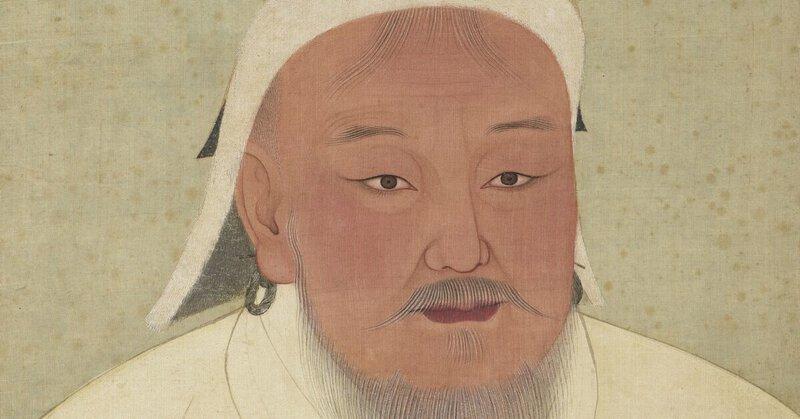
On the windswept Mongolian steppe around 1162, a woman named Hoelun held her newborn son and noticed something strange clenched in his tiny fist — a dark clot of blood, solid and deliberate, as if the infant had arrived already gripping the world. Among the Mongol clans, people whispered that this child was marked. They had no idea how completely he would prove them right.
The Birth of Temüjin: A Prophecy Written in Blood

The boy’s name was Temüjin. His father, Yesügei, was a minor chieftain of the Borjigin clan — influential enough to have rivals, not powerful enough to guarantee his family’s safety. The steppe Temüjin was born into was not a nation or an empire. It was a fractured, violent mosaic of competing tribes: Tatars, Merkits, Naimans, Keraites, and dozens of smaller clans, each one raiding, feuding, and surviving at the expense of the others. A boy born into this chaos carried roughly even odds of dying young, his name absorbed back into the grass.
That he did not — that Temüjin instead became Genghis Khan, the founder of the Mongol Empire and ruler of the largest contiguous land empire in human history — is one of the most extraordinary biographical arcs ever recorded. The story moves through kidnapping, near-slavery, devastating personal loss, and a genius for alliance-building that would eventually reorder the entire Eurasian continent. It begins, though, with that fistful of blood and a mother who refused to read it as anything other than destiny.
Childhood Forged in Hardship

Temüjin was approximately nine years old when the world caved in. His father Yesügei, while returning from arranging his son’s betrothal to a girl named Börte from a neighboring clan, accepted food and hospitality from a group of Tatars — the tribal enemies who had long clashed with the Borjigin. The Tatars poisoned him. By the time Yesügei made it home, he was dying, and with his death the clan’s loyalty evaporated almost immediately.
The clan elders decided they would not follow a widow and her children. They stripped the family of their horses, their followers, and most of their security, and rode away. Hoelun was left on the steppe with Temüjin, his brothers, and a half-brother, facing the Mongolian winter with almost nothing. What followed was a survival chronicle as raw as anything in medieval history: hunting marmots and field mice, digging for roots, enduring cold that could kill a healthy adult, let alone a child.
The Secret History of the Mongols — the closest thing to a primary biographical source for this period, composed by unknown authors in the thirteenth century — does not soften these years. They were recorded as foundation stones, not as tragedies to be pitied. The message embedded in the text is deliberate: the man who would unite the steppe first had to survive it with nothing, so that he would understand precisely what nothing meant.
A defining trauma came after Temüjin had begun rebuilding some standing and had retrieved his promised wife Börte. A rival tribe, the Merkits, raided the family camp while Temüjin escaped on horseback. Börte was captured and carried off. On the steppe, a stolen wife was both a personal devastation and a public declaration of weakness — a signal to every watching clan that this man could be taken from. Temüjin refused to accept that signal. He would use the crisis as the first real test of the political tool that would eventually build an empire: the deliberate, calculated alliance.
The Art of the Alliance: Uniting the Mongol Tribes

Temüjin could not rescue Börte alone. He did not try. Instead, he called on two carefully cultivated relationships: his blood-brotherhood, or anda, with a man named Jamuga, and the patronage of Toghrul, the powerful leader of the Keraite confederation, who had owed a debt of loyalty to Temüjin’s late father. Borrowing their warriors, Temüjin struck the Merkit camps, recovered Börte, and emerged from the episode with something more valuable than revenge — a reputation.
Word spread across the steppe the way only truly useful information does: this man delivers results, and he rewards those who ride with him. Where most chieftains hoarded plunder among their bloodline and promoted by birth, Temüjin distributed spoils equitably and elevated men by demonstrated ability. It was a radical proposition on a landscape defined by kinship politics, and it worked. Followers arrived, and then more followers after them.
Over the following two decades, Temüjin prosecuted a rolling campaign of absorption and destruction against the major tribal confederations, one by one. The Tatars — who had poisoned his father — were defeated and dispersed. The Naimans fell. The Merkits were broken permanently. Even Jamuga, his old blood-brother and sometime rival, was eventually defeated as the two men’s visions for the steppe proved irreconcilable. The unification of the Mongol tribes was less a single glorious battle than a grinding, two-decade negotiation conducted simultaneously in the languages of diplomacy and violence. By approximately 1206, no significant power on the steppe did not answer to Temüjin.
1206: The Kurultai and the Founding of the Mongol Empire

In 1206, on the banks of the Onon River in the heart of Mongolia, something unprecedented happened. The tribal leaders — men who had fought alongside Temüjin, and some who had fought against him before surrendering — gathered in a great ceremonial assembly called a kurultai. They raised a standard of nine white yak tails, the symbol of supreme authority, and proclaimed Temüjin by a new name: Chinggis Khan. The precise meaning of the title remains debated among scholars, with interpretations ranging from “universal ruler” to “oceanic ruler,” suggesting something boundless and all-encompassing. The political meaning, however, was unambiguous. The Mongol Empire was formally founded, and Genghis Khan was its first and supreme khan.
This moment deserves careful attention, because it is often misread as a simple coronation of a warlord. It was not. Genghis Khan was proclaimed by collective agreement. The kurultai was a constitutional act — a ceremonial and political compact among formerly warring peoples to become something larger than any single clan. With that proclamation came a codified body of law, the Yasa, which formalized principles Temüjin had already been practicing: prohibition of the kidnapping of women, protections for envoys and merchants, mandated religious tolerance across the empire’s territories, and a meritocratic military structure that promoted by performance rather than by birth. These were not the simple edicts of a conqueror. They were the architecture of a functioning state, and they are what separates the Mongol Empire’s founding from the merely violent seizures of power that surrounded it on every side.
The Mongol Empire’s origin story, properly understood, is not a tale of pure conquest. It is a story of institutional invention — of a man who grasped that terror alone could not hold together a people as vast and fractious as the steppe’s tribes. A framework was required, one that people across dozens of clans and cultures could recognize as legitimate. Temüjin built that framework, and it outlasted him by generations.
Military Genius: How Herders Became World-Beaters

The empire’s expansion after 1206 was staggering in its speed and geographic reach, powered by a military system unlike anything its opponents had previously encountered. The most famous Mongol tactic was the feigned retreat: cavalry would appear to flee in disorder, drawing enemy formations out of their defensive positions and into open ground, where a disciplined encirclement — the nerge, adapted directly from traditional communal hunting techniques — would close around them. Armies that believed they were winning discovered too late that they had been guided to their own destruction. Opponents repeatedly mistook the maneuver for cowardice until it had already killed them.
Equally consequential was the empire’s institutional capacity to learn from conquered peoples. Chinese engineers provided siege warfare expertise, allowing the Mongols to reduce the walled cities that cavalry alone could not take. Persian administrators helped govern and tax conquered territories. Uyghur scribes gave the empire a written bureaucratic language. The Mongol military functioned less like a traditional army and more like a learning organization, upgrading its capabilities with every campaign rather than fighting the next war with the last war’s tools.
Communications were weaponized through the yam, a sophisticated relay-station messenger network that allowed commanders to coordinate across hundreds of miles faster than any rival force could respond or adapt — an advantage in information speed that consistently outpaced opponents who had no equivalent system. And psychological terror, deployed deliberately and strategically, reduced the cost of future campaigns. Cities that surrendered promptly were absorbed and protected. Cities that resisted were made into object lessons, and the news traveled ahead of the armies, softening resistance before a single arrow was fired. The brutality was, from a coldly strategic standpoint, also a form of efficiency.
The Man Behind the Legend: Character, Contradictions, and Context

Genghis Khan’s life resists the clean moral categories that later storytellers have often tried to impose. He ordered devastations that emptied cities and shattered civilizations. He also mandated religious tolerance across his empire at a time when much of Europe was burning heretics, and he established protections that allowed merchants of any faith to travel safely across his territory. He executed former allies when political necessity demanded it — Jamuga among them — and remained fiercely loyal to those who had stood by him in the lean years on the steppe. He was, in short, a human being operating at a scale that makes both his virtues and his brutality difficult to absorb through any single moral lens.
He never learned to read. He built an empire that required sophisticated written administration across a dozen languages and cultures, and he did it by surrounding himself with literate, capable advisors and genuinely listening to them. The Secret History of the Mongols portrays a man acutely aware of his own limitations and ruthlessly determined to compensate for them — a quality that is, in its way, more remarkable than any battlefield victory. Conquest can be explained by force of circumstance and superior tactics. Knowing what you do not know, and building systems around that gap, requires a different and rarer kind of intelligence.
His death came in 1227, during a campaign against the Tangut kingdom of Xi Xia. The precise cause remains historically uncertain: sources variously cite a riding injury, illness, and other causes, and no single account has been definitively verified. Per his instructions, his burial site was concealed with such thoroughness that it has never been found — a final, characteristic act of control over how his story would be received. He left behind sons who would expand what he had built into four major successor khanates, and a territorial inheritance stretching from the Pacific coast to the Caspian Sea, assembled in roughly two decades from a starting point of scattered, hungry clans with no shared written language and no common political identity.
Why the Mongol Empire’s Founding Still Matters
The question of who founded the Mongol Empire has a simple answer — Genghis Khan, in 1206 — but the answer that actually repays attention is the how, and the what followed. No single factor explains the rise. Personal trauma shaped his psychology and his understanding of loyalty. Political innovation gave him a framework that outlasted his personality. Military reinvention gave him tools no opponent was prepared to counter. Remove any one of those elements and the story ends differently, probably in obscurity on a steppe that had already swallowed countless would-be conquerors.
Historians now understand that the Mongol conquests, catastrophic as they were for many of the civilizations they engulfed, produced a significant unintended consequence: the Pax Mongolica, a period of relative stability and enforced safety across the overland trade routes connecting China to Europe. Goods, technologies, and ideas moved along those routes with new freedom. So, tragically, did pathogens — the same connected arteries that carried silk, spices, and paper almost certainly accelerated the spread of the Black Death across Eurasia in the fourteenth century. The modern world, in ways both constructive and devastating, carries the fingerprints of what Temüjin built from that frozen steppe in the years after his father was poisoned and his clan rode away.
The blood clot legend — whether it records something literally observed, or whether it was shaped in the retelling by people who already knew what Temüjin would become — captures something essential about how the Mongols understood their founder and, by extension, themselves. Destiny, in their telling, was not passively received. It was gripped. Held tight against abandonment on the steppe, against a stolen wife and two decades of enemies who had every reason to see him fail. Temüjin’s entire life was an argument that what you hold onto, and how hard you hold it, is the only prophecy worth trusting — and that empires, like fists, begin with a choice to close.

 English
 Arabic
 French
 Spanish
 Portuguese
 Deutsch
 Turkish
 Dutch
Dutch
 Italiano
 Russian
 Romaian
 Portuguese (Brazil)