


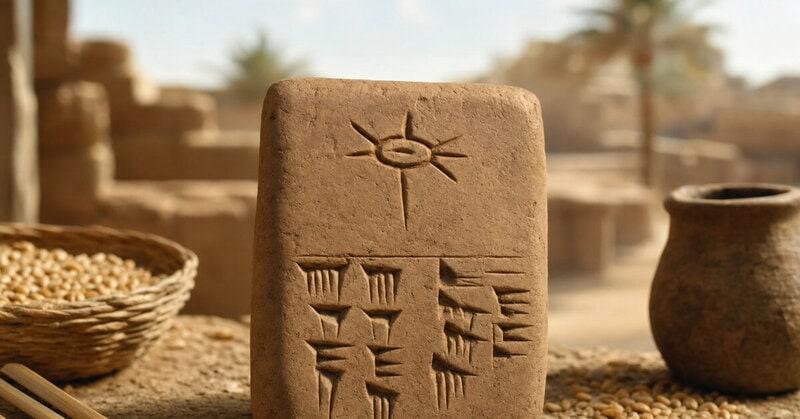
Somewhere in the city of Uruk, around 3200 BC, a temple administrator pressed a sharpened reed into a palm-sized rectangle of wet clay and drew a small oval with lines radiating from it — the symbol for “head.” Beneath it he pressed a series of wedge-shaped marks recording a quantity of barley. It was not a poem. It was not a prayer. It was a receipt, and it was among the earliest writing the world had ever seen. That single, bureaucratic gesture would ripple forward across five thousand years of human history.
How Long Did Mesopotamia Last?

Before tracing the arc of events, the question of scale deserves a direct answer. The Mesopotamia time period stretches, in its broadest definition, from the first permanent agricultural settlements of the Ubaid period around 6500 BC to the Arab Muslim conquest of the 7th century CE — a continuous story of urban, literate civilization spanning roughly ten thousand years. Even measured conservatively, from the rise of the first cities around 3500 BC to the conquest, the span exceeds four thousand years. For comparison, that is longer than the interval separating us today from the reign of Hammurabi. Mesopotamia was not an episode. It was an era unto itself, and every civilization that followed it — Persian, Greek, Roman, Islamic, and beyond — inherited something from the river valley without always knowing it.
The Land Between the Rivers: Geography as Destiny

The word Mesopotamia is Greek — “the land between the rivers” — a name coined by outsiders for a region whose own inhabitants called it by a dozen different names across the centuries. Today, the territory covers most of modern Iraq along with parts of Syria, Turkey, and Kuwait. In ancient times it was defined by two rivers: the Tigris and the Euphrates, both fed by snowmelt from the mountains of Anatolia, both prone to flooding with terrifying unpredictability. The floods that could drown a village in spring might leave the same village surrounded by some of the richest agricultural soil on earth by summer. That volatile generosity shaped everything.
The region’s central paradox is that it was simultaneously abundant and fragile. Unlike Egypt’s Nile, which flooded on a reliable annual schedule and receded neatly, the Tigris and Euphrates were erratic. Floods came at different times, at different intensities, and from different directions. Surviving them required collective action on a scale no single family or clan could manage. Irrigation canals had to be dug and maintained communally. Surplus grain had to be stored and redistributed across communities. When you are managing shared resources across hundreds of households, you need records — and records, pressed persistently into clay by generations of administrators, eventually become writing. The geography did not merely set the scene. It authored the plot.
The story begins long before any city rose. During the Ubaid period (roughly 6500-3800 BC), small agricultural villages appeared across the river plains, clustered around simple mud-brick temples that served simultaneously as community centers, granaries, and the earliest seats of institutional power. By the Uruk period (c. 4000-3100 BC), something remarkable was happening: villages were swelling into towns, and one town — Uruk itself — was becoming something the world had never produced before. The full sweep of the history of Mesopotamia stretches from these prehistoric mud-brick beginnings to the Arab conquest of the 7th century CE.
The First Cities and the Invention of Writing (c. 3500-2300 BC)

By around 3000 BC, Uruk had grown to house an estimated 40,000 to 80,000 people — a number that strains comprehension when you consider that nothing remotely comparable existed anywhere else on earth at the time. It had neighborhoods, specialized craftspeople, a monumental temple complex called the Eanna dedicated to the goddess Inanna, and an administrative class that was furiously inventing the tools of urban management as it went. Cuneiform script — named for the wedge-shaped (cuneus) impressions left by a reed stylus — emerged directly from the pressure of keeping track of it all. What began as pictographic accounting symbols evolved, over several centuries, into a flexible writing system capable of recording grammar, legal decisions, royal decrees, and eventually the world’s first great surviving work of literature: the Epic of Gilgamesh.
The Early Dynastic Period (c. 2900-2350 BC) saw Uruk joined by a constellation of rival Sumerian city-states — Ur, Lagash, Nippur, Kish, Umma — each ruled by a king who claimed divine endorsement and spent considerable energy making war on his neighbors. The politics of this era are surprisingly legible to modern eyes: shifting alliances, border disputes over irrigation water, propaganda inscriptions claiming the enemy struck first. These were not primitive chiefdoms but sophisticated urban societies with professional armies, legal traditions, and a shared cultural identity built around Sumerian language and religion. The Royal Tombs of Ur, excavated by Leonard Woolley in the 1920s and 1930s, revealed a world of extraordinary material wealth — golden helmets, lapis lazuli jewelry, and, soberly, evidence of human sacrifice accompanying the deaths of royalty.
The era’s great disruptor arrived around 2334 BC in the form of Sargon of Akkad, a figure so consequential that rulers would claim descent from him for centuries after his death. The details of his origins are obscured by later legend, but his achievements are measurable: he unified the Sumerian city-states under a single administration, creating what historians recognize as one of the world’s earliest empires. He fused Sumerian and Akkadian cultures — the latter a Semitic language that would eventually displace Sumerian as the region’s everyday tongue — into a governing template that every subsequent Mesopotamian ruler would borrow from. The idea that one king could legitimately rule the entire known world was, in large part, Sargon’s political invention.
The Third Dynasty of Ur and the Age of Records (2112-2004 BC)

After the Akkadian Empire fractured — under pressure from internal instability, climatic stress, and incursions by mountain peoples known as the Gutians — a new power rose from the city of Ur. The Third Dynasty of Ur (2112-2004 BC) represents one of Mesopotamia’s most intensely documented eras, not because ancient historians preserved it, but because its administrators were almost compulsively devoted to writing things down. Standardized weights and measures, a unified calendar, careful census records, and wage lists for thousands of laborers survive in tens of thousands of clay tablets. The Ur III state was an early experiment in systematic bureaucratic governance, and the surviving record gives modern historians an unusually intimate view of daily administrative life: what workers ate, how long construction projects took, which officials were reprimanded for shortfalls.
It did not last. Around 2004 BC, the city of Ur was sacked by the Elamites — a rival civilization from the Iranian plateau — while Amorite tribes pressed in from the west. A Sumerian lament composed in the aftermath, known today as the Lament for the Destruction of Ur, survives and stands as one of the earliest examples of literary mourning for a fallen civilization. The fall of Ur III fragmented political power across the region into the competitive Isin-Larsa period (19th to 18th century BC), a jostle of smaller kingdoms each claiming to be the legitimate heir of Sumerian tradition. Out of that rivalry, a previously minor city began its long rise.
Hammurabi and the Architecture of Law (1792-1750 BC)

Imagine standing in a Babylonian temple courtyard and finding yourself face to face with a column of black diorite nearly eight feet tall, its smooth surface covered top to bottom in fine cuneiform script. At the top, a carved relief shows a king receiving a measuring rod and ring — symbols of justice — from the seated sun god Shamash. Below the image, 282 laws govern the society you live in. You can read them here, in public, so ignorance is no excuse.
That stele was commissioned by Hammurabi, who ruled Babylon from 1792 to 1750 BC, and it represents one of the most ambitious acts of political communication in the ancient world. Hammurabi transformed Babylon from a second-tier city-state into the unquestioned master of southern Mesopotamia through a combination of shrewd military campaigning and even shrewder diplomacy. His law code was not the world’s first — earlier Sumerian rulers, including Ur-Nammu of Ur III, had written legal codes — but it was the most comprehensive to survive, addressing everything from wage rates for agricultural workers and the liability of architects whose buildings collapse, to the legal standing of enslaved people and the dissolution of marriages. It was a statement that Babylon was a place where justice was systematic rather than arbitrary, and that its king was the appointed guarantor of that system.
Hammurabi’s reign sits close to the midpoint of Mesopotamia’s urban story, which underscores the civilization’s extraordinary length. He died with roughly 2,300 years of Mesopotamian history already behind him — and roughly 2,300 years still ahead.
This recurring pattern — unification, fragmentation, re-unification under a new dynasty — is perhaps the deepest structural truth of the Mesopotamian civilization timeline. It pulses like a heartbeat across three millennia: a strong centralizing ruler forges an empire, the empire fractures after his death or under external pressure, and the pieces recombine under a new dynasty that inherits and amplifies what came before. The river valley was too agriculturally rich to remain divided for long, and too geographically open to remain unified forever.
Assyrian Iron and Babylonian Splendor (c. 900-539 BC)

The first millennium BC brought two of Mesopotamia’s most dramatic performances. The Neo-Assyrian Empire (c. 911-609 BC) built what is widely regarded as the ancient world’s first professional standing army — iron-weaponed, siege-engine-equipped, and backed by a calculated policy of mass deportation deployed against conquered peoples to prevent organized resistance. Assyrian rulers documented their campaigns with unsettling precision in palace reliefs depicting sieges, executions, and the submission of foreign kings. This was propaganda in stone, engineered to terrify enemies before a single soldier crossed their border. At its height, the Neo-Assyrian Empire stretched from Egypt to western Iran, encompassing more territory than any Mesopotamian state before it.
Yet Assyria’s fall, when it came, was total. In 612 BC, the city of Nineveh — the empire’s magnificent capital on the eastern bank of the Tigris — was burned to the ground by a coalition of Babylonians and Medes. The destruction was so thorough that later Greek historians debated whether Nineveh had ever really existed. Its ruins slept under the earth for more than two thousand years before 19th-century archaeologists began to uncover them — and with them, the great library of the Assyrian king Ashurbanipal, which preserved thousands of cuneiform tablets including multiple versions of the Epic of Gilgamesh.
Into the vacuum stepped Nebuchadnezzar II, who took the Babylonian throne in 605 BC and remade Babylon into the largest and most spectacular city in the ancient world. The Ishtar Gate — its deep blue glazed bricks decorated with striding lions, bulls, and dragons — anchored a processional avenue running through the city’s ceremonial core. Greek sources describe Hanging Gardens lush with exotic plants, though archaeologists continue to debate their precise location and physical form; no Babylonian text yet discovered describes them directly. What is not in doubt is that Nebuchadnezzar’s destruction of Jerusalem in 586 BC and the subsequent Babylonian captivity of the Jewish people wove Mesopotamian history permanently into the fabric of world religion. The rivers of Babylon flow through the Psalms. The towers of Babylon haunt the book of Revelation. Ancient Mesopotamia did not stay in the ancient world.
The Long Twilight: From Cyrus to the Arab Conquest (539 BC-7th Century CE)
In 539 BC, the Persian king Cyrus the Great entered Babylon — and, crucially, did not burn it. He positioned himself as a liberator of the peoples Nebuchadnezzar had displaced, including the Jewish exiles he permitted to return to their homeland, an act recorded in the Hebrew Bible and corroborated by the Cyrus Cylinder, a clay barrel inscription discovered in the 19th century and now held in the British Museum. It was a masterclass in imperial legitimacy, and it worked. Babylon passed from Persian to Macedonian Greek to Seleucid to Parthian control over the following centuries, each new master finding that the city’s symbolic weight was too great to squander. Alexander the Great, who died in Babylon in 323 BC, had reportedly intended to make it the administrative capital of his world empire.
Through the Parthian centuries and into the Sassanid Persian era of the early first millennium CE, Mesopotamia’s fundamental infrastructure — its irrigation networks, its trade routes, its accumulated astronomical and mathematical knowledge — continued to function and evolve. A dwindling community of temple scribes maintained cuneiform scholarship in cities like Babylon and Uruk well into the first century CE, preserving traditions that would eventually reach medieval Islamic scholars through Syriac and Arabic translations and, through them, influence the mathematical and astronomical foundations of the modern world. Mesopotamian base-60 arithmetic is why there are 60 minutes in an hour and 360 degrees in a circle.
The Arab Muslim conquest of the 7th century CE brought the Mesopotamia time period to its quiet close as a distinct political and cultural entity. The new rulers founded Baghdad in 762 CE near the ruins of older Sassanid capitals, inheriting a landscape already layered with thousands of years of urban civilization. The cuneiform script ceased to be used or understood. The clay tablets disappeared under the sand. And the inventions born on those river banks — cities, writing, codified law, systematic astronomy, literary narrative — traveled forward into a future that had largely forgotten where they came from.
That forgetting did not last. Beginning in the 1840s, European archaeologists began pulling cuneiform tablets and sculpted palace walls from the Iraqi earth, and the world discovered, with something approaching vertigo, just how long the story of civilization had been running before anyone thought to write it down as history. For a closer look at the objects these river-dwellers left behind, the Getty Museum’s exploration of Mesopotamia offers an exceptional visual introduction — artifacts pressed in clay and carved in stone, still carrying the weight of five thousand years.

 English
 Arabic
 French
 Spanish
 Portuguese
 Deutsch
 Turkish
 Dutch
Dutch
 Russian
 Romaian
 Portuguese (Brazil)
 Greek
Greek