


On a frozen Christmas Night in 1776, George Washington staked the entire American Revolution on a desperate gamble most of his own officers thought was madness — and the 2000 television film The Crossing captures that terror with far more historical honesty than you might expect. But the film itself, and the real events it dramatizes, are wrapped in persistent myths worth untangling.
Myth 1: The Crossing Is a Big-Screen Hollywood Epic

Many viewers who stumble across The Crossing assume they are looking at a theatrical studio release — the kind of prestige historical drama that commands a multiplex and a marketing budget. In fact, The Crossing (2000) is a made-for-television movie produced for A&E, placing it squarely in the tradition of prestige cable TV rather than the blockbuster category. Understanding that context is essential to appreciating what the filmmakers were actually attempting.
Far from being a limitation, the format gave the production room to breathe. Where a theatrical cut might have sacrificed character interiority for action set pieces, the A&E film lingers on decision-making, doubt, and the grinding psychological weight of command — which turns out to be exactly the right lens for this particular story. The result is a film that rewards patience in ways a conventional studio release rarely would.
Myth 2: Jeff Daniels Is an Odd Choice to Play George Washington

When audiences first hear that Jeff Daniels — better known for comedic and contemporary dramatic roles — plays George Washington, skepticism is a natural first reaction. It proved to be misplaced. Daniels earned widespread critical praise precisely because he refused marble-monument reverence, instead portraying Washington as an exhausted, calculating commander who was gambling everything on a single winter night and knew it.
Casting a recognizable contemporary actor rather than a classical unknown was a shrewd choice: it helped audiences see Washington as a flesh-and-blood leader buckling under crushing pressure, not a portrait stepping off a museum wall. Daniels’s coiled, desperate intensity matches the historical record of Washington’s mood in December 1776 — a man who understood that failure meant not just military defeat but almost certain execution for treason — better than any conventionally heroic portrayal could have managed.
Myth 3: Washington Surprised British Redcoats at Trenton

The assumption that Washington crossed the Delaware to attack the British Army is one of the most common errors in casual retellings of this story. The soldiers routed at Trenton on the morning of December 26, 1776 were Hessians — German mercenaries hired by the British Crown — not British regulars. The film is historically accurate on this point, and the distinction carried genuine political weight at the time.
Defeating hired foreign soldiers sent a different message to the colonial public than beating the king’s own troops would have. Hessian forces made up roughly a third of all combatants fighting for Britain in America during the Revolution, and Trenton became their most spectacular and humiliating defeat. Washington understood the propaganda value of routing mercenaries on American soil, and The Crossing captures that calculation in his reasoning rather than glossing over it.
Myth 4: Washington Knew the Battle Would Succeed Before It Began

There is a retrospective inevitability that creeps into popular memory of famous victories — we know how they ended, so we unconsciously assume the victor must have sensed success coming. The film firmly refuses this comfort. It frames the crossing and the attack on Trenton as a desperate, high-risk gamble in which Washington genuinely did not know the outcome, and in which failure would almost certainly have ended both his command and the Revolution itself.
By December 1776, Washington’s forces were so depleted, frozen, and demoralized that many officers privately doubted the Continental Army could survive another month without a dramatic win. The battle turned out far more successful than Washington had dared anticipate — the Hessian garrison was overwhelmed — but nothing about the night’s opening hours made that outcome feel assured. The film’s dramatic tension is historically honest, not manufactured for the screen.
Myth 5: The Crossing Depicts a Straightforward Military Victory

Seen through the lens of hindsight, Trenton looks clean: surprise attack, swift collapse, American triumph. The film refuses that tidiness. Its power comes from portraying the event as an existential crisis in which Washington’s career, his life under potential treason charges if captured, and the American cause itself were balanced on a single winter night. Two supporting columns meant to cross the Delaware alongside Washington’s force failed to make it across, meaning he proceeded knowing he would have no flanking support whatsoever.
That desperation is historically grounded. Thomas Paine wrote The Crisis — with its famous opening lines about times that try men’s souls — just days before the crossing, and the mood he was describing was exactly the one the film dramatizes. The Crossing earns its tension not by inventing jeopardy but by restoring the jeopardy that popular myth has quietly edited out of the story.
Myth 6: The Crossing Happened on Christmas Morning

The date “December 25” attached to this event leads many people to picture a daytime crossing — Washington setting out on Christmas morning in some revolutionary procession. The reality is starker. The crossing of the Delaware began on the night of December 25, 1776, with Washington’s forces pushing off from the Pennsylvania bank in pitch darkness, driving sleet, and bone-cracking cold. The attack on Trenton itself came at dawn on December 26, and it is the compression of this timeline that causes popular memory to lose the brutal overnight ordeal of the river passage.
The film correctly places the crossing — not the battle — at the center of its drama, because getting his men, horses, and artillery across an ice-choked river in a nor’easter storm was itself a near-miracle before a single shot was fired. The Christmas Night framing is not a minor scheduling detail; it is the entire story of what made the operation so improbable and so extraordinary.
Myth 7: Roger Rees Has Only a Minor Background Role
Some viewers who know The Crossing primarily through its association with Jeff Daniels assume the rest of the cast serves mainly as backdrop. Roger Rees is the clearest counterexample: he co-stars in a substantial supporting capacity, and his scenes with Daniels form much of the film’s dramatic backbone. Rees was a celebrated stage actor whose work with the Royal Shakespeare Company had made him one of the most respected theatrical performers of his generation, and he brings that weight to the film’s dialogue-driven command debates.
The pairing of Daniels and Rees — two actors with deep stage roots — gives The Crossing much of its texture in scenes depicting the strategic arguments and officer dissent surrounding the decision to cross. Those scenes, grounded in two actors who know how to make words land with precision, are where the film makes its most compelling historical argument about the nature of revolutionary leadership.
Myth 8: Emanuel Leutze’s Famous Painting Accurately Depicts the Crossing

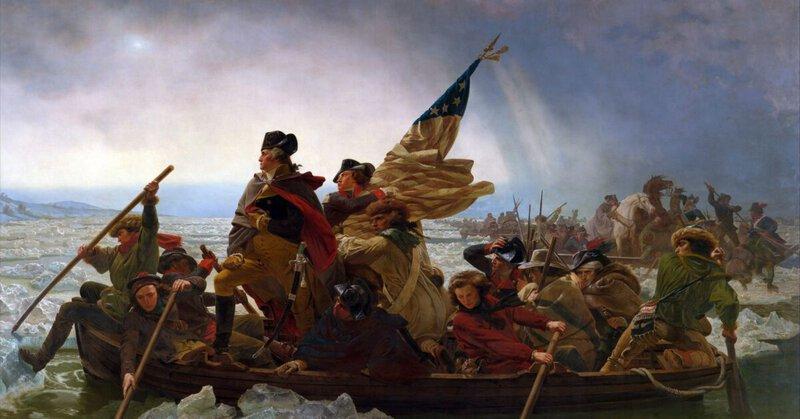
Emanuel Leutze’s 1851 painting is the image most people carry in their heads when they think about Washington crossing the Delaware — Washington standing heroically in a boat, dawn breaking over a relatively serene river. It is also, in key respects, wrong. The flag shown in the painting was not adopted until months after the crossing. The boats depicted are the wrong type entirely; the actual vessels were flat-bottomed Durham boats, unglamorous cargo craft far better suited to hauling artillery through ice floes than the rowboat-style hulls Leutze painted. And that luminous sunrise? The crossing happened in pitch darkness.
The Crossing leans deliberately into the darkness, cold, and chaos that Leutze’s composition smoothed into grandeur, making the film in some respects a more faithful visual record than the iconic image it implicitly corrects. The real story is murkier, wetter, and more terrifying than any painting can comfortably hold — and the film knows it.
Myth 9: The Film Takes Heavy Creative Liberties With the Historical Record

Given how dramatically charged the film is, it would be reasonable to assume that much of its tension is invented for the screen. Reviewers and historians examining The Crossing noted the opposite: the film hews closely to the documented sequence of events surrounding the Christmas Night operation and the Battle of Trenton. Washington’s resolve against officer dissent, the chaos of the river crossing, the swiftness of the Hessian collapse — all align with primary-source accounts and respected historical scholarship.
Where the film dramatizes, it dramatizes mood and motive rather than fabricating incidents, which is why it has found use as a supplementary teaching tool in American history courses. You can purchase a copy or check current streaming availability, and what you will find is a historically grounded account dressed in genuine dramatic urgency — not Hollywood invention dressed as history.
The night Washington crossed the Delaware was more chaotic, more cold, and more close-run than the painting, the mythology, or even a careful reading of the history tends to convey. The quiet achievement of The Crossing is that it insists you feel every desperate hour of it — and it earns that insistence by staying honest about what those hours actually looked like.

 English
 Arabic
 French
 Spanish
 Portuguese
 Deutsch
 Turkish
 Dutch
Dutch
 Italiano
 Russian
 Romaian
 Portuguese (Brazil)