


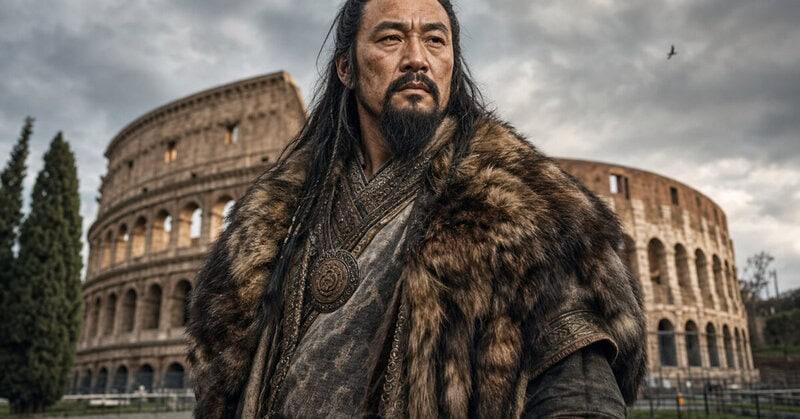
In the summer of 452 CE, smoke rose in columns from the ruins of Aquileia — a city so completely erased by Attila’s forces that later generations claimed even the storks and swallows abandoned its rubble — and the Po Valley trembled under the thunder of Hunnic cavalry. Rome, just days’ march to the south, seemed to be next. And yet the man history calls the Scourge of God turned his horse around and never came.
The Myth at the Gates

Here is the paradox that has haunted historians ever since: Attila the Hun, the most feared warlord the late Roman world had ever confronted, stood within reach of the eternal city — and walked away. Centuries of storytelling have quietly erased that detail, fusing his name with Rome’s destruction until the association feels like established fact. It isn’t. So if Attila didn’t sack Rome, why does nearly everyone believe he did? Who actually did the sacking? And what does the real story reveal about one of history’s most misunderstood figures?
The answers tell us as much about how history travels — distorted, compressed, and emotionally supercharged — as they do about the man himself. Attila lived approximately 406 to 453 CE, ruled the Hunnic Empire from 434 until his death, and earned the Latin nickname Flagellum Dei, the Scourge of God. He was real, he was devastating, and his campaigns reshaped the late Roman world. He just never burned Rome.
Who Was Attila, Really?

Attila did not begin as a solo act. He first came to power in 434 CE sharing the Hunnic throne with his elder brother Bleda — a joint arrangement that was, by all indications, uneasy from the start. Around 445 CE, according to Britannica’s biography of Attila, Bleda was murdered, and the historical record strongly implies his brother’s hand in the act. Whatever moral weight one attaches to that, it was politically decisive. Attila became sole master of an empire stretching across the Eurasian steppe, commanding a confederation of nomadic peoples whose mounted warriors could cover ground that Roman legions, burdened by supply trains and fixed roads, simply could not match.
The details that tend to surprise modern readers sit awkwardly beside his monster-at-the-gates reputation. He reportedly spoke both Gothic and Latin. He received Roman ambassadors — including the historian Priscus, who left one of the most vivid eyewitness accounts of any barbarian court — at a timber-hall settlement far more modest than the marble palaces of Constantinople. He dressed plainly, more so than the nobles around him, and ate from wooden plates while guests were served on silver. This was partly performance, a ruler’s studied contrast with the luxury he extracted from defeated enemies. But it was also a man comfortable enough in his own power to need no gilded props.
Over roughly a decade of campaigning, Attila led his forces through territories encompassing what is now Hungary, Spain, Italy, and Greece, burning towns, triggering mass displacement, and extracting enormous tribute payments from an Eastern Roman Empire desperate to keep Hunnic cavalry pointed elsewhere. The Western Empire, poorer and more fragmented, was less able to buy him off — which is what eventually brought his army across the Alps.
The Timeline: What the Huns Actually Did to Rome

The chronology, laid out plainly, makes the mix-up understandable even if it doesn’t excuse it. In 451 CE, Attila led his forces into Gaul — roughly modern France — and was checked, bloodily, at the Battle of the Catalaunian Plains by a Roman-Visigoth alliance under the general Aetius. It was one of the very few times a major Hunnic assault was turned back in open battle, and the outcome mattered enormously for the survival of the Western Empire. The following year, Attila pivoted south into Italy, razing Aquileia and menacing the Po Valley cities. Then, in the summer of 452, he stopped. Rome was never touched.
The Western Roman Empire was in fact sacked twice in the fifth century — by Alaric’s Visigoths in 410 CE and by the Vandals in 455 CE — and centuries of retelling have blurred those perpetrators into a single fearsome, horse-riding composite villain. The word “Hun” itself metastasized into a generic term for barbaric destruction; it was still being weaponized in First World War propaganda, applied to German soldiers, long after the actual Huns had disappeared from history. That cultural residue clung to Attila’s name and made him a convenient repository for every memory of Rome’s violent unraveling.
Attila’s story also reaches us almost entirely through hostile Roman and Greek sources. The historian Priscus was an eyewitness to Attila’s court, but writers like Jordanes — composing his history of the Goths decades after the fact — had every reason to cast the Hunnic leader as an apocalyptic force, an instrument of divine punishment for Roman sins. Mythologizing, under those conditions, was not just inevitable; it was practically a literary obligation. The BBC’s profile of Attila traces how the written record was always filtered through Roman anxiety and theological agenda.
Why Did Attila Turn Back? The Meeting on the Mincio

The moment that has inspired the most romantic interpretation came when Pope Leo I rode north to meet Attila near the River Mincio — an encounter so charged with drama that Raphael painted it on a Vatican wall more than a thousand years later. In Raphael’s vision, Leo advances in papal splendor while Saints Peter and Paul hover menacingly overhead, and Attila, visibly shaken, backs away. It is a magnificent image. It is also, almost certainly, theology dressed up as history.
The more plausible explanations are considerably less miraculous and considerably more interesting. By the summer of 452, Attila’s army was in serious difficulty. Famine and disease — possibly plague — had torn through his forces during the Italian campaign. Supply lines were dangerously overstretched. An Eastern Roman relief force was reportedly closing in from the east. Continuing south toward Rome’s heavy fortifications, with a depleted and sickened army, for a siege of uncertain duration and outcome, was not courage — it would have been recklessness. Pope Leo’s negotiating mission almost certainly offered Attila the political cover he needed for a withdrawal that military logic had already made inevitable.
Attila’s own strategic pattern reinforces this reading. Throughout his campaigns, he consistently preferred raiding and extortion to occupation. Tribute payments from terrified emperors were faster, cheaper, and far less administratively complicated than governing conquered cities. Turning back, accepting the terms Leo offered, and leaving Italy with tribute and prestige nominally intact was, by Attila’s own well-established playbook, the rational move. The broader arc of his campaigns is mapped at the World History Encyclopedia’s Attila timeline.
The Empire Behind the Legend

Understanding why Attila stopped — in Italy, in Gaul, repeatedly — requires understanding what the Hunnic Empire actually was, and what it wasn’t. It was not a bureaucratic state with provinces, governors, and tax collectors. It was a coalition of subordinate kings and tribal leaders held together by Attila’s personal authority and the steady delivery of plunder and tribute to those who followed him. The moment that delivery stopped, loyalty became negotiable. Perpetual forward momentum was not merely a military preference; it was a structural necessity.
That inherent fragility is the key to the whole story. The wealthy, already-softened cities of northern Italy — Aquileia, Milan, Padua — offered exactly the kind of plunder that kept the coalition intact and hungry followers satisfied. Rome, heavily fortified, psychologically steeled, and capable of prolonged defense, offered serious risk without guaranteed reward. For a confederation that could not afford a costly, prestige-damaging failure, the strategic calculus was clear long before Leo’s delegation ever mounted its horses.
Attila never got another opportunity to reconsider. He died in early 453 CE — found dead on what was reportedly his wedding night, most accounts suggesting a severe hemorrhage, possibly from a ruptured blood vessel or esophageal bleeding brought on by heavy drinking — and the empire he had built through sheer force of will began fracturing almost immediately. His sons quarreled bitterly over the succession, subordinate peoples seized the moment to revolt, and within a few years the Hunnic Empire had effectively ceased to exist as a unified power. HowStuffWorks’ overview of Attila’s life captures how swiftly a structure built entirely on one man’s dominance can collapse the moment that man is gone.
Who Really Sacked Rome — and Why the Confusion Matters

The answer unfolds in two distinct acts, the first arriving forty-two years before Attila ever crossed the Alps. In 410 CE, Alaric the Visigoth led his forces into Rome — the first foreign army to breach the city in roughly 800 years. The psychological shock reverberated across the entire Roman world, prompting Augustine to begin writing The City of God partly as a theological response to pagans who blamed Christianity for Rome’s sudden vulnerability. Alaric’s sack was devastating symbolically, though his forces withdrew relatively quickly and without systematic destruction.
The more methodical pillaging came forty-five years later. In 455 CE, the Vandal king Genseric sailed from North Africa and spent approximately two weeks systematically stripping Rome of its accumulated wealth — a sustained, organized looting operation that gave the English language the word “vandalism.” It was, by any measure, a more thorough sack than Alaric’s. Attila the Hun, meanwhile, had been dead for two years when Genseric’s ships landed. The Scourge of God’s crimes against Rome were real and serious: economic devastation across the western provinces, mass population displacement, the slow hemorrhage of imperial resources through decades of tribute and extortion, and the corrosive psychological terror of a force that seemed impossible to stop. But the physical sacking of the city — twice over — was entirely someone else’s work.
The confusion endures because it satisfies something history rarely resists: the desire for a single, coherent villain. Attila is terrifying, exotic, and safely distant in time, which makes him a perfect canvas for accumulated fears about the fall of civilization. The Visigoths and Vandals were, awkwardly, Christian peoples deeply entangled with Roman culture — harder to cast as pure external threats, easier for later Christian chroniclers to quietly reassign. Attila, the steppe nomad with the apocalyptic nickname, slotted into the monster role with far less historical friction.
Why Attila Still Haunts Us
Attila’s historical shadow is wildly disproportionate to his actual time in power — fewer than twenty years of rule, a career that ended not in some climactic battle but apparently in bed, alone, on a wedding night. He arrived at precisely the moment when the Western Roman world was psychologically primed to believe in its own destruction, and he became the face of that destruction even where his hand was absent.
After his death, different cultures built radically different Attilas for radically different purposes. Medieval European chronicles made him a punishment dispatched by God. Hungarian national tradition has sometimes cast him as a founding hero and source of martial pride. German Romantic literature of the nineteenth century wove him into epic poetry and nationalist mythology. Each version tells you far more about the culture doing the reshaping than about the man it claims to remember.
The question of whether Attila sacked Rome turns out to be a small window into something much larger: how history travels, not as accurate data but as emotional shorthand, with the most visceral story persistently outcompeting the more complicated truth. What the real facts ultimately reveal is a calculating, adaptable warlord who understood the limits of power as clearly as he understood its possibilities — a man who knew precisely when to burn a city and when to turn his horse around. That kind of cold strategic intelligence is, in its own way, far more unsettling than a simple monster thundering at the gates.

 English
 Arabic
 French
 Spanish
 Portuguese
 Deutsch
 Dutch
Dutch
 Italiano
 Russian
 Romaian
 Portuguese (Brazil)
 Greek
Greek