


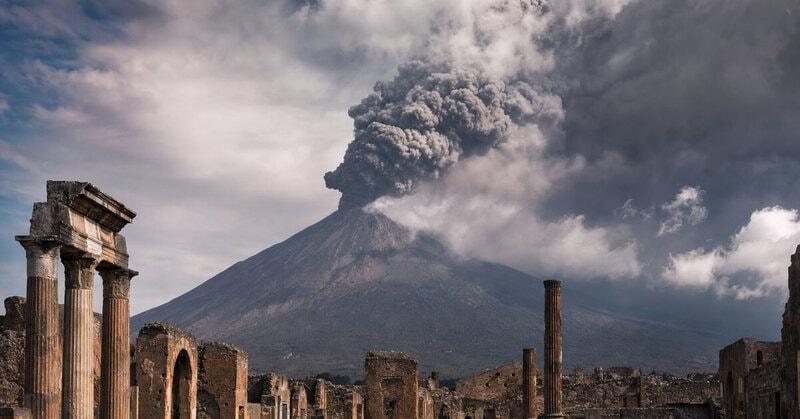
The bread was already in the oven. Somewhere in the forum, a merchant was mid-argument over the price of garum. Children were running the sun-baked streets of a city that had existed, more or less undisturbed, for centuries — and then, just after midday on August 24, 79 AD, the mountain to the northwest split itself open, and everything stopped.
A Sleeping Giant on Fertile Slopes

To the people of Pompeii, Vesuvius was not a threat. It was furniture. A large, green, reassuringly solid mountain whose volcanic soil grew grapes so well that vineyards climbed almost to its summit. The Romans of the first century AD had no word for what Vesuvius actually was — the concept of a volcano, and the word itself, would not arrive for centuries. It was simply a mountain. A very fertile mountain. A mountain you built a prosperous city of roughly 11,000 people beside without a second thought.
There had been warnings, in hindsight blindingly obvious. A major earthquake in 62 AD had cracked Pompeii’s buildings and buckled its streets, sending tremors through the region that damaged infrastructure across the Bay of Naples. Smaller tremors rattled the area in the days before the eruption. But earthquakes were a routine feature of life in Campania — unpleasant, occasionally destructive, nothing to abandon your home over. The mountain stayed green. The grapes kept growing. And Pompeii, sitting roughly 9 kilometres southeast of the summit, went about its business.
That proximity — just under six miles from the crater — meant that when Vesuvius finally chose its direction of collapse, Pompeii’s fate was geometrically fixed. There was no version of events in which the city survived what was coming.
Phase One: The Column That Touched the Stratosphere

Just after midday on August 24, 79 AD, the eruption announced itself not with a slow build but with an almost instantaneous violence. A colossal column of ash, pumice, and superheated gas punched 20 to 30 kilometres into the atmosphere — what volcanologists now classify as a Plinian eruption column, named, with considerable irony, after the very man who witnessed and described it.
Pliny the Younger was seventeen years old and staying with his uncle, the naturalist Pliny the Elder, at Misenum on the far side of the Bay of Naples. In letters written years later to the historian Tacitus — the only surviving eyewitness account of the disaster — he described a cloud rising from the mountain in the shape of a pine tree: a vast trunk of gas shooting upward, then spreading at altitude into a canopy of billowing debris. It is, by any measure, the first detailed piece of writing about a natural disaster in the Western literary tradition. He was watching from roughly 30 kilometres away. What those 30 kilometres spared him is difficult to fully comprehend.
What fell on Pompeii in those first hours was not the thick, suffocating ash of popular imagination. It was pumice — lightweight, pale grey, warm to the touch — raining down in a relentless, disorienting fall. Uncomfortable. Frightening. But survivable. The roads out of Pompeii were still open. Thousands of people made the rational calculation, grabbed what they could carry, and left. Archaeological evidence from across the broader region confirms significant flight: many of the city’s residents escaped the eruption entirely.
Those who stayed made a fateful gamble. Some may have believed the worst had passed. Others likely delayed too long, loading carts with valuables, searching for family members, tending to livestock. Some may simply have been too old, too young, or too unwell to travel. Whatever their reasons, by staying through that first survivable phase, they committed themselves to what came next.
The Long Dark Middle: Hours of Accumulating Doom

Through the afternoon and into the evening, the pumice fall continued without relief. It piled up in the streets — centimetre by centimetre, then tens of centimetres, eventually approaching a metre in depth. The sky darkened so completely that Pliny the Younger, across the bay, described a blackness denser than any ordinary night, a darkness that swallowed the landscape whole. In Pompeii, torches and oil lamps would have done little against that weight of ash-thickened air.
The danger quietly compounding during these hours was structural. Pompeii’s rooftops were largely flat, in the Roman style, and flat rooftops are not designed to bear the weight of steadily accumulating volcanic rock. Archaeological evidence shows that a significant number of buildings collapsed under the pumice load during this phase of the eruption, killing residents who had chosen the apparently sensible option of sheltering indoors rather than braving the debris-filled streets. The decision to stay inside, which must have felt like caution, became a death sentence for many.
Meanwhile, to the northwest, the smaller city of Herculaneum was experiencing something stranger: relative quiet. Wind direction meant that the pumice fall largely bypassed Herculaneum during these long afternoon and evening hours, leaving its residents in an eerie, paralysed uncertainty. Less ash. Less immediate danger. No clear signal of what was coming for them specifically. That apparent reprieve made their eventual fate, when it arrived, even more complete.
Scattered across Pompeii’s ruins, archaeologists have recovered the evidence of these desperate middle hours: coins and jewellery dropped in flight, small household gods — the Lares, protective figures of the Roman home — clutched and then abandoned, the physical residue of people trying to decide what mattered enough to carry into an unknown future, and then running out of time to carry anything at all.
Phase Two: Pyroclastic Surges and the Hour Everything Ended

In the early hours of August 25, the character of the eruption shifted in a way that left no room for survival decisions. The Plinian column, which had been sustaining itself for roughly twelve hours, became gravitationally unstable and partially collapsed. What followed were pyroclastic density currents — superheated avalanches of gas, ash, and rock fragments that rolled down Vesuvius’s flanks at speeds exceeding 100 kilometres per hour, at temperatures modern volcanological research estimates above 300 degrees Celsius.
These surges, not the hours of pumice fall, were the principal mechanism of death for those still in Pompeii when August 25 arrived. Forensic analysis of victims’ remains has shown that many died with extraordinary speed from extreme thermal shock. The heat was sufficient to cause instantaneous and severe muscle contraction, locking bodies into the defensive postures — hands raised, knees drawn up — that have come to define the visual language of Pompeii’s tragedy. The hollow spaces left in the hardened ash as those bodies eventually decomposed, filled with plaster by the archaeologist Giuseppe Fiorelli in the 1860s, produced three-dimensional casts of those final moments: a technology of grief that turns catastrophe into portraiture.
Herculaneum’s end came even faster. Struck by the first surges before Pompeii, the city was buried under as much as 20 metres of pyroclastic material — a depth that reflects the ferocity of what hit it. Residents who had gathered at the beachfront boathouses, perhaps waiting for rescue by sea, died in the initial surge. Their skeletal remains, preserved in remarkable detail by the conditions of their entombment, were not discovered until the twentieth century.
By the time anything resembling grey dawn light filtered through the ash clouds on August 25, it was finished. Pompeii lay beneath 4 to 6 metres of ash and pumice — volcanic material compressing streets, filling rooms, sealing doorways, and preserving in extraordinary detail the moment of a city’s death. The eruption that began just after midday on August 24 had run its course in roughly 18 hours. Eighteen hours to erase a city from the living world.
What the Ash Preserved: An Accidental Ethnography

The same catastrophe that killed Pompeii also saved it, in a way that nothing deliberate could have managed. Volcanic material sealed the city so rapidly and so completely that conditions of preservation were created that archaeologists working anywhere else on earth can only dream of. Frescoes remained vivid with red, ochre, and gold. Food carbonised in bakery ovens. Election campaign graffiti stayed legible on whitewashed walls. The remains of a dog, still chained at a doorway, told a story of someone who left in too much haste, or perhaps believed they would return.
As National Geographic has noted, Pompeii gives us something almost no other ancient site can offer: not the monuments the powerful wanted preserved, but the texture of ordinary life — how people cooked, what they ate, how they decorated their homes, what they wrote on walls when they were annoyed or in love or bored. It is Roman civilisation caught at a specific afternoon in the first century, rather than curated and edited across centuries of selective memory.
The buried landscape extends well beyond Pompeii’s walls. Herculaneum, Stabiae, and countless surrounding Roman villas were also destroyed and buried in the 79 AD eruption, making the entire Vesuvian archaeological zone one of the richest concentrations of Roman-era material culture on the planet. And it is far from exhausted. The ongoing Great Pompeii Project, running through the 2020s, continues to uncover new rooms, new victims, and new inscriptions that revise and deepen our understanding of the city.
One of the most significant recent debates concerns the eruption date itself. A charcoal inscription discovered in 2018 in a house undergoing renovation references a date in mid-October, leading some scholars to argue that the eruption occurred in late October rather than on August 24. Supporters of the later date also point to pomegranates and chestnuts found among the ruins — fruits more typical of an autumn harvest — as well as the heavy woollen clothing worn by some victims, unusual for an August heatwave. Others maintain that August 24 remains consistent with Pliny the Younger’s account and is supported by the overall archaeological record. The question has not been definitively resolved, and it is a useful reminder that even Pompeii, the most studied ancient city on earth, continues to generate genuine scholarly disagreement.
A Danger That Has Not Passed

It would be comforting to treat Vesuvius as a chapter closed by time. It is not. The mountain is classified as a dormant stratovolcano, not an extinct one, and volcanologists consider it among the most dangerous active volcanic systems in the world — not because of its size, but because of what surrounds it. Approximately three million people live in the Naples metropolitan area within its potential impact zone. The eruption of 79 AD was not even Vesuvius’s last: the volcano has erupted dozens of times since antiquity, most recently in 1944. The Italian government maintains a detailed evacuation plan for the municipalities of the so-called Red Zone, a modern administrative echo of the desperate flight of Pompeii’s survivors nearly 2,000 years ago.
What keeps drawing people back to Pompeii, though, is not the geological threat or even the archaeological spectacle. It is something quieter and more unsettling: recognition. The people buried under Vesuvius’s ash were worried about money and status, were fond of their dogs, left food half-eaten on tables, scratched declarations of love and cutting insults into walls, and died, many of them, in the middle of completely ordinary moments. The nervous dog at the door. The lovers found side by side. The unfinished loaf of bread, still in the oven when the sky cracked open.
Eighteen hours. Four to six metres of ash. Nearly two thousand years of silence. And a city that, in being destroyed so completely and so suddenly, became the closest thing the ancient world left us to a mirror.

 English
 Arabic
 French
 Spanish
 Portuguese
 Deutsch
 Turkish
 Italiano
 Russian
 Romaian
 Portuguese (Brazil)
 Greek
Greek