


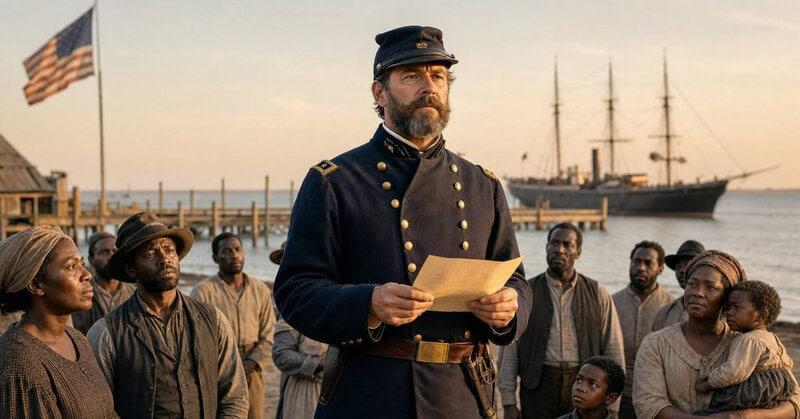
On the morning of June 19, 1865, a Union general stepped ashore in Galveston, Texas, carrying news that was already two and a half years old — and the story of why it took that long is one of the most haunting, and ultimately triumphant, chapters in American history. This is the timeline of Juneteenth: how freedom was declared, delayed, and finally delivered.
January 1, 1863: The Emancipation Proclamation Exists on Paper Only

On New Year’s Day 1863, President Abraham Lincoln issued the Emancipation Proclamation, a wartime executive order declaring that enslaved people in Confederate states in rebellion were legally free. It was a document of enormous moral and political weight — and almost immediately hamstrung by the realities of war. The proclamation carried no enforcement mechanism beyond the presence of Union soldiers. Freedom, in practice, traveled only as far as federal troops had already marched.
Deep in the Confederate interior, the order was effectively meaningless without armed force behind it. Without soldiers to read it aloud and stand behind its words, it remained what its critics called it: a piece of paper. Nowhere would that gap between law and lived reality prove wider — or more consequential — than in Texas.
It is also worth understanding what the proclamation did not do: it did not free enslaved people in the four slaveholding states that had remained in the Union, nor in Confederate areas already under Union control. It was a targeted wartime measure, which is precisely why its enforcement depended so entirely on military reach.
Why Texas Was the Last Holdout: Geography, War, and Deliberate Silence

Texas was a world apart from the major Civil War battlefields. No decisive campaigns swept through its interior, no occupying Union columns forced a reckoning, and the state spent most of the war in an uneasy Confederate limbo, far from the carnage that was slowly strangling the rebellion elsewhere. That geographic isolation made it a refuge — and enslavers took full advantage. Slaveholders from Louisiana, Mississippi, and other areas under Union pressure relocated to Texas, bringing their enslaved people with them, deliberately moving human beings away from the approaching sound of freedom.
Historians note a darker layer still: some enslavers in Texas appear to have withheld news of the Emancipation Proclamation entirely, extracting additional seasons of unpaid labor before the truth could arrive. The Smithsonian’s National Museum of African American History and Culture frames this deliberate suppression as central to understanding why the Juneteenth origin story carries such weight. The delay was not merely logistical. In documented cases, it was a choice made to preserve the economic benefits of enslaved labor for as long as possible.
April 1865: The Confederacy Collapses, but Texas Remains Untouched

When Confederate General Robert E. Lee surrendered at Appomattox Court House on April 9, 1865, the Civil War was effectively over. The news rippled outward — but not evenly, and not immediately to Texas. The state’s last Confederate governor, Pendleton Murrah, chose flight over surrender, slipping away to Mexico rather than formally yielding authority. His departure left behind a power vacuum rather than a peaceful transfer of control, and Confederate structures of authority lingered in the absence of anyone to formally dismantle them.
For the roughly 250,000 enslaved people still held in Texas, the war’s end changed almost nothing overnight. Freedom, which had been legally theirs for more than two years, remained theoretical — a rumor, a hope, a thing that had happened somewhere else. What was missing was the same thing that had always been missing: Union soldiers on Texas soil, with the authority and numbers to make the law real.
June 19, 1865: General Granger Arrives in Galveston

On June 19, 1865, Union Major General Gordon Granger arrived in Galveston with a detachment of federal troops — the enforcement the Emancipation Proclamation had been waiting more than two years to find. He read aloud General Order No. 3, which announced in plain terms what Lincoln had declared in January 1863: the enslaved people of Texas were free. The precise location where the order was read is debated by historians — some accounts place Granger at Ashton Villa, others at the Galveston customhouse — but the content of the order and its effect are not in dispute.
General Order No. 3 opened with direct language: “The people of Texas are informed that, in accordance with a proclamation from the Executive of the United States, all slaves are free.” That single afternoon in a coastal Texas city closed a gap that should never have existed. The two-and-a-half-year distance between January 1, 1863 and June 19, 1865 is the central wound — and the central turning point — at the heart of Juneteenth history. It marks the moment when an abstract legal declaration finally became a human reality.
The Immediate Reaction: Joy, Disbelief, and the Hard Road Ahead

Contemporary accounts describe what happened in Galveston when the news spread: weeping, prayer, embraces between strangers, and the disoriented euphoria that comes when something long hoped for arrives without warning. Many freed people immediately left the plantations and farms where they had been held, striking out on foot to search for family members who had been sold away — often over enormous distances. Those searches, frequently unsuccessful, are as much a part of what Juneteenth commemorates as the liberation itself.
General Order No. 3, however, carried a sobering instruction alongside its announcement of freedom. The newly freed people were advised to remain at their current workplaces “for wages” — a clause that reflected both the federal government’s uncertainty about how to manage mass emancipation and its reluctance to fully disrupt the Southern labor economy. Freedom had arrived, and it arrived already hedged. The tensions embedded in that single clause would echo through Reconstruction and well beyond.
The First Juneteenth Celebrations: Built by Communities Before Governments Noticed

As early as 1866, African American communities in Texas began gathering each June 19 to mark what had happened the year before. They called the observance Jubilee Day, or Emancipation Day, and they filled it with prayer, music, public readings of the Proclamation, and communal meals. These were not events organized by governments or underwritten by institutions — they were created entirely by the communities who understood, from direct experience, exactly what the date meant and why it deserved to be remembered.
As the decades passed and African Americans moved northward and westward during the Great Migration, the commemoration traveled with them, taking root in Black communities across the Midwest, the West Coast, and beyond. It survived Jim Crow’s active hostilities, the economic strains of the Depression, and the upheavals of the Civil Rights era — sustained not by law or official recognition, but by collective memory passed deliberately from one generation to the next. For more than a century, communities honored this day entirely on their own terms, long before any government chose to endorse it.
Juneteenth’s Many Names: Jubilee Day, Black Independence Day, Freedom Day

Over more than 150 years of community observance, the holiday gathered names the way a river gathers tributaries. Jubilee Day. Black Independence Day. Emancipation Day. Freedom Day. Each name illuminates a different dimension of what June 19 means — legal liberation, cultural identity, the particular claim African Americans hold on the American promise of self-determination — all of them anchored to that single afternoon in Galveston.
The variety of names is itself meaningful. No single governing body decreed what to call this day; the names multiplied organically as different communities in different places made the commemoration their own. That organic spread — across generations, geographies, and naming traditions — reflects what the history of Juneteenth demonstrates most clearly: that the day was never the property of any single institution. It was always something a people preserved for themselves.
The Oldest Nationally Celebrated Emancipation Commemoration in the United States

Historians and institutions recognize Juneteenth as the oldest nationally and internationally celebrated commemoration of the ending of slavery in the United States. That distinction matters because it points to something the Emancipation Proclamation alone could never have produced: not a legal milestone observed from a distance, but a lived one, claimed and sustained by the people most directly affected by it.
Communities chose June 19 rather than January 1 as their date of remembrance for a precise reason. The Proclamation told them they were free. Galveston showed them what free actually looked like — what it meant to have soldiers present, an order read aloud, and authority standing behind the words. For generations, communities preserved that distinction carefully, even when the broader country had no interest in honoring it alongside them.
Texas Acts First; the Nation Follows Forty Years Later
Texas became the first state in the nation to recognize Juneteenth as an official state holiday, doing so in 1980 — a fitting acknowledgment from the place where the story reached its long-delayed turning point. Other states followed in subsequent decades, with recognition accelerating notably after the summer of 2020, when renewed national attention to racial justice brought Juneteenth to a wider public audience than it had previously reached.
On June 17, 2021, President Joe Biden signed the Juneteenth National Independence Day Act into law, making June 19 an official federal public holiday — the first new federal holiday added to the calendar since Martin Luther King Jr. Day was established in 1983. The official name was chosen deliberately; its echo of the Fourth of July was intentional, cementing the framing of June 19 as a second independence day — one that acknowledges the population the original declaration left behind. As Britannica notes, federal recognition represented the culmination of decades of advocacy by communities that had been observing the day without government endorsement for well over a century. Federal designation was not the beginning of Juneteenth; it was the country finally catching up.
What Juneteenth Commemorates — and Why That Distinction Matters

Understanding what Juneteenth actually commemorates requires holding two things at once. It marks a genuine moment of liberation — the day freedom became real for roughly 250,000 people in Texas who had been denied it despite a law declaring otherwise. And it marks, simultaneously, a documented failure: the two-and-a-half-year gap between a legal declaration and its enforcement, made possible in part by deliberate concealment and in part by the limits of a government that could write freedom into law but struggled to deliver it on the ground.
That gap is not a historical curiosity. It is a precise, documented illustration of the distance that can exist between a right on paper and a right in practice — a distance that has reappeared, in different forms, throughout American history. Juneteenth asks a harder question than Independence Day: what does freedom mean when its enforcement depends entirely on who holds power and where they happen to be standing?
Recognized now by the federal government and observed across communities of every background, Juneteenth endures because its origin story refuses to be only a celebration. It is a triumph and a reckoning at the same time — a reminder that the most important word in the phrase “all men are created equal” has always been the one that went unspoken: eventually. From a document without a delivery system in 1863 to a federal holiday in 2021, the arc of Juneteenth traces the long, uneven, still-continuing American effort to close the distance between its founding promises and its actual practice.

 English
 Arabic
 French
 Spanish
 Portuguese
 Deutsch
 Turkish
 Dutch
Dutch
 Italiano
 Russian
 Romaian
 Greek
Greek