


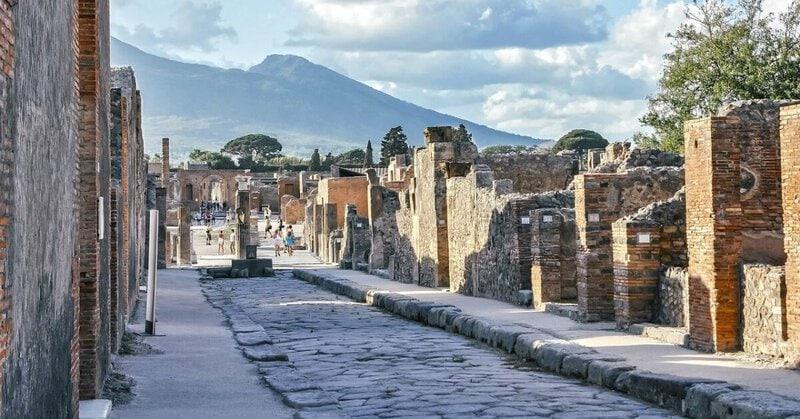
Vesuvius fell silent nearly two thousand years ago, but Pompeii has never stopped speaking. From a lucky pickaxe strike in the sixteenth century to an artificial intelligence deciphering a charred scroll in 2024, each generation of scientists and excavators has pulled a new confession from the ash — and the revelations keep coming.
Late 16th Century – Domenico Fontana Stumbles onto a Buried City

In the late sixteenth century, the Italian architect Domenico Fontana was overseeing the digging of an irrigation channel through the sun-baked Campanian countryside when his workers’ tools rang against something solid: ancient walls, carved stone, Latin inscriptions. Nobody quite knew what to make of the find. The land yielded its secret reluctantly, and without a framework to understand what lay beneath, the crew pressed on. The channel was finished, and the buried city was left to its silence for another century and a half.
That unremarkable trench, dug for the most practical of reasons, was nonetheless the opening cut in one of archaeology’s longest and most astonishing stories. Systematic excavation would not begin until the mid-eighteenth century, but Fontana’s accidental encounter with Pompeii marked the moment the ancient world first reached back through the earth to touch the modern one. Even then, the find was not entirely ignored: Fontana noted the inscriptions in his records, and later scholars would use those notes to help identify the site when serious digging finally resumed.
1709 – Herculaneum Emerges from the Rock, Raising the Stakes

More than a century after Fontana’s labourers moved on, a well-digger near the town of Ercolano punched through solid ground and broke into a vast underground theatre. He had found Herculaneum, Pompeii’s prosperous neighbour, equally destroyed by Vesuvius in AD 79 but buried under an entirely different substance: not loose ash but a dense, rock-hard crust of volcanic material that had sealed the city like a time capsule made of stone. The conditions were brutal to excavate but extraordinary for preservation — wood, food, rope, and even human tissue survived in ways that open-air ash burial could never guarantee.
The discovery doubled the archaeological window onto the ancient Roman world overnight. Crucially, the two sites are complementary rather than redundant: Pompeii preserves street layouts, painted walls, and body casts in ash, while Herculaneum’s harder volcanic matrix has yielded intact wooden furniture, carbonised food, and — as the twenty-first century would reveal — biological material of a kind no one had thought possible to recover.
1860s – Giuseppe Fiorelli’s Plaster and the Faces of the Dead

By the 1860s, excavators had long noticed strange cavities in the hardened ash — hollow spaces where something organic had once been. Giuseppe Fiorelli, the director of excavations, realised those voids were body-shaped: the ash had set around the victims as they died, and when flesh and bone decayed, it left a perfect mould behind. He began injecting liquid plaster into the cavities, and what emerged were the dead themselves — or their exact outlines: a dog writhing against a chain, a mother curled around a child, a man with his arm thrown across his face against a heat he could not stop.
The plaster casts of Pompeii’s victims have been studied and exhibited ever since, and they remain among the most viscerally affecting forensic records in all of archaeology. They are not sculptures or reconstructions — they are the precise negative space left by people in their final moments, giving the eruption an almost unbearable human scale. Modern researchers have gone further still, using CT scanning to examine the bones preserved inside those casts, extracting information about age, health, and even diet that Fiorelli could never have imagined.
2018 – A Graffiti Scrawl Forces a Rethink of the Eruption Date
For nearly two thousand years, scholars accepted the date of the eruption as 24 August AD 79, drawn from a letter by Pliny the Younger written decades after the disaster. Then, during excavations in Pompeii’s Regio V district, archaeologists found a charcoal inscription on a wall that referenced a date equivalent to mid-October — weeks after summer’s end. Because charcoal is fragile and fades quickly, the inscription almost certainly had to have been written shortly before the mountain blew, placing the catastrophe firmly in autumn.
The implications were immediate and wide-ranging. The discovery, reported by National Geographic among others, explained several puzzles that had quietly nagged at archaeologists for generations: why victims were found wearing heavier woollen clothing, why some cellars contained harvested autumn fruits such as pomegranates, and why certain wine vessels appeared to show a recent harvest already under way. A single scrawl on a wall had rewritten a date treated as settled fact for two millennia — and it did so by being almost absurdly mundane, the kind of casual notation a workman might make on any ordinary afternoon.
2020 – A Vitrified Brain Reveals the Violence of the Pyroclastic Surge

Among the skeletal remains recovered at Herculaneum, scientists examining one victim’s skull found something that had never been documented before in any human remains: fragments of black glass where the brain had been. The pyroclastic surge — a wave of superheated gas and ash that rolled down Vesuvius at terrifying speed — had reached temperatures estimated above 500 °C. At that heat, soft tissue does not simply burn; it can vitrify, transforming almost instantaneously into glass.
As reported in detail by Science, this is the only known case of a human brain turned to glass by volcanic heat. More remarkably, proteins and fatty acids remained chemically identifiable within the glassy material — a molecular portrait of a Roman nervous system, frozen at the precise moment of death nearly two thousand years ago. The find also helped scientists refine their models of how the pyroclastic surge killed: the evidence suggests that death at Herculaneum was essentially instantaneous, the extreme heat causing immediate and total cellular destruction before the body could experience a prolonged end.
2020 – A Thermopolium Excavated in Full, Counter-Top to Kitchen

Also in 2020, excavators in Regio V finished uncovering something that Romans of Pompeii would have recognised immediately: a thermopolium, the ancient equivalent of a street-food counter. The front panels were still decorated with vivid frescoes of animals — a duck, a rooster, sea creatures — and the deep terracotta vessels set into the stone counter still contained traces of the last meals ever served there. Laboratory analysis of residues identified duck, pig, goat, fish, and snails.
Thermopolia were not unusual in Roman towns — archaeologists have identified more than eighty in Pompeii alone — but having one excavated so completely, with its food chemistry intact, gave historians an unusually precise picture of what ordinary Romans actually ate rather than what elite writers claimed they ate. This was not the lavish banquet culture of aristocratic literature but the daily reality of working people grabbing a hot meal on the way to the forum. It was intimate and utterly human, and it had been waiting under the ash for two thousand years.
2022 – DNA of the Victims Reveals a Surprisingly Cosmopolitan City

In 2022, a landmark genetic study changed the picture of who actually lived in Pompeii. Researchers with support from the Max Planck Institute for Evolutionary Anthropology extracted and analysed ancient DNA from the skeletal remains of victims, and the results were striking: the ancestry of those tested did not point primarily to Roman-Italian stock but traced heavily to the Eastern Mediterranean and the Near East. The analysis revealed a city shaped by migration, trade, and the forced movement of enslaved people across a vast empire — a genuinely cosmopolitan population far removed from the homogeneous Roman town of popular imagination.
The study also produced a subtler, more poignant finding: individuals discovered sheltering together were not always biologically related. The groups huddled in cellars and doorways as the mountain erupted were often mixed — strangers, perhaps, or people bound by ties of work, shared lodgings, or a desperate collective instinct to survive. The genetics quietly complicated stories that archaeologists had been confidently telling about these final groupings for well over a century, and they raised fresh questions about the social bonds — chosen as much as inherited — that defined life in an ancient Roman city.
2023 – A Hidden Private Bathhouse Surfaces After 2,000 Years
In 2023, excavators working through an unexcavated block of Pompeii broke into a private bathhouse that no human eye had seen since AD 79. The BBC reported the discovery of frescoed walls, marble detailing, and an intact changing room — all sealed beneath volcanic debris for roughly two millennia. The scale and quality of the decoration pointed to an owner of extraordinary wealth, adding texture to ongoing research into Pompeii’s social hierarchies and the considerable gap between its richest and poorest residents.
The bathhouse was also a reminder of something that can be easy to forget: despite centuries of excavation, as The New Yorker has noted, a significant portion of Pompeii remains entirely unexcavated, lying undisturbed beneath the surface. Archaeologists have deliberately chosen to leave large sections untouched, partly to preserve them for future techniques that do not yet exist, and partly because the conservation of what has already been uncovered is itself an enormous and unfinished challenge. Every new trench is a gamble, and lately, the gambles keep paying off.
Post-AD 79 – Romans Returned and Lived Among the Ruins for Centuries

One of the most unsettling revisions to Pompeii’s story has nothing to do with the eruption itself. Research reported by Live Science found evidence that Romans returned to the buried city and occupied it for approximately 400 years after the disaster — scavenging valuables, stripping building materials, and living in makeshift conditions on top of the ash layer. Archaeologists characterise the period as one of likely anarchy: no administration, no civic order, just opportunistic inhabitants picking through a dead city’s remains.
The finding fundamentally complicates the romantic image of Pompeii as a place hermetically sealed at a single catastrophic moment. Long before modern excavators arrived with careful stratigraphic methods, the site had already been disturbed, looted, and partially dismantled by people who were themselves living in the shadow of the mountain that had killed their predecessors. It means that some absences in the archaeological record — valuable objects not found where they might be expected, walls stripped of their decorative facing — may reflect ancient scavenging rather than the eruption itself. The story of the site did not end on that October morning in AD 79; it merely entered a strange, lawless new chapter.
February 2024 – Artificial Intelligence Reads a Scroll Burned Shut for 2,000 Years

In early 2024, a story broke that felt almost too extraordinary to be true. An artificial intelligence model, trained on microscopic X-ray scans of a carbonised scroll recovered from the Herculaneum Papyri — hundreds of scrolls found in a villa library buried near the town — successfully read text that had been sealed since the eruption of AD 79. The scroll contained philosophical writing in Greek, its letterforms invisible to the naked eye within fused, fragile layers of charred papyrus. The Guardian reported the breakthrough as a landmark moment in the recovery of ancient knowledge, noting that the winning entry in a global competition to crack the scrolls had been submitted by a team of students working independently.
The implications stretch far beyond a single text. Hundreds of other Herculaneum scrolls remain unread because physical unrolling destroys them — the papyrus, carbonised by the surge, crumbles at the touch. If artificial intelligence can decode their contents from the inside out using non-invasive scanning, the villa library at Herculaneum — which scholars believe may contain lost works of philosophy, history, poetry, and literature known only by ancient references to titles that no longer exist — could yet give up its secrets without sacrificing a single fragile page. Two thousand years of silence, ended by an algorithm.
From a late-sixteenth-century drainage ditch to a twenty-first-century machine-learning model, the story of Pompeii is still being written. The ash preserved not just bodies and buildings but questions — and science, generation by generation, is finding the patience to answer them.

 Arabic
 French
 Spanish
 Portuguese
 Deutsch
 Turkish
 Dutch
Dutch
 Italiano
 Russian
 Romaian
 Portuguese (Brazil)
 Greek
Greek