


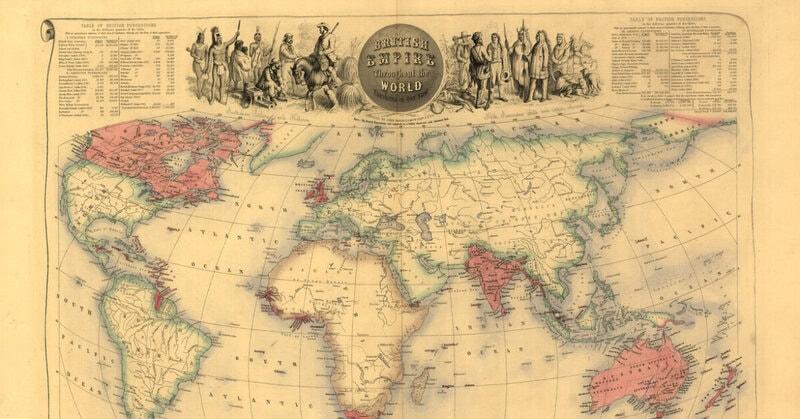
In 1920, somewhere in a London office smelling of ink and ambition, a cartographer unrolled a map of the world and faced a spectacle that must have stopped him cold: roughly a quarter of the Earth’s entire land surface was shaded pink. Not scattered dots of pink — a vast, continent-hopping sweep of it, from the Canadian Arctic to the Australian outback, from the valleys of India to the southern tip of Africa. The sun, as the saying went, genuinely never set on it. And yet, for all the staggering reality those pink patches represented, the full story of what made the British Empire the largest empire in recorded history — and what that label quietly conceals — is more tangled, more human, and more morally weighted than any single colour on a map can convey.
How Historians Measure Imperial Size

Before crowning any winner, historians have to agree on what game they are playing. Two yardsticks dominate the debate: total land area (every square mile claimed, regardless of whether those miles form a connected mass) and contiguous land area (territory forming one unbroken, theoretically walkable expanse). The distinction sounds academic. In practice, it splits the leaderboard entirely — and explains why two empires can each hold a legitimate claim to the title of “biggest.”
By total area, the British Empire stands alone at the summit. At its peak in the early 1920s, it covered roughly 13.71 million square miles, spread across every inhabited continent and every major ocean. It was stitched together not by shared borders but by sea lanes, telegraph cables, and the Royal Navy. If you wanted to walk from one British territory to the next without crossing foreign soil, you usually couldn’t. The empire was less a solid landmass than a global archipelago of power — India here, Canada there, coaling stations and naval bases scattered strategically in between. Statista’s visualisation of peak land area across history’s great empires makes this scale viscerally clear: no other recorded polity comes close on the total-area chart.
But that single headline figure — 13.71 million square miles — flattens centuries of expansion and contraction, and papers over radically different kinds of control. Some territories were governed with meticulous bureaucratic intensity; others were claimed on paper and barely visited. That pink on the cartographer’s map was, in places, more aspiration than administration. To understand what biggest really means, you have to let the Mongols into the room.
The Mongol Empire: The Contiguous Colossus

Picture the Eurasian steppe in 1206. Temüjin, newly titled Genghis Khan, has just unified a fractious collection of nomadic tribes through a combination of military genius, strategic marriage, and unsparing violence. What follows is one of history’s most vertiginous accelerations of power. Within roughly two generations, Mongol armies sweep from the Korean peninsula to the banks of the Danube — China, Persia, Central Asia, and the Russian principalities all absorbed or crushed. By the mid-thirteenth century, the Mongol Empire had become something the world had never seen before and has not seen since: approximately 9.3 million square miles of unbroken, contiguous land, stretching in one vast mass from the Pacific coast of Asia deep into Eastern Europe.
No oceans to cross. No sea lanes to defend. Just one continent-sized territorial bloc clenched around the Eurasian heartland. Standard historical rankings of the world’s largest empires list the Mongol Empire as the largest contiguous land empire ever assembled — a record it still holds. The British Empire holds the record for largest empire overall by total area. The difference between those two sentences is the entire argument.
The contrast between the two is almost architectural. The British Empire was a maritime archipelago — dispersed, dependent on ships and ports. The Mongol Empire was a continent. British power could project itself anywhere a Royal Navy vessel could reach; Mongol power operated like gravity, an enormous terrestrial mass pulling everything around it into orbit. The Mongol Empire’s effective lifespan — roughly 1206 to the early fifteenth century, before it fragmented into successor khanates — is itself instructive. Even 9.3 million contiguous square miles proved impossible to hold together indefinitely, which is one of history’s bluntest warnings about the limits of raw territorial size as a measure of lasting power.
British Empire vs Mongol Empire: Why the Comparison Gets Complicated

When people search for a direct comparison of the two empires’ size, they often expect a clean answer. They get a paradox instead. The British win on total area. The Mongols win on contiguous land. Both statements are simultaneously and verifiably true — and together they reveal that “biggest” is not a fact so much as a question about what you value in an empire.
Consider what the ocean changes. British sea power meant that Canada and India could be economically integrated into the same imperial system despite being separated by thousands of miles — as long as the Royal Navy ruled the waves. But it also meant that a sufficiently powerful rival fleet, or simply the loss of naval supremacy, could sever the empire’s arteries rapidly. The Mongol khans faced no equivalent naval threat. Their vulnerability was different: the sheer difficulty of governing a landmass so enormous that even their celebrated Yam postal relay system — a network of horse-mounted couriers that made communication across Central Asia faster than almost anything before the telegraph — was stretched to its operational limits.
Population adds another dimension. At its height, the British Empire governed an estimated 412 million people, representing approximately 23% of every human being alive around 1913 — more subjects, in absolute terms, than any ruler in history had previously claimed. Comparing empires by population across time reveals how much this figure also reflects the world’s own dramatic population growth by the early twentieth century rather than uniquely deep imperial penetration alone. The Mongol Empire ruled a world with far fewer people overall, so its proportional share of global humanity may have been broadly comparable — but the absolute numbers belong to Britain.
Then there is the governance question. The Mongol Empire, for all its reputation for violent conquest, developed a surprisingly sophisticated administrative apparatus: the Yam relay system, standardised commercial law under the Yasa code, and the deliberate movement of artisans, scholars, and merchants between distant provinces. It was brutal and efficient in roughly equal measure. The British Empire, by contrast, administered its territories through a patchwork of Crown colonies, self-governing dominions, protectorates, and chartered trading companies that sometimes barely communicated with one another. The East India Company governed much of the Indian subcontinent for nearly a century before the Crown took direct control in 1858. Treating this loose constellation as a single coherent “empire” in the same sense as the centralised Mongol state requires a generous definition of the word.
What ‘Control’ Really Meant: The Texture of Imperial Power

Look closely at the British Empire’s claimed territory and the pink patches begin to differentiate sharply. The densely administered jewel of India — with its railways, civil service, and elaborate legal codes — represented a completely different imperial experience from the vast interior of northern Canada, where “British territory” sometimes meant little more than a surveyor’s line drawn through terrain that indigenous peoples had governed through their own sophisticated systems for millennia. Much of those 13.71 million square miles was real in a cartographic sense while being nearly phantom in any practical administrative one.
Modern historians, increasingly dissatisfied with the square-miles metric, have begun measuring empires by economic extraction, cultural transformation, and long-term demographic impact. By those standards, the traditional rankings become considerably more complicated. The British Empire’s structural economic practices — the deliberate orientation of colonial economies to serve British industry, the movement of wealth from periphery to centre — were slower and more legally embedded than Mongol conquest, but arguably more durable in their effects. The Mongol Empire’s violence was often catastrophic and swift; the devastation of cities like Baghdad and Samarkand during the conquests was near-total. The British Empire’s exploitation was frequently quieter, dressed in the language of law and civilisation, and engineered systems of inequality that outlasted the empire itself by generations.
Neither legacy is comfortable. Both demand to be understood in human terms, not just square miles. A broader survey of the most significant empires in world history underscores how every candidate for “biggest” carries human costs that area figures alone cannot begin to capture.
The Record That Keeps Shifting

Even the British Empire’s peak year is contested. The period 1920-1922 is most commonly cited, after Britain acquired League of Nations mandates following the First World War — territories in the Middle East and Africa transferred from the defeated Ottoman and German empires. But 1920 was also the year the Irish War of Independence was tearing the empire’s oldest colony away from London’s control. The empire’s greatest territorial extent coincided almost precisely with the first unmistakable signals of its unravelling. Area on a map, it turns out, is a lagging indicator of actual imperial power.
Factor in what historians call “informal empire” — countries never formally colonised but so thoroughly dominated by British finance and trade that their sovereignty was largely nominal — and the reach of British influence expands considerably further. Much of Latin America in the nineteenth century effectively operated within a British economic orbit, its railways, banks, and bond markets heavily funded from London. Counting those territories would inflate British imperial reach well beyond what any map of pink shading shows, while simultaneously making the category of “empire” still more elastic.
The long afterlives of both empires are impossible to ignore. Former British imperial territories today encompass land where approximately 2.5 billion people live. The Mongol Empire’s successor states — Timurid Central Asia, Mughal India, the Ilkhanate’s deep influence on Iran, the Golden Horde’s formative role in shaping Russia — carved the political geography of half the Eurasian world. Neither empire is merely historical. Both remain, in different ways, unfinished stories playing out in the present.
Three Questions, Three Defensible Answers

If the question is total land area claimed at peak, the British Empire wins — approximately 13.71 million square miles, recognised by standard historical rankings as the largest empire on record. If the question is contiguous land power — an unbroken territorial mass across which armies could move without crossing water — the Mongol Empire wins decisively, with roughly 9.3 million square miles that still constitute the largest contiguous land empire ever assembled. If the question is sheer human scale, the British Empire again: 412 million people, 23% of all humanity around 1913, a figure no other empire has matched in absolute terms.
Three different questions. Three defensible answers. One genuinely complicated record.
There is perhaps a final provocation worth sitting with. The obsession with ranking empires by size — by the grandness of their numbers, the boldness of their colours on a map — may itself reflect an imperial habit of mind. Empires loved large, legible figures. They used them to project legitimacy, to inspire awe, and to justify the entire enterprise. The cartographer unrolling his map in 1920 and marvelling at all that pink was, in a sense, doing exactly what the empire wanted him to do: measuring its greatness in square miles rather than in the lives that filled them. The more uncomfortable reckoning — the one that history keeps returning to — is not how much land these empires covered, but what that coverage cost the hundreds of millions of people who lived, worked, and died inside it.

 English
 Arabic
 French
 Spanish
 Portuguese
 Deutsch
 Turkish
 Dutch
Dutch
 Italiano
 Russian
 Portuguese (Brazil)
 Greek
Greek