


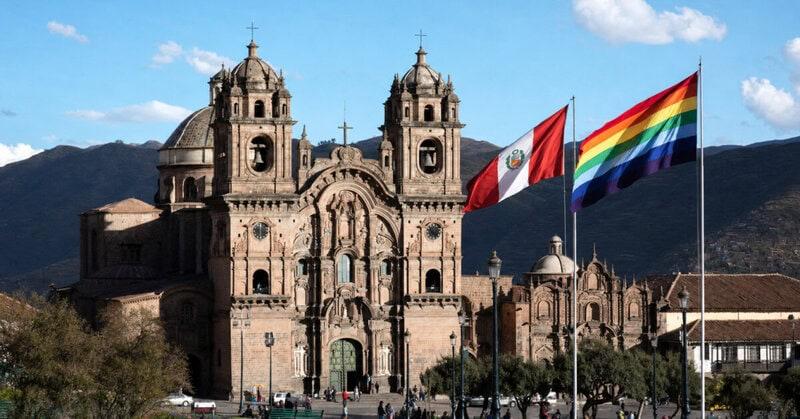
Picture the bright rainbow banner snapping in the Andean wind above the ancient stones of Cusco, and it’s easy to assume you’re looking at something ancient — a proud emblem carried by Inca warriors, blessed by the sun god Inti. You’d be wrong. The story of the so-called “Inca Empire flag” is really a story about how modern imagination fills the silences of history, and untangling that story requires confronting several layers of myth that have hardened into apparent fact.
The Inca Empire Never Had a National Flag in Any Modern Sense

Walk through the logic of Tawantinsuyu — the Inca Empire’s own name for itself, meaning “Four Quarters Together” — and a national flag simply makes no conceptual sense. What existed was an imperial banner tied directly to the person of the emperor, the Sapa Inca, rather than to any idea of a collective citizenry or shared nationhood. Authority radiated from that sacred individual outward, not from a unifying symbol that might outlast him.
Vexillologists, scholars who study the history and symbolism of flags, are careful to stress this distinction. A banner of royal authority and a national flag are fundamentally different objects carrying fundamentally different political meanings. The question “was there an Inca flag?” therefore depends entirely on what you mean by the word “flag” — and the honest answer, by any modern definition, is no.
Each Emperor Redesigned the Imperial Banner for Himself

If there was any consistent visual culture around Inca imperial banners, it was one of deliberate inconsistency. Each new Sapa Inca added his own personal blazon — a distinctive animal, bird, or other emblem of his choosing — making every emperor’s banner a one-of-a-kind creation. There was no template passed down, no standardized design that persisted across generations of rulers.
The practical consequence was striking: because the banner was so deeply personal, it effectively died with the man who carried it. No single reproducible symbol ever accumulated the kind of institutional weight that a true national flag requires. Inca banners, fascinating as they are, never cohered into anything like the durable emblems we associate with modern flags or state identity.
Scholars Formally Classify Inca Banners as ‘Vexilloids,’ Not True Flags

Researchers examining the visual culture of the Inca Empire have placed imperial banners into a precise technical category: vexilloids. The Portland Flag Association’s Vexilloid Tabloid has explored this classification in detail. Vexilloids are objects that function like flags — carried on a pole or staff, signaling authority to those who see them — but that lack the standardized, reproducible design that defines a modern flag. Think of a medieval king’s personal standard rather than a country’s national ensign.
This technical classification quietly dismantles a popular assumption. The Inca had no equivalent of the Stars and Stripes, no emblem that a citizen could reproduce, recognize, and rally around independently of the ruler’s physical presence. The vexilloid label is a small word doing significant historical work.
The Rainbow ‘Inca Flag’ Is a Modern Creation — Roughly 450 Years After the Empire Fell

The colorful rainbow banner that dominates image searches for “Inca Empire flag” has no pre-Columbian roots whatsoever. It was created to represent the contemporary identity and unity of Andean communities — a modern political and cultural construction aimed at giving those communities a living emblem, not an archaeological recovery of a lost one. The Spanish had effectively completed their conquest of the Inca Empire by the 1570s, and a considerable stretch of centuries separated that collapse from the rainbow banner’s creation.
That gap matters enormously. Discussions in the vexillology community routinely surface genuine surprise when people learn the banner is a modern symbol. Its symbolism belongs to a contemporary political moment, however sincerely it reaches back toward an ancient civilization.
Cusco Officially Adopted the Rainbow Banner — Cementing a Modern Symbol as Ancient Iconography

The rainbow flag is officially known as the Flag of Tawantinsuyo, and it has been formally adopted as an emblem of Cusco, the historic Inca capital high in the Peruvian Andes. That municipal adoption gave the banner the institutional gravitas of an ancient symbol, even though it is a modern creation. City governments have a way of laundering newness into apparent antiquity simply by flying something officially and prominently enough for long enough.
Tourists arriving in Cusco today see the rainbow flag snapping alongside Peru’s red-and-white national colors on government buildings and plaza poles. The visual context — ancient Inca stonework, colonial churches, this bright banner — does enormous persuasive work, reinforcing the impression that the flag carries roots stretching back to the empire itself. It does not.
The Empire’s Four-Quarter Structure Suggests Banners Were Regional, Not Unified

The empire’s very name encodes its administrative structure: four suyus, or quarters, each with its own directional identity and distinct characteristics. Chinchaysuyu lay to the northwest, Antisuyu to the northeast, Qollasuyu to the southeast, and Kuntisuyu to the southwest. This profound regional differentiation suggests that whatever banner culture existed within Tawantinsuyu was locally specific rather than empire-wide — different corners of a vast territory marked by different insignia, not a single shared symbol.
A truly unified imperial flag would have needed to transcend these four distinct regional identities, speaking for everyone from the Pacific coast to the Amazonian lowlands. The historical evidence, such as it is, suggests nothing of the sort ever emerged. The empire’s administrative genius lay in managing enormous diversity, not in flattening it beneath a single banner.
No Authentic Original Inca Banner Has Ever Survived
Search for images of an “Inca Empire flag” and you will almost certainly encounter a striking geometric design. What you are less likely to notice is the critical fine print: the widely circulated “Banner of the Inca Empire” image on Wikimedia Commons is explicitly labeled a modern reconstruction, not a photograph or period drawing of a surviving artifact. No confirmed original Inca banner has ever been preserved in a museum collection or recovered from an archaeological site.
This absence is not surprising. Spanish conquest was systematically destructive of Inca material culture, and textile-based objects — the most likely medium for any banner — are among the most perishable things humans produce. What survives is inference, colonial chronicle, and educated imagination. Every visual representation of an “Inca flag” is, at root, an act of modern creativity, however carefully researched it may be.
Indigenous Communities Raised Alarms When the ‘Inca Flag’ Was Confused With the LGBT Pride Flag

The rainbow palette that makes the Tawantinsuyo flag visually striking also makes it easy to mistake for the international LGBT pride flag. The BBC reported that indigenous Andean communities expressed genuine concern about exactly this confusion. For communities who regard the banner as a solemn emblem of Andean identity and cultural survival, being associated — however accidentally — with an entirely different global movement was culturally significant and, at times, deeply distressing.
The confusion itself reveals something important about the rainbow banner’s place in public consciousness: it is recent enough that it has not yet had the decades needed to establish a truly distinct visual identity in the global imagination. The mix-up is a symptom of how young the “Inca flag” really is as a recognized symbol, and how much work remains before it is understood on its own terms.
What Spanish Conquistadors Actually Described Were Portable Royal Standards

The most direct historical witnesses to Inca imperial ceremony were the Spanish chroniclers who arrived in the sixteenth century, and what they described in battle and procession was not a flag in any modern sense. They recorded elaborately decorated royal standards — objects far closer to a medieval royal pennant, carried to signal the physical presence and sacred authority of the Sapa Inca himself. These were imperial insignia of the most personal kind, inseparable from the ruler they represented.
The political logic was the inverse of a national flag’s. When a nation’s flag is lowered, the nation endures; when the emperor’s standard was retired at his death, its authority vanished entirely with him. That distinction cuts to the heart of why the search for an “Inca flag” in the historical record keeps coming up empty: the Inca never needed one, because power resided in a person, not in a piece of cloth.
What the Inca Empire’s Banner Culture Actually Tells Us

Understanding that the Inca never developed a true national flag is not a diminishment of their civilization — it is an invitation to appreciate it on its own terms. Tawantinsuyu was one of the largest empires in human history, administering millions of people across some of the most extreme terrain on earth, without a wheel, without written script as Europeans understood it, and without a standardized flag. Its organizational achievements were staggering by any measure.
The impulse to supply the Inca with a flag reflects a broader and very human tendency to project modern political concepts backward onto civilizations that operated according to entirely different logics. National flags are products of a specific historical moment — the rise of the nation-state in early modern Europe — and importing that concept into pre-Columbian Andean civilization distorts rather than illuminates.
The rainbow flag flying over Cusco is a meaningful and legitimate emblem of living Andean identity, cultural pride, and the endurance of indigenous communities through five centuries of upheaval. That is a genuinely powerful thing to be. It simply isn’t, and never was, an artifact of the Inca Empire itself — and the history is far richer for understanding exactly why.

 Arabic
 French
 Spanish
 Portuguese
 Deutsch
 Turkish
 Dutch
Dutch
 Italiano
 Russian
 Romaian
 Portuguese (Brazil)
 Greek
Greek