


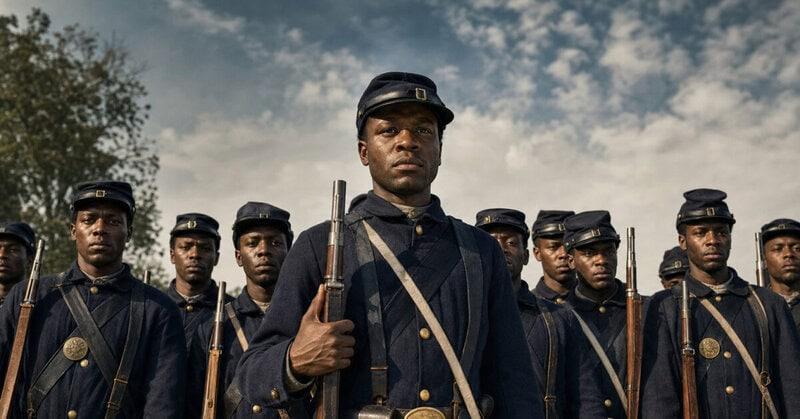
Edward Zwick’s Glory (1989) introduced millions of viewers to one of the Civil War’s most extraordinary stories—but the 54th Massachusetts Infantry’s real history is messier, richer, and in many ways more astonishing than anything that made it to the screen. Here are nine things the film left on the cutting-room floor of history.
1. The 54th Massachusetts Was Not the First Black Union Regiment—Just the Most Famous

Glory describes the 54th as “the first all-black volunteer regiment to fight for the North,” a line that lodged itself in popular memory—and that happens to be wrong. The 1st Kansas Colored Infantry and the 1st Louisiana Native Guards both saw combat before the 54th ever shouldered a rifle in anger. The actual distinction the 54th held was that it was the first Black regiment raised in the North, a narrower claim but one that carried enormous political weight in 1863, when abolitionist Boston was watching every move the regiment made.
Zwick’s framing works as dramatic shorthand, but it flattens a complicated, decades-long timeline of Black military service into a single origin story. Men had already bled under the Union flag before Shaw’s regiment fired its first shot—a truth that makes the broader struggle for recognition even more layered than the film suggests.
2. Robert Gould Shaw Was a Combat Veteran, Not a Bewildered Boy, When He Took Command

Matthew Broderick plays Shaw as a somewhat naive, uncertain young officer—a portrait that makes for compelling cinema but soft-pedals the man’s actual résumé. Before accepting the colonelcy in early 1863, Shaw had already survived the brutal conditions of Cedar Mountain and Antietam. He was not a fresh-faced innocent handed a regiment he didn’t understand; he was a combat veteran who knew exactly what sending men into a fortified position could cost.
Shaw’s own letters reveal that his hesitation about taking the command stemmed not from inexperience but from a very clear-eyed fear: if the regiment stumbled, it would hand ammunition to every skeptic who argued Black men couldn’t fight. He was 25 years old when he led the 54th up the sand slopes of Fort Wagner in July 1863—young by modern standards, but by the standards of that war, already a seasoned officer carrying the weight of a cause larger than himself.
3. Denzel Washington’s Flogging Scene Is the Film’s Most Historically Contested Moment

The scene is shattering to watch: Washington’s Trip, a fictional escaped slave, stripped and publicly flogged for going AWOL, his face a controlled mask of defiance while a single tear tracks down his cheek. It earned Washington the Academy Award for Best Supporting Actor and remains one of the most discussed moments in the film’s enduring legacy. There is one stubborn problem: flogging had been officially abolished in the U.S. Army in 1861, two years before the scene is set, making it anachronistic as literally depicted.
The filmmakers defended the sequence as an emotional truth rather than a documentary fact—a representation of the broader machinery of dehumanization that Black soldiers faced regardless of official regulations. Military historians pushed back, arguing that trading accuracy for dramatic impact does its own kind of disservice to men whose real suffering was already dramatic enough. It is a debate the film continues to provoke more than three decades after its release.
4. The Real 54th Staged an Eighteen-Month Pay Protest That the Film Only Partially Shows

Glory touches on the pay gap—Black soldiers received ten dollars a month while white soldiers received thirteen—but the regiment’s response was more radical and more sustained than the film conveys. From May 1863 until August 1864, the men of the 54th refused to accept any pay at all. For eighteen months, they served, marched, and fought without a single dollar of wages, determined not to accept an unequal rate as though it were normal. Congress finally equalized wages retroactively, but only after more than a year of collective, disciplined resistance.
Among those who held the line for the full protest period was Sergeant William Carney, who would later distinguish himself at Fort Wagner. The pay strike deserves to be understood as an act of organized political courage, not merely a grievance—these men were making an argument about citizenship with their empty pockets.
5. Fort Wagner Was a Tactical Defeat, but the 54th’s Charge Transformed Northern Public Opinion

On the evening of July 18, 1863, the 54th Massachusetts led the Union assault on Battery Wagner, a Confederate earthwork commanding the entrance to Charleston Harbor. What followed was a frontal attack across a narrow beach under withering fire, and the regiment suffered roughly forty percent casualties before being driven back. Shaw was killed scaling the parapet, and Confederate forces buried him in a mass grave alongside his men—a deliberate insult. His father, Francis Shaw, responded publicly that he could think of no finer burial for his son, turning the Confederate gesture of contempt into a statement of solidarity that echoed across the North.
The tactical failure became a political turning point. Northern newspapers that had been openly hostile to Black enlistment shifted their editorial positions after correspondents reported on the regiment’s conduct under fire. Recruitment of Black soldiers accelerated across the Union in the months that followed. A charge that failed to take its objective nevertheless took something more durable: it changed the argument about who this war was being fought by, and for.
6. Sergeant William Carney—the Flag Bearer Who Earned the Medal of Honor—Never Appears in Glory

During the Fort Wagner assault, as the color guard fell one by one, Sergeant William Carney seized the American flag and carried it forward despite being shot multiple times. He reached the base of the Confederate parapet, held the colors upright even as he collapsed, and is reported to have said upon returning to Union lines that the old flag never touched the ground. Carney later received the Medal of Honor for the act, making him one of the first Black Americans to earn that distinction.
He does not appear in Glory. The film’s decision to build its story around a fictional ensemble rather than documented individuals was a defensible creative choice, but the omission of Carney is the most glaring gap between the movie and the regiment’s actual legacy. His name is central to how the 54th is remembered in Massachusetts to this day, and audiences who discovered the regiment through the film often have no idea he existed.
7. The 54th Massachusetts Kept Fighting for Two More Years After Fort Wagner

Glory ends with the Fort Wagner assault, the screen going dark after the charge, implying that Shaw’s death and the regiment’s story arrived at the same moment. In fact, the 54th continued to serve through the final years of the war, fighting at Olustee in Florida and participating in the long siege operations that eventually forced the evacuation of Charleston—the very city whose harbor they had failed to crack at Battery Wagner. The regiment was mustered out in August 1865, four months after the Confederacy’s surrender, having compiled a record spanning dozens of engagements.
The film’s ending is emotionally coherent and cinematically powerful, but it leaves viewers with the impression of a regiment that burned bright and vanished. The truth is that the men of the 54th kept marching, kept fighting, and kept making the argument—with their continued service—that Black soldiers belonged not just in one famous charge but in the full, grinding work of winning the war.
8. Shaw’s Real Officer Corps Was Far More Conflicted Than the Film Suggests
Cary Elwes portrays Major Cabot Forbes as a steady, uncomplicated ally to Shaw, a portrait that smooths over what was actually a fractious and uncertain officer corps. Several of the 54th’s officers resigned rather than accept what they regarded as a socially stigmatizing command—a tension the film acknowledges only in passing.
Shaw himself had to write personal appeals to prospective officers, invoking their sense of duty and their place in history, simply to keep his command staffed during the regiment’s formation. That backstage struggle—the recruiting of white men willing to lead Black soldiers at a moment when doing so carried real social risk—is one of the more revealing subplots that the film’s pace never quite had room to explore. The officers who stayed were making a choice that cost them something, and the ones who left were being honest about the limits of their convictions.
9. The Shaw Memorial That Opens the Film Is One of the Most Significant Works of American Public Sculpture

The film’s early scenes gesture toward the Shaw Memorial on Boston Common, a bronze bas-relief by sculptor Augustus Saint-Gaudens that depicts Shaw on horseback moving alongside his men on foot—one of the very few Civil War monuments to place Black soldiers in visual and narrative equal footing with their white commander. The memorial took fourteen years to complete, a span that itself reflects the difficulty of getting the country to look squarely at what the 54th represented. It was unveiled in 1897, with surviving veterans of the regiment present at the ceremony.
The monument went on to inspire Robert Lowell’s poem “For the Union Dead” and remains one of the most studied works of American public sculpture, noted for the way Saint-Gaudens rendered individual faces in the ranks rather than an anonymous mass. That the film opens in its shadow is fitting: the memorial was doing in bronze what Glory would later attempt in film—insisting that these men be seen not merely as a symbol, but as people with faces.
Glory is a genuinely powerful film, and its emotional core—the dignity and courage of Black men fighting for a country that had enslaved them—is historically true in the ways that matter most. But the real 54th Massachusetts was stranger, longer, and more complicated than any two-hour film could hold. The gaps are worth exploring precisely because the men who lived inside them deserve the full story. Readers who want to go deeper can start with the film’s Wikipedia entry, the IMDB page, or join the ongoing conversation about the film’s legacy happening right now among viewers who are rediscovering it.

 English
 Arabic
 French
 Portuguese
 Deutsch
 Turkish
 Dutch
Dutch
 Italiano
 Russian
 Romaian
 Portuguese (Brazil)
 Greek
Greek