


Few figures in ancient Egyptian mythology provoke as much fascination — or as much dread — as Set, the red-maned god of storms, deserts, and chaos. Across thousands of years of ancient Egyptian civilization, he was worshipped, feared, erased, and invoked — a deity too powerful to ignore and too dangerous to fully trust. Understanding Set means accepting that Egyptian religion was never a tidy contest between good and evil, but something far more psychologically honest than that.
Set’s Name Came in Multiple Spellings — and Every Variation Carried Meaning

Across the long sweep of Egyptian history, the god’s name appeared as Set, Seth, Sutekh, Setesh, and Seteh. Modern readers might mistake these variants for scribal inconsistency, but each form tracked something real: a shift in dialect, a change of dynasty, or a deliberate adjustment in how much reverence versus fear a particular community wanted to signal. Language was ritual in ancient Egypt, and word choice around a god this volatile was never accidental.
The Semitic rendering Sutekh is especially telling. It traveled well beyond Egypt’s borders, adopted by peoples across the ancient Near East who had absorbed enough about this god of violence and disorder to give him a name they could pronounce. That linguistic export speaks to how wide — and how unsettling — his reputation had grown beyond the Nile Valley.
Born of Sky and Earth — Set’s Divine Parents Were the Cosmos Itself

Set’s mother was Nut, the great arching sky goddess whose body formed the vault of heaven, and his father was Geb, the god of the earth. This was not a minor divine lineage. It placed Set at the absolute center of Egyptian cosmology, making him a full sibling to Osiris, Isis, and Horus the Elder — the very gods around whom Egypt’s most sacred myths revolved.
That celestial parentage made Set’s destructive nature all the more alarming to ancient Egyptians. Chaos had not crept in from outside creation; it had been woven into creation from the very beginning, nursed by sky and earth alongside the gods of order and resurrection. Egyptian theology grappled with this tension for millennia and never quite resolved it — which may be precisely why Set remained so compelling across so many centuries.
Lord of the ‘Red Land’ — Set Ruled Egypt’s Lethal Desert Margins

Ancient Egyptians organized their world around a stark geographical divide. The “Black Land” was the rich, dark soil of the Nile floodplain — the domain of life, agriculture, and civilization. The “Red Land” was everything beyond: the scorching, bone-dry desert that stretched to every horizon. Set was lord of the Red Land, the divine embodiment of a wilderness that could swallow a person without trace.
That dominion carried a political charge as well as a cosmic one. Foreigners and invading armies almost always arrived from those hostile margins, emerging from the sand as though conjured by the god himself. In Egyptian thought, Set’s rulership of the desert and his association with outsiders were not two separate ideas — they were the same idea, expressed simultaneously in geography and in myth.
Mythology’s Most Infamous Divine Murderer — Set Killed His Own Brother Osiris
The Osiris myth is one of the foundational stories of ancient Egyptian civilization, and at its heart is an act of breathtaking violence: Set murdered his own brother Osiris, driven by jealousy and ambition. He did not stop there. He dismembered the body and scattered the pieces across Egypt, forcing the grieving Isis into a desperate search to gather her husband back together. The story encoded Egypt’s deepest anxieties about death, betrayal, and the fragility of order.
The moral weight of that murder echoed through Egyptian culture for millennia. Set became the archetype of treachery, and during periods of particularly intense hostility toward his cult, scribes and priests chiseled his name from temple walls and monument inscriptions — a ritual erasure meant to diminish his power by stripping him of his identity. Even rendered in stone, his name was considered dangerous enough to destroy.
Defender of the Sun — Set’s Violence Had a Protective Dimension
The desert was only the beginning of Set’s portfolio. Set also held dominion over thunderstorms, eclipses, and earthquakes — every violent convulsion that shook the natural world and reminded human beings how precarious their existence really was. Whenever the sky darkened without warning or the earth trembled underfoot, Set’s hand was felt in it.
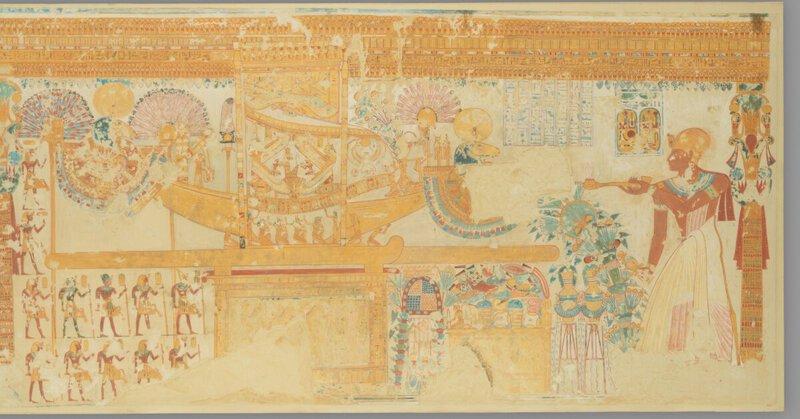
Yet his role had a profoundly protective dimension that resists any simple reading of him as a villain. Each night, as the solar barque of Ra journeyed through the treacherous underworld, it was Set who stood at the prow, fighting off the chaos-serpent Apep with raw, ferocious strength. Without Set’s violence — his particular brand of savage power — the sun would never rise again. This dual identity as destroyer and indispensable defender made him one of the most psychologically complex figures in the entire Egyptian pantheon.
The Color Red Was Set’s Signature — and Ancient Egyptians Found It Deeply Unsettling

If you wanted to evoke the presence of Set in ancient Egypt, you reached for red. The color was inseparably bound to him, linking the desert’s red sand, the red of blood, and the red of uncontrolled chaotic energy into a single visual warning. Red-haired or red-skinned animals were considered sacred to Set and were sometimes sacrificed in rituals specifically designed to neutralize his influence — the logic being that a god could be appeased or redirected through the symbols most closely associated with him.
The association ran so deep that it shaped scribal practice. Some ancient Egyptian scribes wrote Set’s name in red ink rather than the standard black, treating the color itself as a ritual precaution — a written acknowledgment that even naming him required care. In a culture where writing was a sacred technology, choosing red ink was not decoration. It was a protective act.
Trickster and Schemer — Divine Mischief With Existential Consequences

Across world mythology, trickster figures tend to be slippery, unpredictable, and dangerous in equal measure — and Set fits squarely into that tradition. Egyptian texts portray him as cunning and untrustworthy, a god who could not be relied upon to respect the boundaries of divine conduct. Unlike some trickster figures who ultimately serve a restorative function, however, Set’s deceptions carried existential stakes. His chaos directly threatened Ma’at — the cosmic principle of truth, justice, and balance upon which Egyptian civilization was founded.
The long mythological feud between Set and his nephew Horus, battling for the throne of Osiris across a series of trials, contests, and outright brawls, reads very much like an extended trickster saga. Each god plots, schemes, and cheats in turn. Egyptian storytellers elaborated the tale across centuries, finding in it a rich and renewable exploration of power, legitimacy, and what happens when the rules of the cosmos are bent almost to breaking point.
God of Foreigners — Egypt’s Divine Explanation for the Outside World
Set’s dominion explicitly included foreign peoples and foreign lands, making him Egypt’s theological framework for a persistent cultural anxiety: the threatening, incomprehensible world beyond the Nile Valley. That association became especially charged during the Hyksos period, roughly 1650 to 1550 BCE, when foreign rulers occupied northern Egypt and adopted Set as their own patron deity. Later Egyptian pharaohs leveraged that fact ruthlessly, using the Hyksos devotion to Set as further evidence that both the occupiers and the god himself were forces of dangerous disorder.
The paradox at the center of this story is striking. Some of Egypt’s most celebrated warrior-pharaohs proudly bore Set’s name: Seti I, whose very title means “He of Set,” and the great Ramesses II, who fought under Set’s influence and made no apology for it. These rulers were not embarrassed by the association — they were advertising it, claiming Set’s raw military ferocity as a personal asset and as a warning to any power that considered challenging Egypt’s reach.
Master of Warfare — Pharaohs Conscripted Set’s Violence as a Military Asset
For all the dread his name inspired, Set was genuinely useful to a state that needed to project terrifying strength. He was revered as a god of warfare and violent power, and Egyptian soldiers invoked Set before battle, asking him to lend them his legendary ferocity. The god of disorder, called upon in the service of imperial order — the contradiction was real, and Egypt’s military culture embraced it without apparent discomfort.
Seti I and Ramesses II both drew explicitly on Set’s martial identity to define their reigns. In doing so, they completed a remarkable theological maneuver: a god associated with chaos, murder, treachery, and the howling desert had been conscripted into the machinery of the most organized and enduring civilization the ancient world had ever produced. Set never quite became safe — but Egypt found ways to make him indispensable.
Set’s Animal Form — One of Mythology’s Great Unsolved Mysteries

One of the most distinctive and genuinely puzzling aspects of Set’s iconography is the animal used to represent him. Known to Egyptologists simply as the “Set animal,” it has no confirmed identification in the natural world. Depictions show a creature with a curved, tapered snout, tall square-tipped ears, and a stiff forked tail — a combination that matches no known Egyptian species. Scholars have proposed everything from an aardvark to an okapi to a completely mythological composite, but no consensus has emerged.
That unresolved strangeness is itself significant. Every major Egyptian deity was anchored to a recognizable creature — falcon, ibis, crocodile, cat — whose natural behavior illuminated something about the god’s character. Set alone was given an animal that exists nowhere in nature. Whether this was deliberate from the beginning, or whether the original animal was forgotten over time, the effect is the same: Set stands apart even in his visual form, unclassifiable and resistant to the ordering instinct that shaped everything else in Egyptian religious art.
From the red sands of the desert margin to the prow of the sun god’s celestial barque, Set defies any single label. He is a murderer and a savior, a patron of warrior-kings and a symbol of everything Egypt feared about the world beyond its borders. More than almost any other figure in ancient religion, he forces a reckoning with the idea that chaos is not merely the enemy of order — it is, uncomfortably, one of its essential ingredients.

 English
 Arabic
 French
 Portuguese
 Deutsch
 Turkish
 Dutch
Dutch
 Italiano
 Russian
 Romaian
 Portuguese (Brazil)
 Greek
Greek