


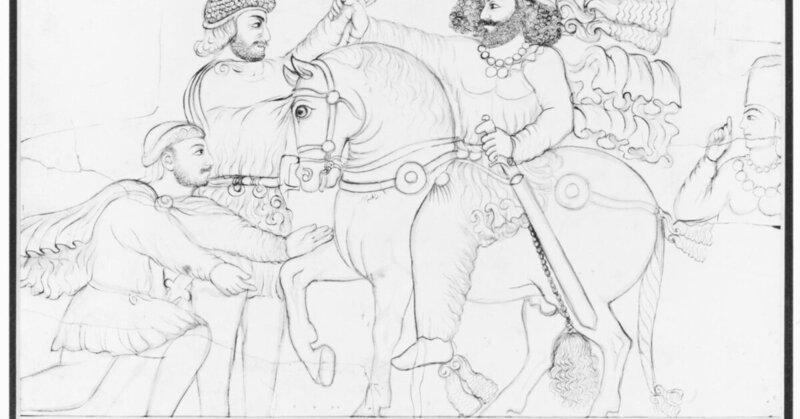
In the summer of 260 CE, the Roman Emperor Valerian knelt in the dust of Mesopotamia while a Persian king placed his foot on the emperor’s back and used him as a mounting block to climb onto his horse. It is the most humiliating image in Roman military history — and most people have never heard of it.
The Emperor in Chains: A Scene Rome Never Wanted You to Remember

The battle near Edessa did not go the way Rome expected. Valerian had marched east with a substantial army to deal with a persistent, dangerous neighbor — the kind of enemy Rome had been fighting for a generation and expected to keep fighting forever, a manageable irritant on the empire’s eastern flank. Instead, Shapur I, King of Kings of the Sasanian Empire, captured him. Not killed him. Captured him. Valerian became a living trophy, displayed at Shapur’s court for the rest of his life, the only sitting Roman emperor ever taken prisoner by a foreign power. The Sasanians recorded the moment in monumental rock reliefs carved into cliff faces at Naqsh-e Rostam, near Persepolis in modern Iran, where they remain visible today: the Roman emperor in submission, the Persian king triumphant on horseback above him.
For more than four centuries — from 224 CE to 651 CE — the Sasanian Empire was Rome’s most formidable rival, a superpower that stretched from the Euphrates to the borders of the Indian subcontinent, that shaped the development of world religion, seeded the aesthetics of medieval Europe, and repeatedly stopped the most powerful military machine of the ancient world. And yet it barely registers in Western popular history. Ancient Egypt gets blockbuster museum exhibitions and Hollywood epics. Rome gets prestige television series and a thousand airport novels. The Sasanian Empire — which humiliated Rome, outlasted numerous Roman dynasties, and transmitted civilization across the known world — gets a paragraph in a textbook, if that. The question worth asking is not only what the Sasanian Empire was. It is why we were never really taught.
Born from a Rebel’s Ambition: How Ardeshir I Built an Empire

The story begins not with a dynasty but with a provincial strongman who decided the existing order was not good enough. Ardeshir I — also written as Ardashīr — was a ruler from Persis, the heartland region of ancient Persia in what is now the Fars province of Iran. In the early third century CE he launched a series of military campaigns that dismantled the Parthian Empire from within, picking off regional governors, forging alliances, and ultimately defeating the last Parthian king, Artabanus IV, in battle. In 224 CE, Ardeshir declared himself Shahanshah — King of Kings — and the Sasanian Empire was born.
What made this more than a simple coup was the ideological architecture Ardeshir and his successors constructed around it. The Sasanians did not present themselves as something new. They presented themselves as a restoration. They claimed descent from the ancient Achaemenid dynasty — the empire of Cyrus the Great, Darius, and Xerxes — and positioned the new state as the rightful heir to a Persian imperial tradition stretching back seven centuries. This was statecraft through memory, a deliberate and sophisticated project of legitimization. The empire rebuilt itself, consciously, within frontiers invoking those previously claimed by the Achaemenids, making territorial ambition inseparable from historical identity.
Zoroastrianism became the state religion, formalized and enforced in a way it had never been before, providing the empire with a unifying spiritual framework and a priestly class — the Magi — deeply entangled with royal power. The capital was established at Ctesiphon, near modern Baghdad on the eastern bank of the Tigris, a city of remarkable scale and cosmopolitan energy. Its great throne hall, the Taq Kasra, featured a parabolic barrel vault of exceptional span — among the largest unreinforced brick arches ever constructed in the ancient world — that left medieval Arab engineers who encountered it centuries later at a loss to explain how it had been raised. The Sasanian military was built around heavily armored cavalry called clibanarii, supplemented by war elephants and sophisticated siege engineering. This was not, by any measure, a peripheral state emerging from the margins. Britannica’s overview of the Sasanian dynasty describes it as one of antiquity’s most administratively and culturally developed polities.
The Empire Rome Could Not Defeat: Four Centuries of Rivalry

The Roman-Sasanian wars form the longest sustained great-power rivalry of the ancient world. Multiple Roman emperors personally led campaigns against Persia. None of them achieved decisive, lasting victory. The relationship had the grinding, catastrophic quality of two tectonic plates meeting — enormous force, enormous destruction, and at the end of it all, the boundary barely moved.
After Valerian’s capture in 260 CE, the flashpoints came with terrible regularity. In 363 CE, the emperor Julian — called the Apostate for his rejection of Christianity — led a major invasion of Sasanian territory, penetrating deep into Mesopotamia before the campaign turned disastrous. Julian was killed during the retreat, one of very few Roman emperors to die on campaign against a foreign enemy. His successor, Jovian, was compelled to sign a humiliating peace treaty ceding significant Roman territory, including the strategically vital fortress city of Nisibis. Then came the early seventh century, when the Sasanian Empire under Khosrow II achieved something genuinely astonishing: his armies seized Jerusalem in 614 CE, captured the relic known as the True Cross and carried it back to Ctesiphon, overran Egypt, and by 626 CE had reached the walls of Constantinople itself in coordination with Avar forces. For a brief, extraordinary moment, a Persian army stood at the edge of Europe’s greatest city.
The strategic geography that made this possible is worth lingering on. The Sasanian Empire controlled all of modern Iran and Iraq, commanding the Zagros mountain passes that funnel any eastern invasion into difficult terrain, the Mesopotamian river system that any western army had to cross and depend upon for supply, and the critical chokepoints of the overland Silk Road routes. Attacking Persia was like attacking a fortress deliberately designed to exhaust aggressors — deep, difficult terrain, with an enemy capable of trading space for time and striking back at chosen moments.
Yet the strangest aspect of this four-century rivalry is not the violence but the intimacy beneath it. The two empires fought endlessly while trading luxury goods, copying each other’s court ceremonies, and occasionally negotiating against shared threats. Roman emperors admired and adopted elements of Sasanian royal imagery. Sasanian nobles drank from Roman glass. Refugees, diplomats, and merchants crossed the frontier constantly in both directions. It was a relationship of violent interdependence — two superpowers so entangled that they could neither destroy each other nor stop trying.
Bigger Than Most Maps Show: The Sasanian World at Its Peak
At its zenith, the Sasanian Empire was not simply a regional power. It stretched from the Euphrates in the west to the borders of the Indian subcontinent in the east. It controlled portions of the Caucasus to the north and held influence over Eastern Arabia and parts of the Arabian Peninsula, giving it leverage over Gulf trade routes. Sasanian commercial networks extended into maritime trade across the Indian Ocean, connecting the empire’s economy to markets in India, Southeast Asia, and East Africa in ways that Western histories of ancient commerce rarely discuss.
Ctesiphon at its height was one of the largest cities in the world, and perhaps the most genuinely cosmopolitan. Nestorian Christian scholars — expelled from the Byzantine Empire as heretics following the Council of Ephesus in 431 CE — found refuge there and established theological and medical schools that became centers of learning. Greek philosophical and scientific texts were translated into Middle Persian. Jewish communities, some with roots tracing back to the Babylonian exile, thrived under Sasanian law and produced major works of scholarship, including the Babylonian Talmud, compiled during this period. The intellectual ferment of that city did not disappear when the empire fell; it flowed directly and massively into the early Islamic civilization that absorbed it, giving the new caliphate an administrative vocabulary, a philosophical library, and an artistic grammar it could not have constructed from scratch. The Metropolitan Museum of Art’s essay on the Sasanian Empire traces this transmission in careful detail, noting the empire’s role as a civilizational switchboard connecting East and West.
The economy was built on precisely this geographical position. The empire sat astride both the land routes of the Silk Road and the sea lanes of the Indian Ocean simultaneously, taxing silk, spices, and other high-value commodities. Sasanian merchants operated across vast distances. The imperial treasury, at its peak, was formidably wealthy — which makes the speed of its later exhaustion all the more striking.
Art That Outlived the Empire: The Sasanian Visual Language and Its Hidden Heirs

Walk past the right museum case — at the Metropolitan, the British Museum, or the Hermitage — and you might find a Sasanian silver plate that stops you even if you have no idea what you are looking at. A king on horseback, drawing a bow, a lion twisting beneath the hooves in its death agony. The musculature of the animals rendered with confident precision. The king’s silk robes billowing in stylized folds that somehow still read as fabric moving in actual wind. The whole composition contained within a raised rim, the silver chased and gilded so that the scene seems lit from within. It is extraordinary work, and many visitors walk past it on their way to something more famous.
Scholars have spent decades tracing where that visual language traveled after the empire fell, and the answers keep expanding. The paired birds flanking a central tree or vase — a motif common on Sasanian textiles — appears in Byzantine church decoration, in Tang dynasty Chinese silks, and in Carolingian ecclesiastical treasures made in France centuries after the empire’s end. The hunting king, the winged figure, the interlaced floral border: these patterns migrated along trade routes carried by merchants, refugees, and portable objects — silk above all, because silk carried pattern as well as prestige. Iran Chamber’s historical overview of the Sassanid Empire notes the far-reaching cultural influence the empire exercised through these material and aesthetic exports.
The argument some art historians make is striking: much of what the Western eye registers as distinctively Byzantine or characteristically early Islamic in medieval decorative art has a Persian formal skeleton underneath it — compositional habits, iconographic conventions, decorative grammar — absorbed so thoroughly that it became invisible. The Sasanian contribution was subsumed into the traditions it had shaped. The empire became a ghost inside the aesthetics it had built.
The Fall: How the Last Persian Empire Ended in a Generation

The end, when it came, came with bewildering speed. The catastrophic war between the Sasanian Empire and Byzantium that ran from 602 to 628 CE was the kind of conflict that produces no winners. Khosrow II had stretched the empire to its greatest territorial extent — Jerusalem, Egypt, the Caucasus, the edge of Constantinople — but the effort bled the treasury dry and exhausted the military nobility. When the Byzantine Emperor Heraclius mounted a counter-offensive that drove the Sasanians back across the territory they had seized, he was not destroying a healthy empire; he was collapsing a structure already severely weakened from within. A series of rapid coups followed at Ctesiphon. In roughly a decade, the empire cycled through more than a dozen claimants to the throne.
Into this chaos came the early Islamic armies out of Arabia after 632 CE — forces propelled by religious conviction and military cohesion, striking with a speed and coordination the exhausted Sasanians could not match. The last Sasanian king, Yazdegerd III, was a young man presiding over a collapsing court, unable to hold his nobility together or fund a sustained defense. A series of defeats, culminating at the Battle of Nahavand in 642 CE, broke the empire as a functioning military entity. By 651 CE, Yazdegerd III was dead — murdered, according to the sources, by one of his own subjects while fleeing eastward with the remnants of his court, still technically a king, effectively a fugitive. The World History Encyclopedia’s Sasanian timeline captures the compressed sequence of that final decade with useful clarity.
It is important to resist the pull of inevitability here. Contemporaries were stunned. The Sasanian Empire had survived centuries of Roman assault, incursions by nomadic confederacies from the steppes, and repeated internal rebellions. The speed of the collapse — an empire of that administrative depth and territorial scale dissolving within roughly a decade of battlefield defeats — remains one of the genuinely contested questions of late ancient history. War exhaustion, elite fracture, fiscal collapse, and religious tension are all real and documented factors. Scholars continue to debate how they combined, and no single explanation fully satisfies. The Historical Association’s podcast on the Sasanian Empire addresses these debates accessibly for non-specialist listeners.
Why We Keep Forgetting Them — and Why That Matters Now
The historiographical gap has a specific shape. The Sasanian Empire fell before it could write its own Renaissance-era rediscovery narrative. The early Islamic caliphate absorbed its scholars, its bureaucratic methods, its art, and its administrative knowledge so completely that the Persian source became difficult to see inside the Islamic synthesis. Arab historians acknowledged Persian learning; they did not consistently label it Sasanian. The contribution dissolved into the product.
There is also the problem of whose sources survived into Western scholarly traditions. The classical library preserved the Roman perspective on every major conflict — the Roman account of Julian’s disastrous Persian campaign, the Roman interpretation of Valerian’s capture, the Roman view of eastern diplomacy. Sasanian court chronicles, royal inscriptions, and administrative records were largely lost, untranslated, or inaccessible to European scholars until the nineteenth and twentieth centuries. The empire entered Western modernity as Rome’s difficult eastern neighbor rather than as Rome’s civilizational equal — defined by its relationship to the power that got to write the history.
The contemporary resonance is not subtle. The geography the Sasanians administered for four centuries — modern Iran, Iraq, the Gulf states, the Afghan borderlands, the eastern Mediterranean hinterland — is precisely the geography at the center of twenty-first-century geopolitics. The fault lines, the strategic chokepoints, even some of the cultural and religious tensions playing out across those regions today have roots that run through the Sasanian period. Oxford’s research on the Sasanian world emphasizes this point directly: understanding the deep imperial history of that space changes how its modern conflicts look, strips away the illusion that present tensions are purely recent in origin, and restores a complexity that shallow historical memory tends to flatten.
Return, at the end, to the cliff face at Naqsh-e Rostam. Shapur I sits on his horse. Valerian kneels beneath him. The relief has been carved in stone for seventeen centuries, visible to anyone who travels to Fars province in modern Iran. Rome did not carve that image. Rome did not choose to remember it. The Sasanians did — because they understood, with the instinct of a civilization that had learned to use memory as an instrument of power, that the story you tell about yourself is part of how you endure. The empire is gone. The stone remains. And the question it poses — which civilizations do you think you know, and which ones were you quietly taught to overlook — turns out to be more consequential than most of us were ever told.

 English
 Arabic
 French
 Spanish
 Portuguese
 Deutsch
 Dutch
Dutch
 Italiano
 Russian
 Romaian
 Portuguese (Brazil)
 Greek
Greek