


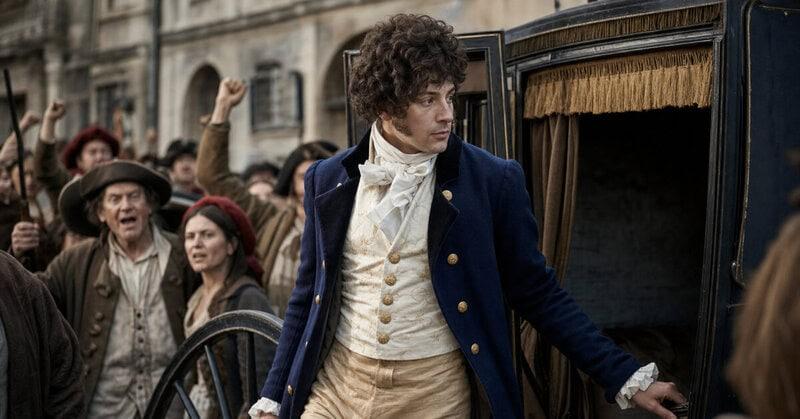
Paris, 1793: a man steps out of a carriage in silk breeches and a powdered wig, and within minutes a crowd has gathered around him — not out of admiration, but fury. His crime is stitched into every seam of his clothing, and before the day is out, he may answer for it before a revolutionary tribunal. In no other moment in Western history did a hem length, a hat style, or a fabric choice carry quite so much weight — up to and including the weight of one’s life.
A Society Written in Cloth: The Ancien Régime’s Dress Code

To understand why French Revolution fashion became a story about survival, you first have to understand how legible French society was before 1789. The court at Versailles operated under elaborate dress expectations — certain silks, certain embroideries, and certain styles were the near-exclusive preserve of the nobility. Eighteenth-century fashion made it especially easy to tell the aristocrats from everyone else, and that visibility was entirely deliberate.
The silhouette of a noblewoman was almost architectural: towering powdered wigs that could rise a foot or more above the head, wide panniers that pushed skirts out to considerable widths, and gowns encrusted with embroidery that cost more than a laborer might earn in a year. Noblemen wore fitted knee-breeches called culottes, silk stockings, embroidered coats, and shoes with ornate buckles. These were not merely fashion choices — they were declarations of rank, underwritten by wealth that most Parisians could only observe from a distance.
Commoners wore rough wool, undyed linen, and practical long trousers suited to physical work. The gap between these two wardrobes was so vast that every Parisian street was already a daily political statement, long before the Bastille fell in July 1789. When the Revolution arrived, it did not invent clothing as a political language — it simply set that language on fire.
The Sans-Culottes: Trousers as a Declaration of War

No group embodied the weaponization of clothing more deliberately than the sans-culottes — literally, those “without breeches.” The name itself was the point. By proudly wearing the long workingman’s trouser instead of the aristocratic culotte, these radical urban revolutionaries turned an everyday garment into a manifesto. Revolutionary fashion and the sans-culottes movement were inseparable — the look was a uniform, a political platform, and a provocation all at once.
The full ensemble was carefully constructed for maximum symbolic impact: striped trousers (the stripes themselves associated with the working trades), a short plain jacket called the carmagnole, wooden clogs that announced honest labor, and — most iconically — the red cap of liberty, the bonnet rouge. The red cap drew its meaning from ancient Roman practice, where freed slaves wore a similar pileus cap as a sign of their liberation. In the streets of Paris, it announced something equally radical: that the wearer had broken free from the old order.
Then there was the cockade. The tricolor rosette of red, white, and blue — the colors that came to symbolize French republicanism — was not merely a fashionable accessory. Wearing the tricolor cockade was legally mandated for men from 1792, and the requirement was extended to women in 1793, transforming dress from social custom into enforceable law. Failing to wear the cockade — or wearing the wrong colors — could mark a person as a royalist sympathizer, an invitation to mob violence, arrest, or worse. A small ribbon, a matter of life and death.
Silk, Brocade, and the Guillotine: When a Wardrobe Became Evidence

The danger was most acute during the Reign of Terror, roughly 1793 to 1794, when the Committee of Public Safety under Maximilien Robespierre oversaw the execution of thousands of perceived enemies of the Republic. Revolutionary committees organized across Paris’s neighborhood sections monitored residents with exhausting vigilance, and dress was one of the most immediate proxies for loyalty.
Nobles and wealthy bourgeois who could not shed their habits fast enough found their wardrobes turned against them. A powdered wig glimpsed at a checkpoint, an embroidered coat collar, a silver shoe buckle catching the light — any of these details could prompt a stop, a search, and a denunciation. The wardrobe maneuvers of the Terror years read like something from a spy novel: aristocrats burning wigs in kitchen fireplaces, pawning jewels for rough cloth, and rubbing dirt into their hands to simulate the calluses of physical labor. It was a real-life game of costume with mortal stakes.
The cruelest irony belongs to Robespierre himself. While his radical allies embraced the rough simplicity of sans-culotte dress, the Incorruptible — as he was known — continued wearing the powdered wig and neatly fitted coat associated with the old order throughout his time in power, making him an object of suspicion among the most radical factions. When he fell from power in Thermidor (July 1794) and was sent to the guillotine, he went dressed much as he always had. Fashion during the French Revolution so greatly reflected the political climate that even a revolutionary’s choice of tailoring could become a liability.
Women, Cotton, and the Revolutionary Wardrobe

While men’s revolutionary fashion settled into a relatively coherent iconography — trousers, cockade, red cap — women’s dress underwent a transformation that was, if anything, more dramatic. Women’s dress changed more drastically than men’s during the 1790s, pivoting sharply away from the rigid architecture of the ancien régime.
Out went the heavy brocade, the stiff stays, the enormous panniers, and the towering wigs. In came white and printed cottons — cheaper, washable, and symbolically untainted by aristocratic excess. Fashionable women increasingly favored a lighter, more flowing silhouette that borrowed loosely from classical antiquity and projected an image of natural virtue rather than courtly artifice.
The political dimension was never far away. Wearing simple cotton and displaying the tricolor cockade was a woman’s visible pledge to the Republic. A silk gown, by contrast, could invite a denunciation from a suspicious neighbor. The Society of Revolutionary Republican Women, founded in 1793, pushed aggressively to make the cockade compulsory for all women in public — a demand that shows how fully French Revolution fashion history had become a story about gender, civic identity, and the obligation to declare one’s politics through dress. Clothing, for women, was never merely clothing.
After the Terror: Fashion as Relief and Rebellion

When Robespierre fell in July 1794 and the Terror ended, Paris exhaled — and then immediately overdressed. The post-Thermidor reaction produced one of the most theatrically extravagant fashion moments in French history: the Incroyables and Merveilleuses, young men and women who adopted deliberately exaggerated clothing as a collective taunt aimed at the grim austerity of the preceding years.
The Incroyables — “the Incredibles” — favored enormous lapels, disheveled hair worn long, and an air of studied carelessness. The Merveilleuses — “the Marvelous Ones” — pushed the neo-classical silhouette to its extreme: sheer, near-transparent muslin gowns, minimal undergarments, and hair cropped short in a style associated with prisoners condemned to the guillotine. It was fashion as exorcism, a way of placing maximum distance between the present moment and the nightmare that had just ended.
The more lasting legacy was structural. After the Revolution, huge powdered wigs, wide panniers, heavy embroidery, and extravagant silks fell permanently out of fashion, replaced by a neo-classical aesthetic that would flow directly into the Empire style under Napoleon. The visual language of the ancien régime — that elaborate costume of inherited privilege — never fully returned. The Revolution had not merely changed hemlines. It had dismantled the idea that clothing was a fixed, birth-given uniform, an expression of a station you occupied rather than a position you chose.
The Practical Mechanics: Fabric, Trade, and the Economics of Revolutionary Dress

The Revolution’s fashion shift was not driven by ideology alone — economics played an equally important role. The luxury textile trades of Lyon, which produced the embroidered silks and brocades favored by the aristocracy, collapsed catastrophically when their primary customers fled France as émigrés or were sent to the scaffold. Thousands of silk weavers found themselves without work, a crisis that contributed to the social instability of the early 1790s and that the Revolutionary government struggled to address throughout the period.
Cotton, by contrast, benefited from the Revolution’s disruption of old guild structures and import restrictions. The simpler, cheaper fabric was far more accessible to ordinary consumers, and its political associations with republican virtue gave it a cultural cachet that silk had once held. The shift from silk to cotton was not simply a matter of taste — it was a realignment of an entire industry, with winners and losers determined as much by the guillotine as by the market.
This economic dimension is worth keeping in mind when reading the revolutionary wardrobe as pure ideology. The sans-culotte who wore striped wool was making a political statement, but he was also wearing what he could afford. The aristocrat who stripped off his embroidered coat was not merely performing survival — he was also divesting himself of an asset he could no longer safely display. Fashion, then as now, sat at the intersection of culture, politics, and money.
Why This Wardrobe Still Matters
The French Revolution established fashion as a political language that subsequent movements would repeatedly borrow: the workers’ caps of the Russian Revolution, the khaki of anti-colonial independence movements, the denim of 1960s counterculture. The mechanism is always the same — reject the ruling class’s aesthetic, adopt the clothing of the people, and make the wardrobe a manifesto.
What made the French case so sharp, and so dangerous, was the speed and totality of the transformation. Clothing played a central role in the Revolution not as vanity but as one of the most democratic forms of communication available to a largely illiterate public. When you could not read a pamphlet, you could still read a cockade. When you could not follow a speech at the National Convention, you could see at a glance who was wearing silk and who was wearing wool — and draw your conclusions accordingly.
The next time you reach for a logo T-shirt, lace up a particular pair of shoes, or pin something to a jacket lapel, you are participating in a conversation the sans-culottes started in the streets of Paris. Every color, every silhouette, every small symbolic detail carries coded meaning that other people read, consciously or not, and respond to.
And somewhere in the memory of all that is a man in silk breeches stepping out of a carriage into the wrong neighborhood in 1793, discovering too late that the most dangerous thing he owned was his wardrobe. The Revolution did not need to know his politics. It could already read them — from the powdered wig on his head to the silver buckles on his shoes — before he said a single word.

 English
 Arabic
 French
 Spanish
 Portuguese
 Deutsch
 Turkish
 Dutch
Dutch
 Italiano
 Romaian
 Portuguese (Brazil)
 Greek
Greek