


The farmhouse is burning. A teenage boy lies dead in the dirt, shot in the back by a British officer who didn’t break stride. And a quiet, grieving widower-farmer — a man who had sworn he was done with war — picks up a tomahawk and walks into the tree line with his two young sons to begin the bloodiest chapter of his life. That scene, from Roland Emmerich’s 2000 epic The Patriot, hooked a generation of viewers on the American Revolution’s forgotten Southern theater. What many of those viewers didn’t know — and what makes the real history even harder to shake — is that the atrocity on screen was less invented than distilled from something that actually happened, on a dusty stretch of Carolina borderland, on a May afternoon in 1780.
A Hollywood Hero Built From Real Bones

Mel Gibson’s Benjamin Martin, the reluctant militia commander at the center of The Patriot, never existed. He is a composite — a dramatic convenience assembled from the lives of several actual Revolutionary War fighters who operated in South Carolina’s backcountry. But calling him pure fiction misses the point. Screenwriter Robert Rodat drew most heavily on Francis Marion, the officer history remembers as the “Swamp Fox”: a South Carolina militia commander whose hit-and-run raids through swamp terrain, whose intimate knowledge of waterways and hidden ground, and whose theater of operations map so directly onto Martin’s story that the resemblance is essentially structural. Marion’s tactics — small bands, night strikes, melting back into landscape the British couldn’t navigate — are the tactical soul of the film.
Thomas Sumter, known as “the Gamecock,” and Andrew Pickens contributed additional strands to Martin’s DNA. All three were backcountry men who watched Crown forces terrorize their communities and responded by raising irregular forces that the British Empire, for all its professional military power, could never quite destroy. The film grossed over $215 million worldwide, lodging the Southern campaign into mainstream imagination in a way no history textbook had managed — but it also smoothed over an uncomfortable truth that the real men carried with them. Francis Marion was a slaveholder. The guerrilla leaders who fought for American liberty operated within, and were materially sustained by, a society built on enslaved labor. The Patriot largely sidesteps this by depicting Martin’s Black workers as free men who take up arms voluntarily alongside their employer — a choice that drew sharp and sustained criticism from historians and is, by any honest accounting, the film’s most consequential departure from the world it claims to represent.
In reality, enslaved people constituted approximately 40 percent of South Carolina’s population during the Revolution. They had their own stakes, their own calculations, and their own profoundly complicated relationship to a war fought ostensibly in the name of liberty — a story the film barely touches. It is the largest silence in an otherwise loud movie, and no honest review of The Patriot can pass over it lightly.
The Waxhaws: The Real Massacre Behind the Movie’s Rage

On May 29, 1780, at a place called the Waxhaws — near what is now the North and South Carolina border — a British cavalry force under Lieutenant Colonel Banastre Tarleton overtook a column of Continental soldiers commanded by Colonel Abraham Buford. What followed became the Revolution’s most infamous alleged war crime in the Southern theater, and the historical heartbeat behind The Patriot‘s most emotionally devastating scenes.
By American accounts, Buford raised a white flag of surrender. Tarleton’s Legion kept cutting. Roughly 113 Continentals were killed and approximately 150 more were wounded, many of them cut down by sabers after they had already laid down their arms. Tarleton and British sources disputed the characterization, arguing that the killing escalated because a shot — possibly accidental — struck Tarleton’s horse at the moment of surrender, triggering a confused and lethal response. The historical record remains contested. But the American version hardened into something more powerful than a legal argument. It became a battle cry. “Tarleton’s Quarter” — meaning no mercy would be given, because none had been received — echoed on Patriot battlefields for the rest of the war. The Waxhaws didn’t just kill men. It converted fence-sitters.
That conversion is precisely what The Patriot dramatizes with the murder of Benjamin Martin’s son. The specific act is invented. The dynamic — Crown forces committing violence so excessive that it destroyed the political ambivalence of people who had hoped to stay out of the war — is historically precise. Military brutality, in the Carolina backcountry as in many conflicts before and since, produced exactly the resistance it was designed to crush.
Banastre Tarleton: The Man Behind the Movie’s Monster
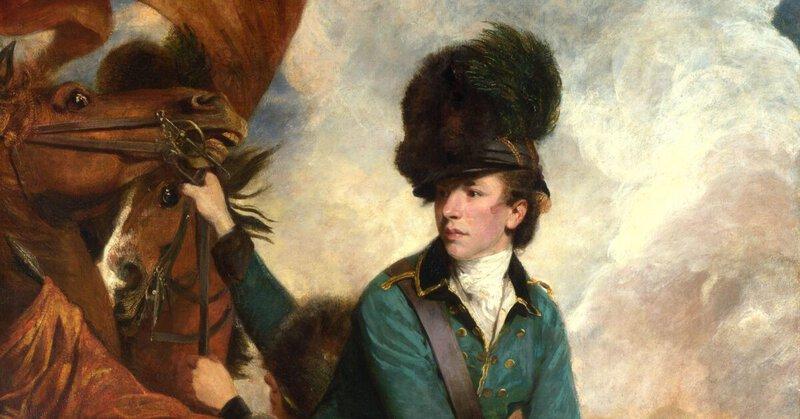
Colonel William Tavington, the film’s chillingly sadistic British antagonist played by Jason Isaacs, is transparently modeled on Banastre Tarleton — young, aggressive, aristocratic, and willing to use terror as a deliberate instrument of war in ways that disturbed even some British contemporaries. Tarleton was only 26 years old during the Southern Campaign, commanding the British Legion, a mixed cavalry-and-infantry loyalist unit, with a strategy built on speed, ferocity, and the systematic destruction of Patriot infrastructure and morale across the Carolinas.
Tarleton’s actual record — burning homes, seizing livestock, the killing field at the Waxhaws — provided ample material for a film villain. Where The Patriot tips into something harder to defend is the invented scene in which Tavington locks civilians inside a church and burns it down. That specific atrocity has no direct historical parallel in Tarleton’s documented record, and it drew loud objections from British critics and historians upon the film’s release. Defenders of the film noted, with some justification, that Hollywood applies dramatic license to every nation’s history including its own — but the fabrication remains the most indefensible invention in an otherwise loosely fact-based screenplay, because it presents a manufactured war crime with the visual authority of historical recreation.
History also denied audiences the satisfaction Tavington receives on screen. Banastre Tarleton survived the war, returned to Britain, served in Parliament, and died in 1833 at the age of 78. There is no battlefield reckoning, no moment of poetic justice. History rarely delivers Hollywood’s moral arithmetic, and Tarleton is one of its sharper illustrations of that principle.
Guerrilla War in the Carolinas: The Strategy That Saved the Revolution

The Southern Campaign, running from roughly 1778 to 1781, was the Revolution’s most brutal and, arguably, its most strategically pivotal theater. The British “Southern Strategy” aimed to retake the colonies from Georgia northward, exploiting deep Loyalist sympathies in the backcountry and severing Patriot supply lines. For a time, it worked catastrophically well. The fall of Charleston in May 1780 and the American defeat at Camden in August of that year effectively destroyed organized Continental resistance in the South. What kept the rebellion alive was exactly the kind of irregular, swamp-anchored guerrilla warfare that The Patriot depicts.
Francis Marion’s actual methods were remarkably effective precisely because of their unconventionality. Small bands. Night raids. Deep knowledge of waterways and swamp terrain that rendered his forces invisible between strikes. The ability to disrupt British communications and supply lines out of all proportion to his numbers. The British commander sent to pursue Marion reportedly described him with profound frustration — a man who struck, vanished, and could not be fixed or destroyed by conventional pursuit. He was, in the language of later military theory, an archetype of the insurgent. The American Revolution’s Southern theater stands among the earliest examples in modern Western history of irregular forces successfully exhausting a conventional imperial army — a template that would echo through centuries of asymmetric conflict.
The Battle of Cowpens on January 17, 1781, briefly referenced in the film, was the real turning point. Brigadier General Daniel Morgan executed a double-envelopment maneuver of genuine tactical brilliance that destroyed Tarleton’s Legion as an effective fighting force. That defeat unraveled the British position in the Carolinas and set in motion the chain of events that ended at Yorktown in October 1781. Cowpens deserves to be as celebrated in American historical memory as Bunker Hill or Valley Forge. That it is not is itself a commentary on how thoroughly the Northern theater has dominated the popular understanding of the Revolution — and why a film like The Patriot, flaws and all, fills a real gap in public awareness.
A Civil War Within a Revolution
The Patriot — which received mixed critical reviews despite its box office success — does capture something historians consistently confirm: the Southern conflict was, at its core, also a civil war. The Carolina backcountry was bitterly divided between Patriots and Loyalists, with neighbors informing on neighbors, families splitting along ideological lines, and old local grievances settled violently under the cover of revolutionary politics. Some historians estimate that more Americans died fighting other Americans in the Southern theater than died fighting British regulars. The film’s depiction of that fratricidal dimension — the Loyalist militia, the sense that no one in the backcountry was simply a bystander — reflects a genuine and underappreciated historical reality.
The film’s broad tactical texture also holds up reasonably well. Militia ambushes, the strategic importance of the South Carolina interior, British vulnerability to supply-line interdiction — these are grounded in the actual conduct of the campaign. Where The Patriot distorts most severely, beyond its treatment of race and slavery, is in the cartoonish consistency of its British villainy. Real British officers operated within a range of motivations and moral constraints. Many were troubled by irregular brutality; some actively attempted to restrain it. Reducing the entire Crown presence to Tavington’s sadism flattens a more complicated picture and, more importantly, obscures the genuine ideological and human complexity that made the Southern theater so significant.
The Real Story Is Still Waiting
Mel Gibson’s Benjamin Martin may be fiction, but the men he was assembled from fought a real war in a real landscape for stakes that were genuinely existential — not just for the colonies, but for themselves, their families, and the communities the British Southern Campaign had systematically terrorized. Francis Marion, Thomas Sumter, and Andrew Pickens remain underrepresented in American historical memory compared to the generals and statesmen of the Northern theater. Their story — morally tangled, tactically inventive, built on a foundation of violence and profoundly contested liberty — is one no single film could fully contain, and one that grows more complicated, not less, the closer you look at the primary sources.
If The Patriot works as history, it works as an entrance: a vivid, imperfect, occasionally irresponsible door into a chapter of the American Revolution that deserves far closer examination than it typically receives. The film remains available to revisit, and the arguments about what it gets right and wrong have only grown richer as historians have returned to the primary sources. The Swamp Fox’s actual raids, the forensic disputes over what happened at the Waxhaws, the brutal arithmetic of guerrilla war against a professional army, and the lives of enslaved South Carolinians caught between two sides neither of which offered them genuine freedom — all of it is there, in the historical record, waiting for anyone the movie made curious enough to look.
The farmhouse in the film is fictional. The fire that lit it was real.

 Arabic
 French
 Spanish
 Portuguese
 Deutsch
 Turkish
 Dutch
Dutch
 Italiano
 Russian
 Romaian
 Portuguese (Brazil)
 Greek
Greek