



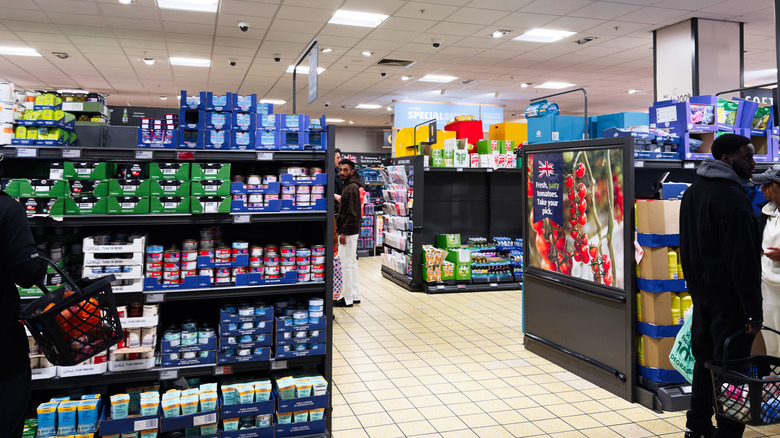
AS photo family/Shutterstock
People of a certain age from the Eastern U.S. might remember Pathmark and its No Frills products. These ultra-simple store brand items came in blank white packages with bold, black lettering describing what was inside: Cola. Beer. Grape drink. Even "potted meat food product." Basically, these were the cheapest possible generic items sold in a completely no-nonsense way.
How times have changed. Store brands, today called more elegant names like exclusive brands or private labels, are big business. Some stores have even built their entire business model on these store brands, like Aldi, which says that over 90% of the items in its stores are its own brands. And some of Aldi's products are remarkably high-quality, winning over even skeptical shoppers.
When notoriously secretive Aldi let British reporter Tom Rowley into their U.K. headquarters, he visited the chain's test kitchen. There, Aldi buyers and executives sample products to determine if they're good enough to be sold under Aldi's private labels, and what adjustments might need to happen before they hit store shelves. Buyers try each item an astonishing 30 times before it gets to the shelves, then again at least once a year. They even compare it against competitors' products and note the price differences between them. Their goal is to make sure the products at least stand up to the competition, while some Aldi brand products are even better than the name-brand counterparts.
Aldi works hard to perfect their products to retain customers
Fantail/Getty Images
This detailed review process isn't accidental, and it's not cumbersome bureaucracy, either (although no product gets into the stores without the chain's managing directors' approval). Tony Baines, a managing director at Aldi, said good enough isn't good enough. "Discount stores used to be places where people needed to shop. Now people actually want to shop here," he told The Telegraph. Customers drawn in by the low prices keep coming back if the products are of high quality.
Across the Atlantic here in the U.S., Aldi uses a similar process for their product testing. But again, Aldi is secretive, and executives rarely speak publicly about what goes into making Aldi's exclusive products. But when they do, it's clear there's a lot of work going on behind the scenes. "We rigorously test every product, sampling 35,000 items annually," said Michael Mache, a buying director for Aldi U.S., to trade publication Progressive Grocer. Still, not everything Aldi does is a hit. They've had some big failures in their more than 100-year history.
Beyond Aldi, private label brands have exploded in popularity. One of the largest grocers in the U.S., Albertsons Companies, has reported private label sales of over a quarter of total sales, and they're looking to increase that proportion, per Grocery Dive. Supermarkets are looking for new and innovative ways to distinguish their own products. And even among private labels, cheaper ones like Aldi's can stand up to the more expensive items. "Often we will have very similar suppliers to the likes of M&S and Waitrose," said Baines at Aldi UK, referring to two higher-end British chains.

 Arabic
 French
 Spanish
 Portuguese
 Deutsch
 Turkish
 Dutch
Dutch
 Italiano
 Russian
 Romaian
 Portuguese (Brazil)
 Greek
Greek